
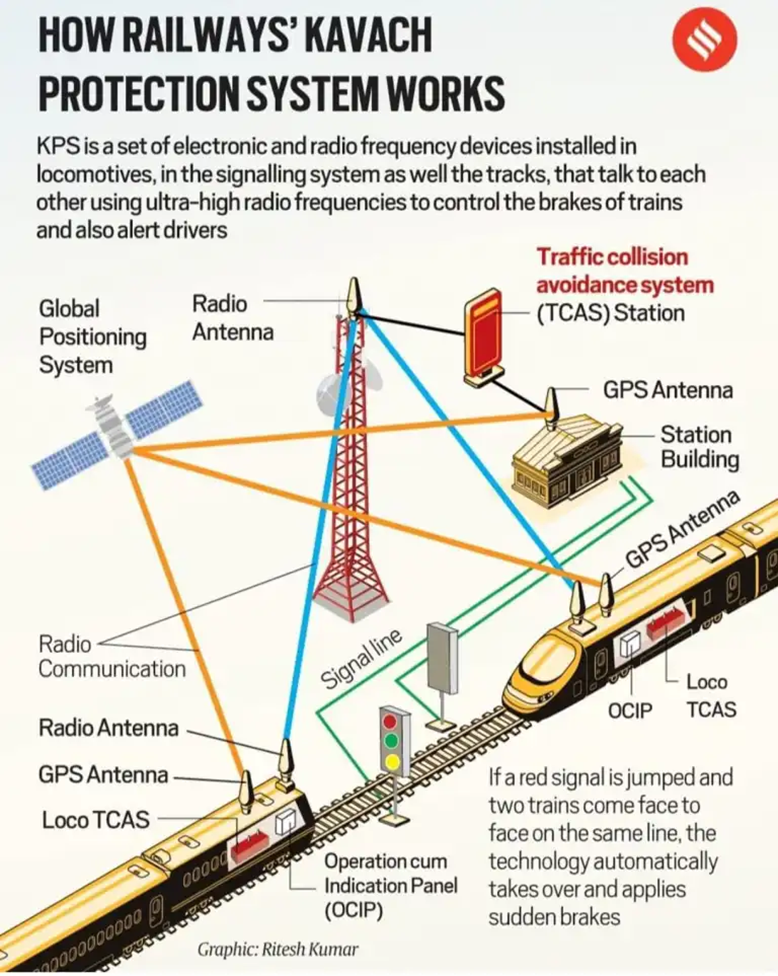
The Union Minister of Railways recently informed the Lok Sabha that the Kavach system has been fully commissioned on over 2,000 km of the rail network. The Railways have laid over 7,129 km of Optical Fibre Cable (OFC) and installed 860 telecom towers to support this complex system.
Deciphering ‘Kavach’: The Indigenous Shield:
- What is it? : An indigenous Automatic Train Protection (ATP) system, technically known as the Train Collision Avoidance System (TCAS).
- Objective: To achieve “Zero Accidents” by preventing collisions due to human error (Signal Passing at Danger – SPAD) or over-speeding.
- Technology Stack:
- RFID (Radio Frequency Identification): Tags placed on tracks to identify precise train location.
- GPS (Global Positioning System): For synchronization and timing.
- OFC & Towers: For ultra-low latency communication between stations and locomotives.
- Key Functionalities:
- Collision Avoidance: Direct Loco-to-Loco communication assesses collision risk and applies automatic brakes.
- Fog Safety: Cab Signalling provides visibility of signals inside the cabin, crucial during foggy weather.
- SOS Feature: Allows loco pilots to broadcast emergency messages to control trains in the vicinity.
Beyond Kavach: Institutional Safety Frameworks
- Rashtriya Rail Sanraksha Kosh (RRSK):
- Launch: 2017-18.
- Corpus: ₹1 Lakh Crore over 5 years.
- Purpose: Dedicated fund for critical safety infrastructure upgrades (track renewal, bridge rehabilitation).
- SIMS (Safety Information Management System):
- A web-based application developed in 2016 for real-time accident reporting and data analysis between Zonal Railways and the Railway Board.
- Elimination of Unmanned Crossings:
- All Unmanned Level Crossings (UMLCs) on Broad Gauge (BG) routes were eliminated by January 2019.
Amrit Bharat Station Scheme
- Launch: Introduced by the Ministry of Railways in December 2022.
- Objective: To transform 1,309 railway stations across India into modern, integrated transport hubs.
- Key Focus: Prioritises the integration of regional architecture, enhancement of world-class passenger amenities, promotion of inclusivity (Divyangjan-friendly), and support for holistic urban development.
Q: With respect to the technical architecture of the 'Kavach' system, consider the following statements:
1. The system primarily utilises Global Positioning System (GPS) data to identify the precise location of trains on the track.
2. The deployment of the system requires the continuous laying of Optical Fibre Cable (OFC) to facilitate ultra-low latency communication between stations and locomotives.

Which of the statements given above is/are correct?
(a) 1 only
(b) 2 only
(c) Both 1 and 2
(d) Neither 1 nor 2

Answer: C

Explanation:

Statement 1 is incorrect: The Kavach system utilises Radio Frequency Identification (RFID) tags installed on the tracks to determine the precise location of trains, whereas the Global Positioning System (GPS) is employed primarily for time synchronization.
Statement 2 is correct : As  the system's architecture necessitates the continuous laying of Optical Fibre Cables (OFC) along tracks to establish a robust, ultra-low latency communication backbone between stationary units and locomotives.