
After the reading of this article you can solve the Model UPSC question:
Rupee depreciation is often seen as a cushion against external trade shocks, but it has limited effectiveness in offsetting the impact of high import tariffs imposed by major trading partners such as the United States.Discuss in the context of recent U.S. tariff measures on Indian exports. (GS 3 Economy)
Context:
The rupee depreciation impact on Indian economy has emerged as a critical concern amid rising trade tariffs, global uncertainty and domestic macroeconomic pressures.
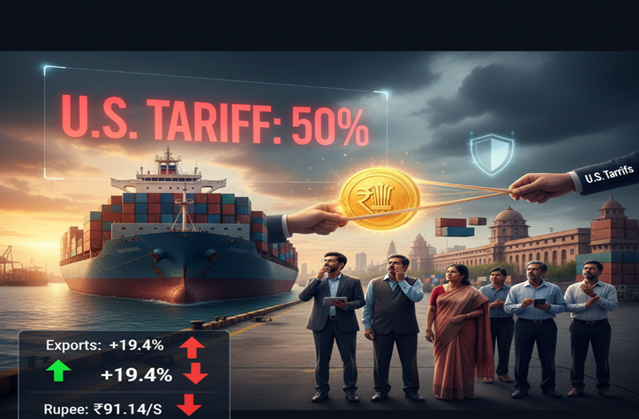
The rupee hit an all-time low of ₹91.14 per US dollar earlier this week. As of today, December 19, 2025, it has strengthened slightly to around ₹89.96–₹90.20 following the Reserve Bank of India’s (RBI) largest intraday intervention in seven months.
Reasons for Rupee Depreciation
1. Geopolitical Pressures & “Trump Tantrums”
- The 50% Tariff Impact: In August 2025, the U.S. imposed a 50% tariff on a large portion of Indian exports. This has created massive uncertainty in the currency market. Investors sell rupees in anticipation of a significant drop in future dollar earnings from the U.S., India’s largest export market.
- Trade Deal Delays: Sentiment has been dampened by the “limbo” in trade negotiations between New Delhi and Washington. The lack of a clear timeline for tariff reduction has led to speculative dollar buying.
2. Persistent FPI / FII Outflows
- “Flight to Quality”: Foreign Portfolio Investors (FPIs) have been aggressive net sellers in the Indian equity market throughout late 2025. In December alone, they were net sellers in 9 out of 11 trading sessions.
- Yield Differentials: Higher yields in U.S. Treasuries and better risk-adjusted returns in developed markets have caused FIIs to pull capital out of India, converting their rupee holdings back into dollars and increasing downward pressure on the INR.
- AI Obsession: Many global funds have been reallocating capital away from India to “AI-centric” hubs in North Asia (like Taiwan and South Korea), leading to a structural decline in the portfolio “largesse” India once enjoyed.
3. Widening Trade and Current Account Deficit (CAD)
- Import Intensity: Despite a strong showing in services, the merchandise trade deficit remains a core pressure point. While imports fell slightly in November 2025, the cumulative deficit for April–November 2025 widened by 9.74% year-on-year.
- Gold and Energy Bill: A spike in gold imports (up over 50% in some months) and volatile crude oil prices have consistently drained India’s dollar reserves. Since oil and gold are priced in dollars, every increase in their demand forces the RBI and importers to sell more rupees.
4. Global Dollar Strength (The “Safe Haven” Effect)
- US Dollar Index (DXY): Even during phases where the DXY eases globally, the rupee has often underperformed its emerging market peers. This is because non-economic and sentiment-driven influences (like the Geopolitical Risk Index) are now accounting for a larger portion of the currency’s variation.
- Monetary Policy Divergence: While the RBI has focused on maintaining “orderly market conditions,” expectations of fewer-than-expected rate cuts by the U.S. Federal Reserve have kept the dollar globally attractive.
Rupee Depreciation Impact on Indian Economy
Negative Impact of Rupee Depreciation
1. Imported Inflation (Cost-Push Inflation)
- Energy Bill: India imports nearly 80% of its crude oil. A weaker rupee means India pays more in local currency for the same barrel of oil, leading to higher petrol and diesel prices at the pump.
- Essential Commodities: The cost of other critical imports like fertilizers, edible oils, and electronic components rises. This “cost-push” inflation eventually trickles down to the common man, increasing the overall cost of living.
2. Higher Debt Servicing Costs
- External Commercial Borrowings (ECBs): Many Indian corporations borrow in dollars because of lower interest rates abroad. When the rupee falls, these companies need more rupees to buy the dollars required for interest and principal repayments.
- Balance Sheet Stress: For firms with “unhedged” exposure (loans not protected against currency swings), a 5% depreciation can increase repayment costs by an equivalent 4–5%, severely squeezing corporate profit margins.
3. Widening Trade and Current Account Deficits
- Inelastic Imports: Items like oil, gold, and high-tech machinery are “inelastic”—meaning India cannot easily reduce its demand for them even if prices rise.
- Off-setting Export Gains: Research from late 2025 (e.g., SBI Research) indicates that the cost of imported raw materials for sectors like electronics and chemicals often offsets any competitive price advantage gained in the export market, failing to meaningfully fix the trade balance.
4. Impact on Households and Individuals
- Foreign Education: For the 7.6 lakh+ Indian students abroad, a falling rupee acts as a “silent fee hike.” A semester fee of $20,000 that cost ₹16.8 lakh at ₹84/$ now costs over ₹18.2 lakh at ₹91/$.
- Outbound Tourism: International vacations become significantly more expensive. In December 2025, many travelers shifted from “long-haul” destinations (USA/Europe) to “short-haul” ones (Dubai/Vietnam) to manage shrinking budgets.
5. Risk of Capital Flight
- Investor Sentiment: Sustained depreciation signals macroeconomic instability. Foreign Portfolio Investors (FPIs), who have already pulled out over ₹1.59 lakh crore in 2025, may continue to exit the Indian market to avoid further “currency translation losses” on their investments.
Positive impact of Rupee depreciation:
1. Enhanced Export Competitiveness
- Price Advantage: A weaker rupee makes Indian goods and services cheaper for foreign buyers. This is a critical “shock absorber” for exporters currently facing 50% U.S. tariffs. By selling at a lower dollar price, they can maintain market share without losing their rupee-denominated profit margins.
- Sectoral Gainers:IT & Software: Companies like Infosys and TCS earn in dollars but pay salaries in rupees. Every ₹1 drop against the dollar typically adds 30–50 basis points to their operating margins.
- Pharma & Textiles: These labor-intensive sectors become more attractive to global buyers compared to competitors with stronger currencies (like the Euro or Yen).
- Agro-exports: As per recent SBI Research, food and agro-based sectors benefit most because they have low import intensity (they don’t need to import raw materials to export).
2. Boost to Remittance Inflows
- The “Wealth Effect” for NRIs: Non-Resident Indians (NRIs) sending money home get more rupees for every dollar. For example, $1,000 sent home in early 2025 (at ₹83) yielded ₹83,000; at ₹91, it yields ₹91,000.
- Significance: India is the world’s largest recipient of remittances. This surge in inflows helps bridge the Current Account Deficit (CAD) and provides much-needed foreign exchange liquidity to the banking system.
3. Natural “Import Substitution” (Make in India)
- Protection for Local Industry: As imports (like electronics, furniture, and processed foods) become costlier, domestic consumers naturally shift toward locally manufactured alternatives.
- Incentive for Value Addition: High import costs force Indian manufacturers to find domestic sources for components (e.g., semiconductors or chemicals), accelerating the goals of Atmanirbhar Bharat.
4. Encouraging Inbound Tourism
- India as a “Cheap Destination”: For international travelers, India becomes a more affordable destination. Their dollars stretch further in terms of luxury stays, travel, and services, potentially boosting the hospitality sector during the peak winter season of 2025-26.
INITIATIVE:
1. RBI’s Monetary & Market Interventions
The RBI is currently Asia’s most active central bank, using its $690 billion “war chest” strategically:
- Tactical Dollar Sales: On December 17, 2025, the RBI intervened through state-run banks to sell dollars as the Rupee breached the 91.14 level. This “forceful intervention” triggered a 1% intraday recovery, the sharpest in seven months.
- Liquidity Management (VRR Auctions): To balance year-end liquidity, the RBI conducted a ₹75,000 crore Overnight Variable Rate Repo (VRR) auction. This ensures banks have enough Rupee liquidity to prevent interest rate spikes while the central bank manages the currency.
- Forex Swaps: The RBI recently utilized a $5 billion forex swap to inject Rupee liquidity into the system without causing the currency to crash, effectively decoupling domestic cash needs from exchange rate defense.
2. Government’s Export Promotion Mission (EPM)
Launched with an outlay of ₹25,060 crore, the EPM is the government’s structural answer to the 50% U.S. tariffs:
- Niryat Protsahan (Financial Support): Provides MSMEs with affordable trade finance, interest subvention, and collateral-free credit.
- Credit Guarantee Scheme for Exporters (CGSE): A specialized ₹20,000 crore scheme that provides a 100% guarantee to banks for lending working capital to exporters, helping them survive the high-tariff period.
- BharatTradeNet: A new unified digital platform for trade documentation and financing, aimed at reducing transaction costs and the “logistical friction” that often hurts Indian exports.
Way Forward
1. Short-Term Stabilization Measures
- Managed Float Strategy: The RBI should continue its “crawl-like” intervention—intervening only to curb excessive volatility rather than defending a specific psychological level. This prevents the depletion of forex reserves while allowing the economy to adjust to global market realities.
- Incentivizing NRI Deposits: To boost immediate dollar inflows, the government and RBI can offer higher interest rates on Non-Resident External (NRE) and FCNR(B) accounts, similar to the measures taken during the 2013 “Taper Tantrum.”
- Easing ECB Norms: Easing the limits and end-use restrictions for External Commercial Borrowings (ECBs) will allow Indian firms to bring in more foreign currency, helping stabilize the capital account.
2. Medium to Long-Term Structural Overhaul
- Aggressive Export Diversification: India must pivot away from over-reliance on the U.S. market (currently facing 50% tariffs). Strengthening trade ties with ASEAN, the Middle East (via CEPA with UAE), and the UK (via the 2025 CETA agreement) is crucial to creating alternative dollar-earning corridors.
- Deepening the “Internationalization of Rupee”: Expand the use of Special Rupee Vostro Accounts (SRVAs) beyond the current 18-22 countries.
- Promote Rupee-denominated Masala Bonds so that the currency risk is shifted from Indian borrowers to foreign investors.
- Import Substitution (Atmanirbhar 2.0): Focus on reducing the “inelastic” import bill. This includes accelerating green energy to reduce oil dependence and scaling up the PLI scheme for semiconductors and electronics to cut down on component imports from China.
3. Strategic Policy Focus
- CAD Management: Maintaining the Current Account Deficit (CAD) within a sustainable limit of 1.5%–2% of GDP should be the primary goal, supported by robust services exports and remittances.
- Fiscal Prudence: Sticking to the fiscal deficit target (targeted at 4.5% by FY26) is vital to maintain investor confidence and prevent further capital flight by FPIs.
Conclusion
The trajectory of the Indian Rupee in late 2025 represents a critical balancing act between maintaining export competitiveness and controlling imported inflation. While the breach of ₹91/$ has caused immediate concern for importers and students abroad, the RBI’s strategic shift toward a “managed float” allows the currency to act as a natural shock absorber against external trade wars.