
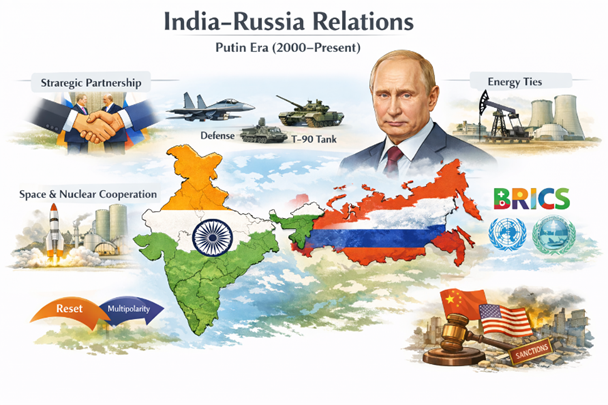
After read this article you can solve this UPSC Mains model question:
"The India-Russia 'Special and Privileged Strategic Partnership' is currently navigating a period of structural transformation. Analyze the key challenges emerging from the shifting global order and suggest how both nations can recalibrate their ties to ensure long-term sustainability." (GS-2 International Relation)
Context
Russian President Vladimir Putin’s visit to India (December 4 and 5) for the India-Russia Annual Summit had sparked a great deal of interest across the world, apart from India itself, though for different reasons.
Historical Background: The “Time-Tested” Bond:
- Early Years (1947–1960s): Diplomatic ties were established in April 1947. The USSR provided critical support for India’s heavy industrialization (e.g., Bhilai Steel Plant).
- 1971 Treaty of Peace, Friendship, and Cooperation: A watershed moment during the Bangladesh Liberation War. The USSR used its UNSC veto to protect India from Western pressure.
- Post-Soviet Era (1991–2000): After the USSR’s collapse, relations were re-codified in the 1993 Treaty of Friendship.
Institutionalization (2000–Present):
A. The Foundation: The 2000 Declaration
In October 2000, during Vladimir Putin’s first state visit to India, the “Declaration on the India-Russia Strategic Partnership” was signed. This was a turning point that:
- Institutionalized the Relationship: Established the Annual Summit mechanism, where the Indian PM and Russian President meet every year—a level of consistency India shares with very few countries.
- Broadened the Scope: Moved beyond just defense to include counter-terrorism, space, and science.
- Strategic Convergence: Both nations officially advocated for a “Multipolar World Order,” resisting a unipolar world dominated by a single superpower.
B. Elevation to “Special and Privileged” (2010)
During President Putin’s 2010 visit, the relationship was upgraded to a “Special and Privileged Strategic Partnership.”
- Meaning: This unique nomenclature signifies a level of trust where Russia provides India with technologies it doesn’t share with others (e.g., Akula-class nuclear submarine leases and BrahMos technology).
- Civil Nuclear Cooperation: The “Haripur” and “Kudankulam” agreements cemented Russia as India’s most reliable partner in nuclear energy, even as India signed the 123 Agreement with the US.
C. The “Make in India” Pivot (2014–2021)
With the advent of the Modi government and Putin’s continued leadership, the defense relationship evolved from a “Buyer-Seller” model to “Joint Research, Development, and Production.”
- S-400 Deal (2018): Despite the threat of US sanctions (CAATSA), both leaders moved ahead with the $5 billion deal, signaling India’s strategic autonomy.
- 2+2 Dialogue (2021): The first-ever 2+2 meeting (Foreign and Defense Ministers) was held, bringing Russia on par with India’s Quad partners in terms of diplomatic infrastructure.
D. The “Post-Ukraine” Reality (2022–Present)
The recent phase under Putin has been defined by Economic Realignment due to Western sanctions.
- Energy Shift: Russia became India’s largest oil supplier (from <1% to ~40% of imports).
- 23rd Annual Summit (Dec 2025): Reaffirmed the bond on the 25th Anniversary of the 2000 Declaration.
- Vision 2030: A roadmap to hit $100 billion in trade.
- Connectivity: Renewed focus on the Chennai-Vladivostok Corridor and the Northern Sea Route (NSR) in the Arctic.
- Labor Mobility: A landmark agreement in 2025 to send skilled Indian workers to Russia to fill labor shortages.
Key Areas of Cooperation:
A. Defence & Security (The Strongest Pillar)
- Equipment Dependence: Russia accounts for nearly 60–70% of India’s military inventory.
- Major Projects: S-400 Triumf systems, Su-30MKI fighters, T-90 tanks, and INS Vikramaditya.
- Shift to “Make in India”: Transitioning from buyer-seller to joint production.
- BrahMos Missile: World’s fastest supersonic cruise missile (now being exported to third countries like Philippines).
- AK-203 Rifles: Manufactured in Amethi, UP.
- Joint Exercises: INDRA (Tri-services) and participation in multilateral drills like Vostok.
B. Energy & Nuclear Security
- Oil & Fertilizers: In FY 2024-25, Russia remained India’s top crude oil supplier (providing over 40% of imports) and a primary source of fertilizers.
- Civil Nuclear: The Kudankulam Nuclear Power Plant (KKNPP) in Tamil Nadu is the only major nuclear project in India built with foreign collaboration (Units 1-6).
- Future: Exploring Small Modular Reactors (SMRs) and liquid natural gas (LNG) ties.
C. Economic & Connectivity
- Trade Target: Bilateral trade hit a record $68.7 billion in FY 2024-25. The new target is $100 billion by 2030.
- Connectivity Corridors:
- INSTC (International North-South Transport Corridor): Reducing time/cost for trade with Eurasia.
- Chennai-Vladivostok Eastern Maritime Corridor: Linking India’s east coast to the Russian Far East.
- Northern Sea Route (NSR): Strategic access to the Arctic.
D. Space & Technology
- Gaganyaan: Russia provided training for Indian astronauts (Gaganyatris) and critical life-support components.
- Cryogenic Engines: Historical Russian support for ISRO’s heavy-lift capabilities.
Emerging Challenges:
1. The “China Factor” & Strategic Divergence
- The “No-Limits” Partnership: Russia’s deepening economic and military reliance on China (due to Western isolation) is New Delhi’s primary concern. India fears Moscow may become a “Junior Partner” to Beijing, potentially compromising Russian neutrality in the event of a Sino-Indian border conflict.
- Indo-Pacific Dissonance: Russia remains critical of the “Quad” (India, US, Japan, Australia), labeling it a Western “bloc-based” approach. India, conversely, views the Quad as essential for a free and open Indo-Pacific—a direct clash in regional maritime visions.
- Russia-Pakistan Ties: Moscow’s “hedging” strategy includes expanding ties with Islamabad. The “Druzhba-2025” joint military exercises and potential energy deals with Pakistan are seen by India as a dilution of its “exclusive” strategic space with Russia.
2. The Economic & Payment Crisis
- Trade Imbalance: While bilateral trade hit nearly $69 billion (FY 2024-25), it is highly lopsided. India’s imports (mostly oil/fertilizers) dwarf its exports (~$5 billion), leading to a massive “Rupee Surplus” in Russian Vostro accounts.
- The Rupee-Rouble Trap: Russian exporters are reluctant to hold large amounts of volatile Indian Rupees. Efforts to institutionalize a digital payment corridor or reinvest these funds into Indian infrastructure (e.g., ports/energy) are still in the pilot stages.
- Eroding “Oil Windfall”: The deep discounts on Russian crude that India enjoyed in 2022-23 have narrowed to just $2.3 per barrel (avg. 2024-25), while the diplomatic cost and shipping risks (sanctions on the “Shadow Fleet”) remain high.
3. Defense Delays & Diversification
- The S-400 Timeline: While four regiments are active, the final delivery of the S-400 Triumf has been pushed to 2026 due to the war in Ukraine.
- Sanctions Pressure (CAATSA): Despite the strategic “exception” given by the US so far, the threat of sanctions remains a “Sword of Damocles,” especially with the 2025 US administration taking a harder line on energy and defense purchases from Moscow.
- Supply Chain Disruptions: Russia’s focus on its domestic war effort has led to delays in the supply of spare parts for India’s Su-30MKI and T-90 fleets, forcing India to accelerate its “Atmanirbhar” (self-reliance) and Western diversification efforts.
4. Humanitarian and People-to-People Irritants
- Recruitment Controversy: A significant diplomatic friction point emerged in 2024-25 regarding Indian nationals duped by “job agents” and forced into the Russian military. As of late 2025, the MEA confirms at least 44 Indians are still on the front lines despite high-level promises of discharge.
- Xenophobia Concerns: Reports of nativist sentiment in Russia following the 2024 Crocus City Hall attacks have raised concerns for the safety of the growing Indian labor and student community.
Way Forward:
1. Economic Diversification & Trade Balance
- The 300-Product Strategy: India has identified nearly 300 high-potential products (engineering goods, pharmaceuticals, agriculture, and textiles) to narrow the $60 billion trade deficit. The goal is to move beyond the “Oil and Defense” trap.
- Target 2030: Accelerating the $100 billion bilateral trade target, which PM Modi recently suggested could be achieved even before 2030 through “bottom-up” organic business growth.
- India-EAEU FTA: Expediting the Free Trade Agreement with the Eurasian Economic Union to provide Indian exporters seamless access to a 180-million-strong market.
2. Financial & Connectivity Architecture
- Payment Interoperability: Moving beyond the “Rupee-Rouble” hurdles by integrating the Unified Payments Interface (UPI) with Russia’s MIR card system and linking national financial messaging systems (bypassing SWIFT).
- Arctic & Maritime Pivot:Northern Sea Route (NSR): India is positioning itself as a key partner in Arctic shipping and resource extraction.
- Chennai-Vladivostok Eastern Maritime Corridor: Operationalizing this will reduce cargo transit time from 40 days to 24 days, effectively linking India’s east coast to the Russian Far East.
3. Evolving the Defense Pillar
- “Atmanirbhar” Co-production: Shifting from “Buyer-Seller” to a “JV-Export” model. The BrahMos-II (hypersonic) and the joint production of AK-203 rifles in Amethi serve as blueprints for exporting to third countries in the Global South.
- Niche Tech Cooperation: Focusing on Cyber Defense, AI, and Quantum Computing. Russia’s proposal to supply AL-41 engines for the Su-30MKI fleet shows a willingness for deeper tech-transfer.
4. Strategic Balancing & Multipolarity
- “China-Neutral” Diplomacy: India must continue to engage Russia to ensure that Moscow’s dependence on Beijing does not translate into an anti-India tilt in continental Eurasia.
- The Global South Bridge: Leveraging BRICS (under India’s 2026 Chairship) and the SCO to drive a “Reformed Multilateralism” agenda that reflects the interests of the Global South, rather than just Western or Chinese blocs.
5. Energy & Environment
- Civil Nuclear Expansion: Following the completion of the Kudankulam units (expected by 2027), India is striving to allot a second site for Russian VVER-1200 reactors.
Conclusion: The “Dhruv Taara” (Pole Star) of Indian Diplomacy
The India-Russia relationship has transcended the traditional “buyer-seller” dynamic to become a cornerstone of global stability. Prime Minister Narendra Modi, during the December 2025 Summit in New Delhi, encapsulated this bond using a powerful celestial metaphor.