
After read this article you can solve this UPSC Mains model question
“The right to a healthy environment has evolved from a directive principle into an enforceable fundamental right through judicial interpretation.” Critically examine this evolution in the Indian context. (GS-2 Polity)
Context
Come winter and the National Capital wakes up with thick smog and severely low air quality, which cripples the city and poses serious health challenges.
Constitutional & Legal provision:
1. Constitutional Provisions
(a) Fundamental Rights
- Article 21 – Right to Life
- Interpreted expansively by the Supreme Court to include:
- Right to clean air
- Right to safe drinking water
- Right to pollution-free environment
- Interpreted expansively by the Supreme Court to include:
(b) Directive Principles of State Policy (DPSPs)
- Article 48A
- “The State shall endeavour to protect and improve the environment and safeguard forests and wildlife.”
(c) Fundamental Duties
- Article 51A(g)
- Duty of every citizen to protect and improve the natural environment.
2. Supreme Court Judgements
(a) Subhash Kumar v. State of Bihar (1991)
- Right to life includes right to enjoyment of pollution-free water and air.
- Explicit recognition of environmental quality under Article 21.
(b) M.C. Mehta v. Union of India (Oleum Gas Leak, 1986)
- Introduced Absolute Liability for hazardous industries.
- Environment protection prioritised over economic interests.
(c) Vellore Citizens’ Welfare Forum v. Union of India (1996)
- Recognised:
- Precautionary Principle
- Polluter Pays Principle
- Held these principles as part of Indian environmental law.
(d) M.C. Mehta v. Kamal Nath (1997)
- Introduced Public Trust Doctrine.
- Natural resources held by the State in trust for the people.
(e) Recent Supreme Court Position
- Right against adverse climate impacts recognised as part of Article 21.(M.K. Ranjitsinh & Ors. v. Union of India & Ors.)
- Emphasis on inter-generational equity and sustainable development.
3. Legal & Statutory Provisions
- Wildlife Protection Act (1972): Protection of endangered species and habitats.
- Water Act (1974) & Air Act (1981): Established the CPCB and SPCBs to monitor and regulate pollution.
- Environment (Protection) Act (1986): An “umbrella legislation” providing the Centre with broad powers to coordinate state and central authorities.
- National Green Tribunal (NGT) Act (2010): Created a specialized forum for the speedy disposal of environmental disputes.
Key Environmental Principles:
1. The Precautionary Principle
- Core Idea: “Prevention is better than cure.” If an action or policy has a suspected risk of causing severe or irreversible harm to the public or the environment, the burden of proof falls on those wanting to take the action to show it is not harmful.
- Scientific Uncertainty: Lack of full scientific certainty should not be used as a reason for postponing cost-effective measures to prevent environmental degradation.
- Landmark Case: Vellore Citizens Welfare Forum v. Union of India (1996).
2. The Polluter Pays Principle (PPP)
- Core Idea: The party responsible for pollution should bear the costs of managing it.
- Extended Scope in India: In India, this doesn’t just mean paying for the cleanup; it also includes compensating the victims of pollution and paying for the restoration of the environment.
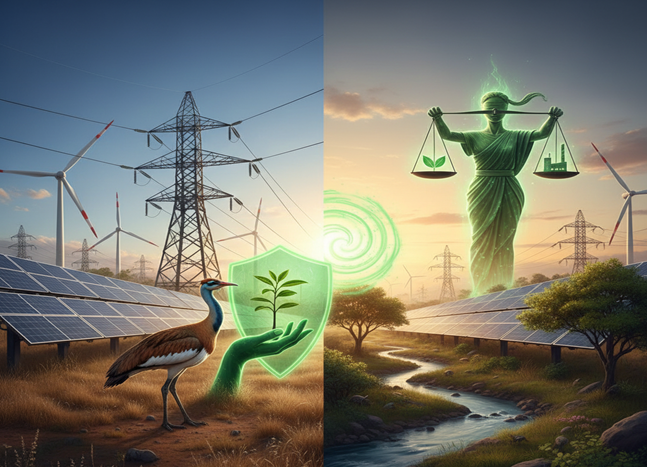
- Latest Application (2025): The Supreme Court in the M.K. Ranjitsinh case reiterated that companies whose power lines cause the death of the Great Indian Bustard must bear the cost of species recovery under this principle.
3. The Public Trust Doctrine
- Core Idea: The State is not the “owner” of natural resources but a “Trustee.”
- Resource Protection: Resources like air, sea, waters, and forests are of such great importance to the people as a whole that it would be unjustified to make them a subject of private ownership.
- Landmark Case: M.C. Mehta v. Kamal Nath (1997), where the court struck down a lease granted to a private motel that would have disturbed the flow of the Beas River.
4. Doctrine of Absolute Liability
- Core Idea: An enterprise engaged in a hazardous or inherently dangerous activity is strictly and absolutely liable to compensate all those affected by an accident.
- No Exceptions: Unlike “Strict Liability” (which has exceptions like “Act of God”), Absolute Liability has no exceptions.
- Origin: Developed by Justice P.N. Bhagwati after the Oleum Gas Leak case (1986) to ensure large industries are held accountable regardless of negligence.
5. Inter-generational Equity
- Core Idea: Each generation has a moral and legal duty to leave the planet in no worse a condition than they received it.
- Sustainable Use: It demands a balance between the needs of the present and the rights of future generations to enjoy a healthy environment.
Current Issues & Challenges in Environmental Governance:
1. Institutional & Implementation Gaps
- The “Symbolism vs. Substantive” Action: As noted by SC Justice R. Mahadevan in December 2025, environmental protection is often relegated to “symbolism” rather than “preventive governance.” Institutions frequently react to crises (like Delhi’s air pollution) rather than maintaining “sustained vigilance.”
- Manpower & Resource Crunch: The Environment Audit Rules, 2025, were recently introduced to allow private auditors to assist. This move stems from the severe capacity constraints within the CPCB and SPCBs, which are currently overwhelmed by the sheer volume of industries they must monitor.
- The “Shadow Fleet” of Violations: Minor but frequent environmental travesties at the district and panchayat levels often escape regulatory notice due to a lack of trained staff and digital surveillance.
2. The Conflict of “Green vs. Green”
- Case Study: The GIB Controversy (2025): The Supreme Court’s ongoing scrutiny of renewable energy infrastructure in the Great Indian Bustard (GIB) habitat highlights a modern paradox. India’s push for “Green Energy” (Solar/Wind) is directly clashing with “Biodiversity Conservation.”
- Defining the Aravallis: In late 2025, the SC adopted a uniform definition for the Aravalli Hills (landforms rising 100m+). While meant to regulate mining, critics argue that the 100-meter threshold might exclude 90% of the landscape, leaving crucial groundwater recharge zones vulnerable to construction.
3. Dilution of Environmental Safeguards (EIA Crisis)
- Post-Facto Clearances: A major point of litigation in 2025 has been the government’s attempt to institutionalize “post-facto” environmental clearances (regularizing projects after they have already caused damage). The SC has consistently struck these down, calling them a violation of the Precautionary Principle.
- Strategic Exemptions: Amendments to the EIA Notification have expanded exemptions for projects labeled “strategic” or “national security,” often bypassing public consultation—the “bedrock” of environmental democracy.
4. Climate Justice & Social Vulnerability
- Adaptive Capacity: The social sector remains underfunded in India’s climate action. While “Mitigation” (EVs, Solar) gets capital, “Adaptation” (protecting farmers from heatwaves or coastal communities from rising seas) lacks leadership and funding.
- Corporate Duty: In a landmark ruling, the SC held that Corporate Social Responsibility (CSR) is not “voluntary charity” but a Constitutional Obligation under Article 51A(g). Companies are now viewed as “guests in the ecosystem,” sharing the duty to prevent species extinction.
Way forward
To ensure the Right to a Healthy Environment is realized effectively, India must transition from “Environmental Adjudication” (courtroom wins) to “Environmental Administration” (ground-level results).
1. Strategic & Legal Reforms
- Codifying the “Climate Right”: India lacks a unified climate law. There is a pressing need for a National Climate Change Act that codifies the Supreme Court’s 2024-25 rulings, establishing clear duties for state agencies and defining “Climate Justice” for vulnerable populations.
- Strengthening the NGT: The National Green Tribunal needs greater financial and administrative autonomy. Its benches should be expanded to ensure that specialized environmental justice is accessible at the regional level, reducing the burden on the Supreme Court.
- Reforming SPCBs: State Pollution Control Boards require a massive infusion of technical manpower and resources. Transitioning to automated, real-time monitoring of industrial effluents and emissions is essential to move away from the “Inspect-and-Fine” model.
2. Corporate & Economic Realignment
- Implementing “Guest in the Abode” Doctrine: As per the Supreme Court ruling (Dec 19, 2025), corporations must internalize the principle that they are “guests” in the ecosystem.
- Mandatory Environmental CSR: Following the latest judicial directive, companies in sectors like mining and power must move beyond symbolic tree planting. A fixed percentage of CSR funds should be ring-fenced for “Species Recovery Programs” and restoring the local ecology directly impacted by their projects.
- Green Credit Rules (2025): Rapidly operationalize the new Green Credit Program, which prioritizes the “survival and canopy density” of forests over the mere number of saplings planted. This ensures that economic incentives are tied to actual ecological outcomes.
3. Grassroots & Technological Interventions
- Environment Audit Rules (2025): Leverage the newly notified rules to involve third-party digital auditors and GIS mapping for environmental compliance. This adds a layer of transparency and prevents “Regulatory Capture.”
- Decentralized Climate Action: Empower Urban Local Bodies (ULBs) and Panchayats with Climate Adaptation Funds. Localized solutions like “Miyawaki Forests” in cities and “Amrit Sarovars” (pond rejuvenation) in villages can act as critical heat-sinks.
- Mission LiFE (Lifestyle for Environment): Institutionalize the LiFE movement into school curricula and municipal bylaws to nudge citizen behavior toward sustainable consumption, making the right to a healthy environment a “shared responsibility.”
Conclusion
“Clean air and a stable climate are no longer just legal aspirations; they are the basic prerequisites for human dignity in the 21st century.” —SC Observations.