
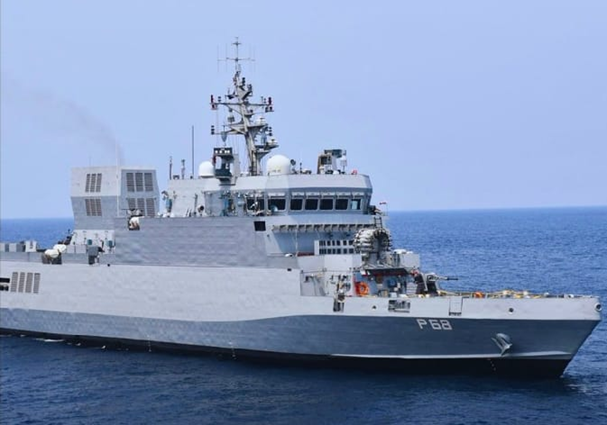
Why in the News?
- In December 2025, the Indian Navy inducted ‘Anjadip’, the third of eight Anti-Submarine Warfare Shallow Water Crafts (ASW SWCs), at Chennai.
- The induction strengthens India’s coastal anti-submarine warfare capability and advances the Aatmanirbhar Bharat initiative in defence shipbuilding.
About Anjadip Ship
- Anjadip is an indigenously designed and constructed ASW Shallow Water Craft.
- It has been built by Garden Reach Shipbuilders and Engineers (GRSE), Kolkata, in collaboration with L&T Shipyard, Kattupalli, under a Public–Private Partnership (PPP) model.
- The ship is named after Anjadip Island, located off the Karwar coast in Karnataka.
- It represents the modern reincarnation of INS Anjadip, a Petya-class corvette that was decommissioned in 2003.
- The vessel has been designed and constructed in accordance with the classification standards of the Indian Register of Shipping (IRS).
Key Features and Technical Specifications
- Length: Approximately 77 metres.
- Displacement: Approximately 900 tonnes.
- Maximum Speed: Around 25 knots.
- Operational Endurance: Nearly 1,800 nautical miles.
- Propulsion: It is the largest Indian Naval warship powered by waterjet propulsion, enhancing manoeuvrability in shallow waters.
Weapons and Sensors
- Equipped with state-of-the-art Lightweight Torpedoes.
- Fitted with indigenously developed Anti-Submarine Rockets.
- Integrated with shallow-water SONAR systems for effective detection and tracking of underwater threats.
- Armed with an indigenous 30 mm Naval Surface Gun.
- The ship has over 80% indigenous content.
Operational Capabilities
- Designed primarily for Anti-Submarine Warfare (ASW) operations in coastal and shallow water regions.
- Enhances the Navy’s ability in:
- Coastal surveillance
- Subsurface threat detection
- Mine-laying operations
- Particularly effective in littoral zones, where larger warships face operational constraints.
Strategic and Defence Significance
- Strengthens India’s coastal defence architecture against submarine threats.
- Demonstrates progress under Aatmanirbhar Bharat by boosting indigenous naval shipbuilding.
- Reduces dependence on foreign defence imports.
- Reflects the growing maturity of India’s domestic defence manufacturing ecosystem and PPP-based shipbuilding model.
Anti-Submarine Warfare Shallow Water Crafts (ASW SWCs)
- Overview: ASW SWCs are a class of indigenously designed and built corvettes for the Indian Navy, primarily to replace the ageing Abhay-class corvettes.
- Project Details: 16 vessels under construction (8 by Cochin Shipyard Limited (CSL) – Mahe-class; 8 by Garden Reach Shipbuilders & Engineers (GRSE) – Arnala-class); contracts signed in 2019; over 80-88% indigenous content under Aatmanirbhar Bharat initiative.
- Primary Role: Anti-Submarine Warfare (ASW) in coastal/shallow waters – detection, tracking, and neutralization of submarines (especially midget submarines).
GRSE – Notable Achievement
- With the delivery of Anjadip, GRSE delivered five naval vessels in a single year, a rare feat.
- Anjadip is:
- The 115th warship built by GRSE.
- The 77th warship delivered to the Indian Navy.
- Other vessels delivered by GRSE in 2025 include:
- Advanced Guided Missile Frigate Himgiri
- ASW SWCs Arnala and Androth
- Survey Vessel (Large) Ikshak
Q. Which of the following best explains the strategic role of ASW Shallow Water Crafts like Anjadip?
(a) Blue-water naval dominance in deep oceans
(b) Long-range missile deterrence
(c) Coastal anti-submarine warfare and mine-laying operations
(d) Amphibious troop deployment

Answer: (c)
Explanation: ASW SWCs are optimised for littoral and shallow-water environments, focusing on submarine detection, coastal surveillance, and mine-laying, rather than blue-water or amphibious roles.