
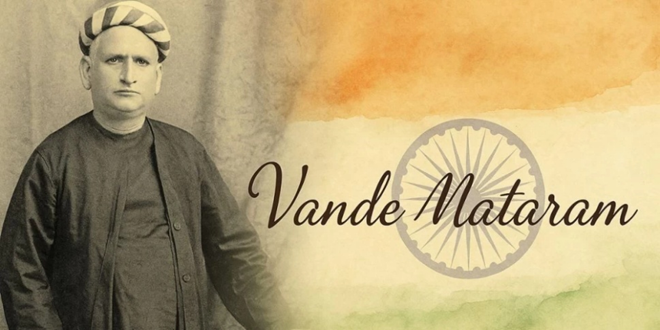
Why in the News?
- The 150th anniversary of Vande Mataram was marked by discussions in Parliament in December 2025.
- Debates focused on whether the song should be sung in its entirety or in part, touching on secularism, minority sensitivities, and historical interpretations.
- Lawmakers cited historical scholarship, notably Sabyasachi Bhattacharya’s “Vande Mataram: The Biography of a Song”, highlighting the cultural and political history of the song.
National Song – Definition and Significance
- Definition: A National Song is a patriotic song that reflects the cultural identity, unity, and historical struggles of a nation but is distinct from the National Anthem.
- India’s National Song: Vande Mataram
- Official Adoption:
- 1937: First two stanzas adopted by the Congress Working Committee.
- 24th January 1950: President Rajendra Prasad declared it to be honoured equally with the National Anthem (“Jana Gana Mana”).
- Constitutional Reference: The Constitution does not explicitly mention a National Song; however, Article 51A(a) encourages citizens to respect national symbols, including the anthem.
- Significance: The song celebrates Mother India as a life-giving and nurturing motherland, invoking devotion, pride, and reverence.
- Flexibility: Unlike the anthem, it can be sung in different languages or tunes and is not mandatory at official events.
Meaning of Vande Mataram – National song
- Original Lines:
- “Vande Mataram, sujalam suphalam, malayaja shitalam,
Shasyashyamalam, Mataram”
- “Vande Mataram, sujalam suphalam, malayaja shitalam,
- Translation/Meaning:
- “I bow to thee, Mother, rich in water, rich in fruits, cool with the winds of the south, fragrant with the crops of the field, dark with the crops of the harvest.”
Historical Background of National Song
- Author: Bankim Chandra Chatterjee (1838–1894), a leading 19th-century Bengali writer and nationalist thinker.
- Composition Date: Believed to be written on Akshaya Navami, 7th November 1875.
- Publication: First appeared in the literary journal Bangadarshan (1875) and later incorporated in the novel Anandamath (1882).
- Musical Setting: Set to music by Rabindranath Tagore, enhancing its appeal as a patriotic hymn.
- Role in Nationalism: Served as a battle cry during the Swadeshi movement, inspiring protests against colonial rule.
Key Milestones
- First Public Rendition (1896): Sung at the Kolkata session of the Indian National Congress, gaining popularity as a patriotic song.
- Swadeshi Movement (1905): Became a rallying point during anti-partition agitation in Bengal.
- Student Movements: Used in protests in Hyderabad–Karnataka region, e.g., Osmania University, Gulbarga University, despite British bans.
- Influence Abroad: Indian revolutionaries used it as a symbol of resistance, e.g., Bhikaji Cama in Stuttgart (1907), Madan Lal Dhingra in England (1909).
Bankim Chandra Chatterjee
- Life Span: 1838–1894.
- Major Works: Anandamath, Durgeshnandini, Kapalkundala, Devi Chaudhurani.
- Contribution: Shaped modern Bengali prose and early Indian nationalist thought.
- Philosophy: Opposed idolatry, promoted rationality and devotion to the motherland rather than religious ritualism.
Difference Between National Anthem and National Song
The National Anthem, Jana Gana Mana, has a fixed tune and is a Fundamental Duty under the Constitution, while the National Song, Vande Mataram, inspires patriotism and devotion, is flexible in rendition, and holds equal reverence without being mandatory.
| Aspect | National Anthem | National Song |
| Purpose | Reflects history and culture of the country | Evokes patriotism and emotional connect among citizens |
| Usage | Fixed tune, pronunciation, and timing; mandatory on select occasions | Flexible in tune and language; not mandatory |
| Composition | “Jana Gana Mana” by Rabindranath Tagore (1911) | “Vande Mataram” by Bankim Chandra Chatterjee (1875) |
| Constitutional Status | Article 51A: Honour listed as a Fundamental Duty | No explicit mention in the Constitution; honoured equally with anthem |
| Adoption | Made official National Anthem | Adopted as National Song by Congress (1937) |
Q. With reference to India’s National Song, consider the following statements:
1. Vande Mataram was composed by Bankim Chandra Chatterjee and first published in his novel Anandamath.
2. The entire song was adopted as the National Song of India in 1937 by the Congress Working Committee.
3. The song is explicitly mentioned in the Constitution of India.

Which of the statements given above is/are correct?
(a) 1 only
(b) 1 and 2 only
(c) 2 and 3 only
(d) 1, 2, and 3

Answer: (a) 1 only

Explanation:
Statement 1 is correct: Bankim Chandra Chatterjee composed Vande Mataram, and it was first published in Bangadarshan and later included in Anandamath (1882).
Statement 2 is incorrect: Only the first two stanzas were adopted as the National Song in 1937, not the entire song.
Statement 3 is incorrect: The Constitution does not explicitly mention a National Song, though Article 51A(a) asks citizens to respect national symbols.