
After read this article you can solve this UPSC Mains Model Question:
Artificial Intelligence is expected to transform labour markets, but its benefits may not be gender-neutral. Analyse the structural reasons behind women’s vulnerability to AI-led job displacement and propose measures to make AI-driven growth inclusive. (GS-3 Employment)
The Upskilling Gap:
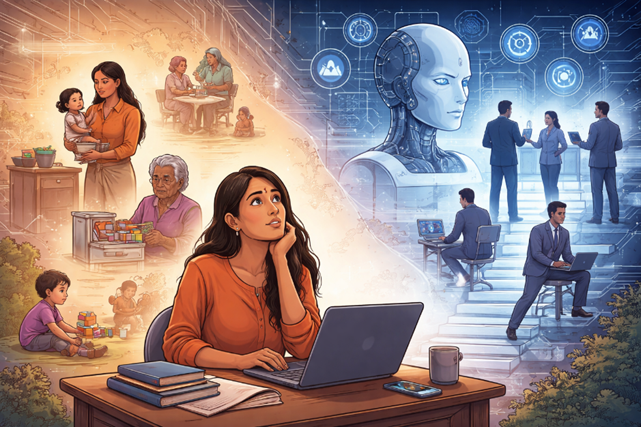
Upskilling gap refers to the widening divide whereby women are less able than men to acquire the new skills required in an AI-driven economy. This gap is rooted not just in employment statistics but in unequal access to time to learn and reskill.
The Current Landscape:
1. Time Poverty as a Core Constraint
Women carry a double burden of paid work plus unpaid care work (childcare, eldercare, domestic chores). Time Use Survey data shows women spend significantly more hours on unpaid work and have less time for skill acquisition compared to men.
2. Labour Force Participation
- India’s female labour force participation remains low and uneven.
- Many women are involved in informal or low-productivity jobs that offer limited incentives or resources to upskill for AI-linked roles.
Issues with Female Workforce in The AI Era:
A. How AI Amplifies Gender Disparities:
- Unequal Exposure to Automation
Women are disproportionately employed in routine, clerical, and service-sector jobs that are more susceptible to AI-driven automation, increasing their risk of displacement. - Skill-Biased Nature of AI
AI complements high-end digital and analytical skills. Due to limited access to STEM education, reskilling opportunities, and time, women are less likely to transition into AI-augmented roles. - Time Poverty from Unpaid Care Work
Continuous upskilling is essential in an AI economy. However, women’s disproportionate unpaid domestic and care responsibilities restrict their ability to engage in training and lifelong learning. - Algorithmic Bias and Discrimination
AI systems trained on historical data often reproduce gender biases in recruitment, promotions, and wage-setting, penalising women with career breaks or part-time work histories. - Digital Divide in AI Usage
Women have lower access to advanced digital tools and are less likely to use generative AI platforms, reducing productivity gains and workplace competitiveness. - Underrepresentation in AI Design and Governance
Fewer women in AI development leads to male-centric system design, overlooking women’s needs and reinforcing exclusion. - Penalisation of Non-Linear Career Paths
AI-based performance evaluation tools often undervalue career interruptions, disproportionately affecting women returning after maternity or caregiving breaks.
B. Structural & Societal Barriers:
- Unpaid Care Work
The bulk of unpaid labour — caregiving, domestic tasks — remains gendered.
Without affordable public care infrastructure (childcare, eldercare), women’s time remains constrained.
- Digital & SKill Divide
Beyond access to technologies, a skills divide persists: women are often less likely to attain advanced ICT and AI skills due to educational, cultural, and confidence barriers.
- Workplace Bias
Tech industries worldwide show persistent gender imbalance and discriminatory cultures that hinder women from entering or advancing in AI-centric jobs.
- Global Findings on Risk
Studies show women are 20% less likely than men to engage with generative AI tools, further reducing their competitiveness in future job markets.
Macroeconomic Implications of the Gender Upskilling Gap in the AI Era:
- Loss of Growth Potential
Excluding women from AI-driven sectors leads to underutilisation of human capital. With women forming nearly half of India’s population, the economy risks sub-optimal GDP growth and reduced productivity gains from AI adoption. - Widening Income & Wage Inequality
AI disproportionately rewards high-skill labour. If women remain trapped in low-skill or informal jobs, gender wage gaps will widen, aggravating overall income inequality and weakening inclusive growth. - Lower Labour Force Participation Rate (LFPR)
Automation-induced job losses in routine sectors (clerical, services, informal work) may push women out of the workforce, further depressing India’s already low female LFPR, which negatively impacts demographic dividend realisation. - Reduced Consumption Demand
Women’s lower earnings and job insecurity reduce household disposable income, dampening aggregate demand, especially in education, health, and consumer goods—slowing economic momentum. - Productivity & Innovation Deficit
Homogeneous AI workforces risk biased innovation. Lack of women in AI design and deployment reduces diversity-led innovation, affecting long-term competitiveness of firms and the economy. - Fiscal Stress on the State
Lower female employment leads to reduced tax base and higher dependence on welfare spending, increasing fiscal pressures and limiting public investment in growth-enhancing sectors. - Intergenerational Impact
Women’s economic disempowerment adversely affects human capital formation of future generations (nutrition, education, health), creating a long-term drag on economic development.
Policy Measures & Recommendations:
1. Reduce Time Poverty (Foundational Reform)
- Expand public childcare and eldercare services through urban anganwadis, crèches, and community care centres.
- Invest in time-saving infrastructure (piped water, clean cooking fuel, public transport) to reduce women’s unpaid care burden.
- Encourage shared care responsibilities through parental leave policies for men.
2. Gender-Responsive Skilling Ecosystem
- Design women-centric AI and digital skilling programmes with flexible schedules, modular courses, and hybrid learning models.
- Integrate AI, data literacy, and digital skills into school and higher education curricula for girls.
- Provide stipends, scholarships, and childcare support during skill training.
3. Inclusive Digital Access
- Ensure affordable access to devices, internet connectivity, and digital platforms for women, especially in rural areas.
- Promote digital literacy campaigns targeting adult women and informal sector workers.
4. Labour Market & Workplace Reforms
- Encourage flexible work arrangements (remote work, part-time, gig models with safeguards).
- Shift towards output-based performance evaluation to avoid penalising career breaks.
- Mandate gender diversity reporting in tech and AI-intensive firms.
5. Safe, Bias-Free AI Ecosystem
- Promote gender-sensitive AI design, including diverse datasets and algorithm audits to reduce bias.
- Support women’s participation in AI research, development, and governance bodies.
6. Government & Institutional Interventions
- Align national initiatives like the IndiaAI Mission with explicit gender inclusion targets.
- Converge skilling schemes (Skill India, Digital India, PMKVY) with women empowerment missions.
- Strengthen data collection on gendered impacts of AI and automation for evidence-based policymaking.
7. Private Sector & Public–Private Partnerships
- Incentivise firms to invest in reskilling women employees through tax benefits and CSR mandates.
- Promote industry–academia partnerships focused on women in STEM and AI.
Way Forward: Ensuring Gender-Inclusive AI-Led Growth
- Move from Skill-Centric to Ecosystem-Centric Approach
Policymaking must go beyond isolated upskilling programmes to address time poverty, care infrastructure, digital access, and workplace norms simultaneously. - Mainstream Gender in AI Governance
Gender inclusion should be embedded in the design, deployment, and regulation of AI, with mandatory bias audits, diverse datasets, and women’s representation in AI policy bodies. - Reimagine Work & Learning Models
Promote flexible, hybrid, and lifelong learning frameworks that allow women to upskill alongside caregiving responsibilities without career penalties. - Strengthen Public Investment in Care Economy
Expanding childcare, eldercare, and social infrastructure will free women’s time, boost labour force participation, and generate multiplier effects for growth. - Target the Informal & Rural Workforce
AI-linked skilling must reach informal, gig, and rural women workers, preventing exclusion from the future digital economy. - Measure What Matters
Regularly track gender-disaggregated data on AI adoption, skill acquisition, and employment outcomes to enable evidence-based corrections.
Conclusion:
India’s AI transition can become a catalyst for women’s economic empowerment only if inclusion is treated as a core economic strategy, not a peripheral social objective. Bridging the upskilling gap is essential for realising equitable, resilient, and sustainable growth.