
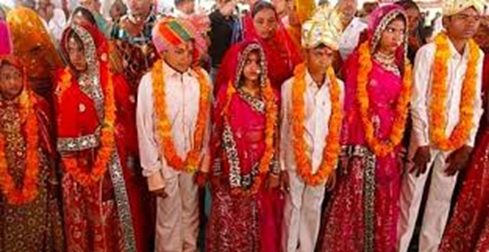
After reading this article, you can solve the UPSC Mains Practice Question given below:
Child marriage in India is not merely a legal violation but a manifestation of deep-rooted structural inequalities.” Examine the factors responsible for the persistence of child marriage in India and suggest suitable measures to address the problem. (GS – II, Subject- Social Issues)
Why in the News
- India has recently reaffirmed its commitment to end child marriage by 2030, in line with the United Nations Sustainable Development Goals (SDG 5.3).
- The Union Government observed the first anniversary of the Bal Vivah Mukt Bharat Abhiyan (Child Marriage Free India Campaign) with a 100-day nationwide awareness drive.
- Despite a steady decline in prevalence, the Supreme Court of India (October 2024) issued comprehensive guidelines, noting that while the law exists, judicial and social backlogs remain significant hurdles.
Present Status of Child Marriage in India
- Definition and Legal Age: Child marriage refers to a marriage in which the girl is below 18 years or the boy is below 21 years, as prescribed under the Prohibition of Child Marriage Act (PCMA), 2006.
- Overall Prevalence and Trend
- India has recorded a significant long-term decline in child marriage.
- As per the United Nations Population Fund (UNFPA)’s analysis of National Family Health Survey (NFHS) data:
- 47.4% of women aged 20–24 years were married before 18 in 2005–06 (NFHS-3).
- This declined to 23.3% in 2019–21 (NFHS-5).
- Despite this progress, the decline has been uneven and slower in recent years, indicating structural constraints.
- Absolute Burden: Due to its large population, India continues to account for a substantial proportion of the world’s child brides, making it a critical focus country for global efforts to eliminate child marriage.
- Inter-State Variations:
- Highest prevalence of child marriage among women aged 18–29 years is observed in: West Bengal, Bihar and Tripura.
- Other States with persistently high incidence include: Jharkhand, Rajasthan, Madhya Pradesh, Andhra Pradesh, Assam and Telangana.
- These patterns highlight that national averages conceal regional and district-level concentrations.
- Socio-Economic Disparities
- Wealth Gradient: About 40% of girls from the lowest wealth quintile were married before 18.
- This compares with only 8% among girls from the highest wealth quintile.
- Education Gradient: Nearly 48% of girls with no education were married before 18. In contrast, only around 4% of girls with higher education experienced child marriage.
- These figures establish a strong correlation between poverty, low education and early marriage.
- Wealth Gradient: About 40% of girls from the lowest wealth quintile were married before 18.
- Rural–Urban Divide: Child marriage remains significantly higher in rural areas than in urban centres.
- Limited access to secondary schooling, healthcare, transport and legal awareness continues to exacerbate rural vulnerability.
- Legal Enforcement Status: Although PCMA, 2006 provides a comprehensive framework, crime and conviction data indicate low enforcement intensity.
- Many cases go unreported due to social acceptance, fear of stigma and reliance on informal marriage practices.
- The interaction of PCMA with the POCSO Act, 2012 has also created enforcement dilemmas, discouraging reporting in some cases.
- Recent Administrative Interventions: Government-led campaigns such as Bal Vivah Mukt Bharat Abhiyan have contributed to increased awareness and prevention at the community level.
- However, the continued prevalence indicates that preventive action has not yet translated into universal behavioural change.
Legal Framework
The legal architecture in India has evolved from the regulatory Sarda Act (1929) to a stringent, prohibitive system.
1. The Sarda Act, 1929 : The first law to set marriage ages (14 for girls; 18 for boys). It was replaced by the PCMA 2006 because it was non-cognizable and lacked the “teeth” to stop weddings before they occurred.
2. The Prohibition of Child Marriage Act (PCMA), 2006: This is the primary secular legislation that mandates the prevention and prohibition of child marriage.
- Definition: Defines a child as a female under 18 and a male under 21.
- Offense Status: Child marriage is a cognizable and non-bailable offense.
- Legal Standing: Marriages are voidable at the option of the minor. However, they are void ab initio (invalid from the start) if they involve trafficking, force, or deceit.
- Machinery: Mandates Child Marriage Prohibition Officers (CMPOs) to intervene and prevent ceremonies.
3. Juvenile Justice (Care and Protection) Act, 2015
- Preventive Shield: Classifies children at risk of marriage as “Children in Need of Care and Protection” (CNCP).
- Intervention: Empowers Child Welfare Committees (CWC) to take protective custody of the minor to prevent the marriage.
4. POCSO Act, 2012
- Sexual Protection: Since child marriage often involves sexual acts with a minor, POCSO is invoked to provide harsher penalties for sexual assault, regardless of “marital” status.
Reasons Behind Child Marriage in India
Child marriage in India is driven by a complex interplay of economic, social, cultural, and institutional factors, as follows:
- The Intergenerational Poverty Trap
- Economic Burden: Families in the lowest wealth quintile are significantly more likely (40%) to marry off daughters early. A girl is often perceived as an “economic liability” due to her limited earning potential in rural settings.
- Survival Strategy: In times of acute financial distress or environmental crises (like droughts), child marriage is used as a coping mechanism to reduce the number of mouths to feed.
- Educational Deficits and School Dropouts
- Inverse Correlation: There is a direct link between the level of education and marriage age. Only 4% of women with higher education marry before 18, compared to 48% with no formal education.
- Institutional Barriers: Lack of safe transport, absence of functional toilets for girls in secondary schools, and the “digital divide” (exacerbated during the COVID-19 pandemic) force girls out of school, making them “eligible” for marriage in the eyes of the community.
- Patriarchal Norms and the “Honor” Narrative
- Preserving “Chastity”: Deep-seated regressive traditions prioritize the “protection” of a girl’s virginity and family honor. Parents often marry daughters off early to prevent “disreputable” elopements or sexual autonomy.
- “Paraya Dhan” Syndrome: The cultural construct that a girl belongs to her husband’s family leads parents to under-invest in her future, viewing marriage as her ultimate destiny.
- The Dowry Menace and Marriage Costs
- Age-Dowry Correlation: In many communities, the “cost” of dowry increases with the age and education of the bride. Marrying a girl young is often seen as a way to negotiate a lower dowry, making it a “financially prudent” choice for poor families.
- Mass Weddings: Practices like Akshaya Tritiya involve mass child marriages to share the logistical costs of the ceremony.
- Perceived “Protective Shield” in Insecure Environments
- Safety Concerns: In areas with high crime rates or social instability, parents view marriage as a way to protect girls from sexual violence. Ironically, this “protection” often leads to a lifetime of domestic abuse and reproductive health risks.
- Impact of Global Crises (COVID-19 & Climate Change)
- Pandemic Reversal: The COVID-19 lockdowns led to a “shadow pandemic” of child marriages. Schools served as a safe haven; once they closed, the lack of monitoring and the sudden spike in poverty forced many families into “stealth weddings” with fewer guests and lower costs.
- Climate Migration: Families displaced by natural disasters often use child marriage to secure a “stable” home for their daughters during migration.
- Conflict of Laws and Judicial Ambiguity
- Secular vs. Personal Laws: Until the October 2024 Supreme Court ruling, there was significant confusion. While the PCMA 2006 is a secular law, various personal laws sometimes provide “leeway” for underage marriages.
- Supreme Court Intervention: The Court recently clarified that the PCMA cannot be stunted by personal laws, emphasizing that the right to choose a partner is a fundamental right that overrides religious customs.
- Implementation Gaps and Low Conviction Rates
- Infrequent Reporting: NCRB data indicates a high “dark figure” of crime (unreported cases). Communities often protect each other, and local officials may hesitate to intervene due to political or social pressure.
- The “Shadow” of POCSO: Strict penal provisions under the POCSO Act (which provides no leeway for consenting adolescents) sometimes discourage young girls from seeking help, as they fear their partners or family members will face life-altering criminal charges.
Impacts of Child Marriage in India
Child marriage has far-reaching and inter-generational consequences that extend beyond the individual girl to families, communities, and national development. Its impacts are multidimensional, affecting health, education, economy, and social justice, as follows:
- Severe Maternal and Child Health Risks:
- MMR and IMR: Girls under 15 are five times more likely to die during childbirth than women in their 20s. Physical immaturity leads to complications like haemorrhage and hypertension, contributing to a high Maternal Mortality Ratio.
- The Neonatal Toll: Infants born to child brides face a significantly higher risk of low birth weight, stunting, and neonatal mortality (50% higher than those born to adult mothers).
- Obstetric Fistula and Morbidity: Early and prolonged labor in physically underdeveloped bodies often causes obstetric fistula, a debilitating condition that leads to chronic incontinence and social ostracization. Statistics suggest that nearly 65% of fistula cases occur in girls under 18.
- Psychological Trauma and Mental Health: Child brides often suffer from depression, anxiety, and PTSD. The sudden transition from childhood to the heavy responsibilities of a daughter-in-law and mother, coupled with social isolation from peers, creates a permanent psychological scar.
- Erosion of Female Labour Force Participation (FLFP): Child marriage acts as a “leak” in the workforce. Married girls are rarely allowed to work outside the home, reducing India’s FLFP. This deprives the economy of the “demographic dividend” and leads to a loss of billions in potential GDP.
- Perpetuation of the Intergenerational Poverty Cycle: Unskilled and uneducated young mothers are unable to invest in the nutrition or education of their own children. This ensures that the next generation remains trapped in the same socio-economic quintile, making poverty a hereditary trait.
- Violation of Fundamental Rights and Agency: The practice violates the Right to Education (Article 21A) and the Right to Life and Liberty (Article 21). It strips a child of their “agency”—the ability to make choices about their own body, career, and life partner.
- Heightened Vulnerability to Domestic Violence: Large age gaps between child brides and their husbands often lead to power imbalances. Research indicates that child brides are significantly more likely to experience intimate partner violence (IPV) and sexual coercion compared to women who marry later.
- Educational Termination: Marriage is the leading cause of school dropouts for adolescent girls in India. Every year of marriage before age 18 reduces the likelihood of completing secondary school by 4 to 6 percentage points, permanently limiting their intellectual and personal growth.
Government Initiatives to Address Child Marriage in India
The Indian government has shifted from a purely legalistic approach to a socio-economic empowerment model, recognizing that ending child marriage requires addressing its root causes. Below are the key initiatives in detail:
1. Flagship Empowerment Schemes
- Beti Bachao Beti Padhao (BBBP, 2015): A tri-ministerial effort (WCD, Health, Education) designed to improve the Child Sex Ratio and ensure girl-child survival. By increasing the Gross Enrolment Ratio (GER) in secondary schools to 78% (2023-24), it provides the most effective deterrent against early marriage: education.
- Sukanya Samridhi Yojana (SSY): A high-interest savings scheme (currently 8.2%) that ensures financial autonomy. It allows partial withdrawal at age 18 specifically for higher education, incentivizing parents to delay marriage until the girl is academically and financially equipped.
- Kanyashree Prakalpa (West Bengal Model): A globally recognized Conditional Cash Transfer (CCT) scheme. It provides an annual scholarship (K1) for school retention and a lump-sum grant of ₹25,000 (K2) upon turning 18, provided the girl remains unmarried and enrolled in education.
2. Digital and Institutional Monitoring
- Bal Vivah Mukt Bharat Abhiyan & Portal: Launched to coordinate the 100-day awareness drive (December 2025). The portal tracks over 38,000 Child Marriage Prohibition Officers (CMPOs), ensuring real-time reporting and administrative accountability.
- National Action Plan to Prevent Child Marriage: Provides a comprehensive framework for better data collection, inter-state coordination, and specialized support for “at-risk” girls.
- Emergency Outreach (CHILDLINE 1098): A 24/7 dedicated telephone service for children in crisis. It acts as the primary tool for the immediate prevention of impending child marriages through state-wide rescue operations.
3. Legal and Protective Frameworks
- Prohibition of Child Marriage Act (PCMA), 2006: The primary legislation prohibiting marriage below 18 for girls and 21 for boys. It mandates the appointment of CMPOs to intervene in and prevent underage ceremonies.
- Juvenile Justice Act, 2015: Classifies children at “imminent risk of marriage” as those in need of care and protection, enabling the state to take legal custody to prevent the union.
- NCPCR Oversight: The National Commission for Protection of Child Rights coordinates with Child Welfare Committees (CWCs) and police to monitor child marriage hotspots and conduct sensitization workshops.
4. Community-Based Partnerships
- Integrated Child Protection Services (ICPS): Strengthens the institutional safety net through District Child Protection Units (DCPUs), focusing on the rescue, counseling, and rehabilitation of child brides.
- Faith-Based Interventions (UNICEF Collaboration): In high-burden states like Bihar, the government works with UNICEF to train local faith leaders and “Kathavachaks” to preach against child marriage.
- Youth Ambassadors (Yuvacharyas): A fleet of village-level messengers who engage families directly to dismantle the “honor” and “economic burden” narratives associated with girls.
Limitation: Schemes often suffer from uneven implementation, limited outreach to the most vulnerable, and inadequate convergence.
Case Study & Best Practices
- Odisha’s ‘Advika’ & ‘Nirbhaya Kadhi’:
- Advika: A unified platform for girls aged 10–19 utilizing “Kishori Diwas” for life-skills and legal awareness.
- Nirbhaya Kadhi (Ganjam): Declared the first child-marriage-free district via incentivized reporting (₹5,000 reward) and mandatory age-proof verification for all weddings.
- Rajasthan’s Community Surveillance: Utilizes “Jan Sunwais” (Public Hearings) for at-risk girls and secures pledges from faith leaders to refuse solemnizing underage marriages, creating a powerful social deterrent.
- Child-Friendly Gram Panchayat (Karnataka & Odisha): Links developmental grants to a village’s “child-marriage-free” status, mirroring the Nirmal Gram (sanitation) model to foster competitive social progress at the local level.
- Gujarat’s ‘Vahli Dikri’ Yojana: A lifecycle financial model providing staggered cash transfers, culminating in a ₹1,00,000 grant at age 18, provided the girl remains unmarried and enrolled in education.
- Assam’s ‘Adolescent Circles’: Targeted interventions in tea estates that focus on “Positive Masculinity,” engaging men and boys to dismantle the patriarchal “honor” narratives that drive early unions.
- Bihar’s ‘Jagriti’ Campaign: Employs peer-educators (Sahiya) for door-to-door counseling, shifting the focus toward the “social and health costs” of early marriage to change parental mindsets in high-prevalence zones.
Way Forward: A Strategic Roadmap to Eradicate Child Marriage in India
To move beyond the existing framework and meet the SDG 5.3 target of ending child marriage by 2030, a more aggressive and inclusive strategy is required. Building on the 2024 Supreme Court guidelines, the following points outline the necessary evolution in India’s policy landscape:
1. Strengthening Legal Enforcement & Accountability
- Legal Harmonization: Ensure the Prohibition of Child Marriage Act (PCMA), 2006, serves as a secular, overriding law that prevails over all personal laws, eliminating judicial loopholes used to validate underage unions.
- Specialized Machinery: Transition Child Marriage Prohibition Officers (CMPOs) from “additional charge” roles to dedicated, full-time positions. States must establish Special Police Units and Special Child Marriage Prohibition Units to prioritize prevention.
- Administrative Responsibility: Accountability for preventing child marriage is now explicitly vested in District Collectors and Superintendents of Police, with mandatory action against neglectful public servants.
2. Judicial and Technological Interventions
- Suo Moto Action: Empowering Magistrates to take independent action to prevent ceremonies and exploring the establishment of Fast-Track Courts specifically for child marriage cases.
- Centralized Reporting: Integration of a reporting portal by the MHA, MWCD, and NALSA to streamline complaints.
- Data-Driven Interventions: Utilize Big Data and AI to analyze NFHS trends and school dropout patterns to deploy preventive measures in high-risk zones before the marriage season (e.g., Akshaya Tritiya).
3. Socio-Infrastructural Deterrents
- Educational Infrastructure: Providing safe public transport, separate toilets, and secondary schools within a 5 km radius to arrest dropout rates, which are the primary catalysts for early marriage.
- Outlawing Betrothals: Expanding the legal framework to criminalize “Child Betrothals”—formal promises of future marriage that strip a child of agency long before the wedding.
- Comprehensive Education: Integrating Sexuality and Rights Education into school curricula to empower students with knowledge of their legal protections.
4. Community-Led Behavioral Change
- Child Marriage Free Villages: Adopting an incentive-based model similar to the “Open Defecation Free” (ODF) status, where Gram Panchayats receive “Child Marriage Free” certifications and additional development grants.
- SBCC Campaigns: Using localized, language-specific Social Behavioral Change Communication to engage “gatekeepers” (faith leaders, village elders) and dismantle the patriarchal “honor” narrative.
5. Financial Sustainability and Rehabilitation
- Dedicated Budgeting: Mandating an Annual Budget Allocation for each State specifically for child marriage prevention and the institutionalization of the Juvenile Justice Fund.
- Survivor Support: Implementing a “Compensation and Rehabilitation Scheme” providing safe shelter, vocational training, and financial aid for girls who opt out of or escape forced marriages.
- Conditional Cash Transfers: Scaling up models like Kanyashree or Vahli Dikri to link significant financial payouts to the completion of Grade 12 and reaching the age of 18.
Conclusion
Child marriage is a complex “social scourge” that erodes the foundation of a Viksit Bharat. While the decline in prevalence from 47.4% to 23.3% is significant, the 2030 SDG target requires a shift from being “law-heavy” to “implementation-strong.” By synchronizing judicial rigor, technological tracking, and community-led social change, India can ensure that every girl has the agency to define her own destiny.