
Why in the News?
- Recent findings from Yonsei University (South Korea) have challenged the long-standing “Standard Model” of cosmology (Lambda-CDM).
- While the 2011 Nobel Prize in Physics was awarded for proving that the universe’s expansion is accelerating, this new study suggests that dark energy may be weakening.
- According to the researchers, the universe might have already entered a decelerated phase of expansion.
- This discovery, supported by data from the Dark Energy Spectroscopic Instrument (DESI), suggests that the “Standard Candles” (Type Ia Supernovae) used to measure cosmic distances may be affected by the age of their parent stars, potentially altering our understanding of the universe’s ultimate fate—shifting from a “Big Freeze” (endless accelerated expansion) to a possible “Big Crunch” (collapse).
Understanding Dark Energy: The Basics
- Dark energy is a hypothetical and poorly understood form of energy that constitutes the largest component of the universe.
- It is believed to be responsible for the accelerated expansion of the universe, as inferred from astronomical observations of distant galaxies and supernovae.
- Observational cosmology indicates that:
- Dark energy forms approximately 68% of the universe.
- Dark matter contributes about 27%.
- Ordinary (baryonic) matter accounts for less than 5%, including stars, planets, gas, dust, and all matter detectable by telescopes.
- These proportions are supported by data from the Cosmic Microwave Background (CMB), galaxy clustering, and Type Ia supernova studies.
Key Features of Dark Energy
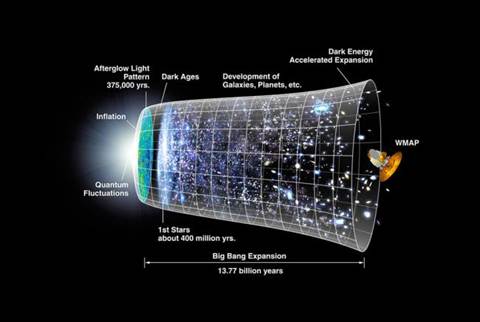
- Driver of Cosmic Acceleration: Dark energy acts like a repulsive force on cosmic scales, working against gravity. This causes galaxies to move away from each other faster over time, leading to the accelerated expansion of the universe.
- Relationship with Space: Dark energy shows that space is not empty, but a dynamic medium that can store energy. Unlike matter or radiation, its energy density does not decrease as the universe expands, making dark energy more dominant over time.
- Influence of Different Energy Forms: The universe’s expansion history depends on which form of energy dominates at a given period:
- Radiation: Dominated the early universe, driving rapid expansion.
- Matter: Slowed expansion due to gravitational attraction.
- Dark Energy: Currently drives accelerated expansion.
Each form of energy affects the geometry and evolution of spacetime differently.
- Dominance in the Cosmic Energy Budget: Dark energy makes up about 68% of the universe’s total energy. Its interaction with dark matter (27%) and ordinary matter (5%) governs the large-scale structure, stability, and evolution of the cosmos.
- Impact on the Universe’s Fate: The strength and behavior of dark energy are critical in determining the future of the universe:
- Very strong dark energy could push galaxies beyond what we can observe.
- Weakening or negative dark energy could slow expansion or even lead to cosmic contraction.
- Extreme Diluteness: Although it dominates the universe, dark energy is incredibly sparse locally, almost undetectable in small volumes. Yet, across vast cosmic distances, its cumulative effect is decisive in shaping the universe’s expansion.
Observational Evidence for Dark Energy
- Hubble’s Discovery (1920s): Edwin Hubble showed that galaxies are moving away from each other, proving that the universe is expanding.
- Type Ia Supernova Observations (1998): Astronomers observed distant Type Ia supernovae to be dimmer than expected, indicating that the universe’s expansion has accelerated over time.
- Nobel Prize in Physics (2011): Saul Perlmutter, Brian Schmidt, and Adam Riess were awarded for using Type Ia supernovae as standard candles to establish the accelerated expansion of the universe.
- Dark Energy in the ΛCDM Model:
- Λ (Lambda): Represents the cosmological constant, associated with dark energy.
- CDM (Cold Dark Matter): Explains the formation of galaxies and large-scale cosmic structures.
- The ΛCDM model assumes that dark energy density is constant over time, driving the accelerated expansion.
Role of Type Ia Supernovae
- Type Ia supernovae have nearly uniform intrinsic luminosity, allowing accurate distance measurement.
- Distance is calculated using apparent brightness, while expansion rate is inferred from redshift.
- Recent debates question whether supernova luminosity evolves with stellar age, potentially affecting precision.
Possible Theoretical Explanations of Dark Energy
Science has not yet confirmed exactly what dark energy is, but three main theories dominate:
1. Dark Energy as a Property of Space (Cosmological Constant)
- Albert Einstein’s General Relativity allows empty space to possess energy, represented by the cosmological constant (Λ).
- Since this energy is inherent to space, it does not weaken as space expands, leading to continuous acceleration.
- However, the origin and exact value of the cosmological constant remain unexplained.
2. Quantum Vacuum Energy
- According to quantum theory, empty space contains fleeting virtual particles that continuously appear and disappear.
- These fluctuations should contribute vacuum energy, but theoretical estimates vastly exceed observed values, creating a major unresolved discrepancy.
3. Dynamic Energy Field or Fifth Force (Quintessence)
- Some theories propose that dark energy arises from a dynamic field rather than a constant value.
- This evolving energy field, known as quintessence, could change in strength over cosmic time.
- While conceptually attractive, no direct observational evidence has yet confirmed its existence.
Scientific Status of Dark Energy
- Ongoing astronomical observations aim to determine whether dark energy is constant, evolves with time, or reflects new physics beyond existing theories.
- Modified Theory of Gravity: Some physicists argue that dark energy does not exist as a substance. Instead, they suggest that Einstein’s theory of gravity may be incomplete at cosmic scales and requires modification to explain why expansion is speeding up.
- Any alternative gravity theory must successfully explain all well-established gravitational phenomena, which remains a major challenge.
- Consequently, distinguishing between dark energy models and modified gravity theories requires more precise observational data and stronger theoretical validation.
Key Instruments Studying Dark Energy
1. Hubble Space Telescope (HST)
- Measures Type Ia supernovae to track cosmic expansion.
- Provides critical data on the accelerated expansion of the universe.
2. Dark Energy Spectroscopic Instrument (DESI), USA
- Conducts galaxy redshift surveys.
- Maps the large-scale structure of the universe to study dark energy’s effects on cosmic expansion.
3. Vera C. Rubin Observatory, Chile
- Observes billions of galaxies to map dark energy.
- Tracks changes in the universe’s expansion over time.
4. Nancy Grace Roman Space Telescope (NASA)
- Enables precision cosmology through deep-field surveys.
- Measures supernovae, galaxy clustering, and weak gravitational lensing to constrain dark energy models.
What is Dark Matter?
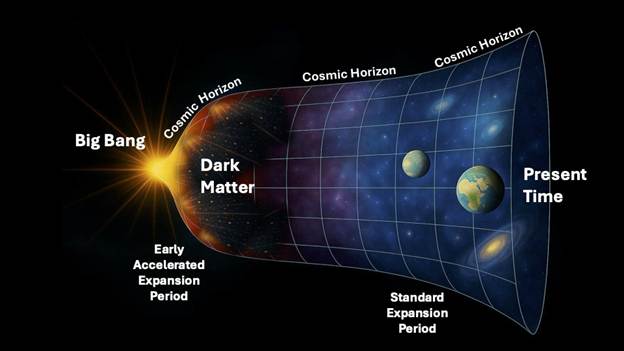
Dark matter is a theorized type of matter that neither emits nor interacts with light or any form of electromagnetic radiation, making it invisible to conventional detection methods. Its presence is inferred primarily through its gravitational influence on visible celestial objects.
Historical Background of Dark Matter
- In 1933, Swiss astronomer Fritz Zwicky observed the Coma galaxy cluster and found that the visible matter could not account for the gravitational binding of the cluster. The required mass was about 400 times larger than what was visible.
- In the 1970s, studies of galactic rotation curves showed that stars at the edges of galaxies move faster than expected from visible mass, suggesting the presence of a massive, invisible halo dominating the galaxies.
Characteristics of Dark Matter
Scientists have clarified what dark matter is not, which helps define its properties:
- Non-luminous: It does not emit, reflect, or absorb light and is not composed of ordinary celestial bodies such as stars or planets.
- Non-baryonic: It is not made of standard matter (protons, neutrons), as such matter would be detectable through its interaction with radiation.
- Not antimatter: Its presence does not produce gamma rays that would result from matter-antimatter annihilation.
- Not supermassive black holes: Large-scale black holes would create detectable gravitational lensing, which is not observed at the required scale.
- Not MACHOs (Massive Compact Halo Objects): Dark matter is not composed of brown dwarfs, neutron stars, or other dense baryonic objects.
Potential Constituents of Dark Matter
- Weakly Interacting Massive Particles (WIMPs): Hypothetical heavy subatomic particles that interact very weakly with ordinary matter.
- Neutrinos: Lightweight particles; unlikely to account for the majority of dark matter.
- Axions: Proposed to explain the lack of an electrical dipole moment in neutrons.
- Neutralinos: Hypothetical particles predicted by supersymmetry.
- Proportion in the Universe: Dark matter accounts for roughly 27% of the universe’s total energy-mass content, suggesting that WIMPs or similar exotic particles likely dominate.
Significance of Dark Matter
- Although invisible, dark matter is crucial for the formation and evolution of galaxies and cosmic structures.
- Its gravitational effects influence the motion of galaxies, clusters, and large-scale cosmic architecture.
- Current research and experiments focus on detecting WIMPs, axions, and neutralinos, though none have been directly observed to date.
Comparison: Dark Matter vs. Dark Energy
Although both constitute the majority of the universe’s content, dark matter and dark energy differ fundamentally in their nature, behavior, and cosmological role.
| Property | Dark Matter | Dark Energy |
| Composition | Hypothetical non-baryonic particles that do not interact with light | Hypothetical form of energy permeating all of space |
| Proportion in Universe | About 27% of total cosmic mass | About 68% of total cosmic mass |
| Distribution | Concentrated in halos around galaxies and galaxy clusters | Evenly distributed across space, uniform at large scales |
| Effect on Gravity | Exerts attractive gravitational pull, binding galaxies together | Exerts repulsive effect, accelerating the expansion of the universe |
| Observational Evidence | Detected through gravitational influence on stars, galaxies, and galaxy clusters | Inferred from cosmic acceleration, supernova observations, cosmic microwave background, and large-scale structure formation |
| Cosmic Role | Provides the gravitational framework for galaxy formation and structure growth | Drives accelerated expansion and affects the ultimate fate of the universe |
With reference to Dark Energy, consider the following statements:
1. Dark energy is responsible for the accelerated expansion of the universe.
2. Its energy density decreases as the universe expands.
3. Dark energy exerts a repulsive force that counteracts the gravitational attraction of matter.

Which of the statements given above is/are correct?
(a) 1 and 3 only
(b) 2 and 3 only
(c) 1 and 2 only
(d) All of the above

Answer: (a) 1 and 3 only

Explanation:
Statement 1 is correct: Observations of Type Ia supernovae, cosmic microwave background, and large-scale structure indicate that dark energy drives the accelerated expansion of the universe.
Statement 2 is incorrect: Unlike matter or radiation, dark energy’s density remains nearly constant over cosmic time in the standard ΛCDM model.
Statement 3 is correct: Dark energy exerts a repulsive effect, opposing the gravitational pull of matter, and is responsible for the accelerated cosmic expansion.