
Why in the News?
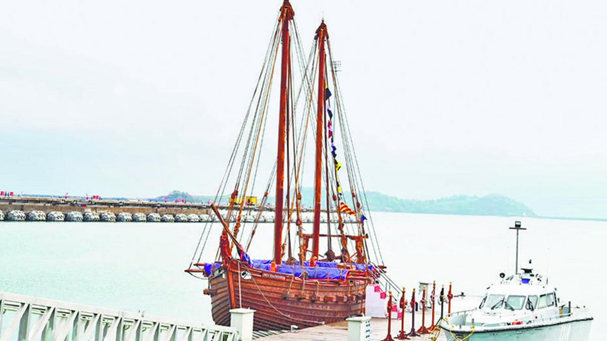
- On December 29, 2025, the Indian Naval Sailing Vessel (INSV) Kaundinya embarked on its historic maiden overseas voyage from Porbandar, Gujarat, to Muscat, Oman.
- This expedition is a landmark effort to rediscover and celebrate India’s ancient maritime heritage.
- The project is a unique collaboration under a tripartite agreement involving the Ministry of Culture, the Indian Navy, and Hodi Innovations, aimed at reviving indigenous knowledge systems and traditional craftsmanship.
What is INSV Kaundinya?
INSV Kaundinya is a pioneering stitched sailing vessel built entirely using traditional Indian shipbuilding techniques that date back over two millennia.
- Historical Inspiration: The vessel’s design is modeled after a 5th-century CE merchant ship depicted in the murals of the Ajanta Caves (specifically Cave 17). It also draws from ancient texts like the Yuktikalpataru (attributed to King Bhoja, 11th century CE).
- Engineering Marvel: Unlike modern ships, it is an engineless vessel that relies purely on wind and sails. It uses no metal nails or fasteners, representing a “living experiment” in ancient naval architecture.
- Cultural Symbols: The ship incorporates several motifs of civilisational significance:
- Gandabherunda: A mythical two-headed eagle, the royal symbol of the Kadamba dynasty (and later the Vijayanagara and Wodeyar dynasties).
- Simha Yali: A mythical lion-like creature sculpted on the bow.
- Harappan-style Stone Anchor: A functional replica of anchors used during the Indus Valley Civilization.
- Sun Motifs: Adorning the cotton sails, representing energy and cosmic order.
The Tankai Method: Ancient Shipbuilding Technology
The construction of INSV Kaundinya utilized the Tankai Method, a 2,000-year-old indigenous shipbuilding practice once prevalent across the Indian Ocean littoral.
- Stitched Plank Technique: Wooden planks (Teak and Sal) are painstakingly stitched together using coconut coir rope instead of metal nails.
- Natural Sealants: The seams are made watertight using a mixture of natural resins, cotton fibre, and fish oil.
- Structural Flexibility: In the Tankai method, the hull is built first, and the ribs are added later. This provides the ship with immense flexibility, allowing it to absorb wave energy and navigate shallow shoals without sustaining the rigid damage common in metal-fixed hulls.
- Durability: The absence of metal prevents corrosion in saline environments, traditionally making these ships easier to maintain for long-distance oceanic travel.
Legendary Mariner: Who was Kaundinya?
The vessel is named after Kaundinya I, a legendary Indian mariner and merchant believed to have sailed from India to the Mekong Delta around the 1st century CE.
- Historical Impact: According to Southeast Asian and Chinese chronicles, Kaundinya married the local warrior Queen Soma and co-founded the Kingdom of Funan (in modern-day Cambodia and Vietnam).
- Cultural Bridge: This union marked the beginning of “Indianised” states in Southeast Asia. The Khmer and Cham dynasties trace their origins to this legendary figure.
- Significance: He represents the earliest documented Indian mariner to have established profound global, cultural, and political ties through maritime enterprise.
Significance of the Voyage
- Maritime Diplomacy: The voyage to Oman (Muscat) strengthens bilateral ties by celebrating shared maritime history between the western coast of India and the Arabian Peninsula.
- Indigenous Knowledge Systems (IKS): The project revives the fading skills of traditional shipwrights, particularly those from Kerala (led by master shipwright Babu Sankaran).
- Naval Architecture Validation: The Indian Navy oversaw the technical validation, using hydrodynamic testing (with support from IIT Madras) to ensure a 5th-century design could safely navigate modern open oceans.
Soft Power Projection: It positions India as a historically rooted maritime power, showcasing civilizational continuity in the Indian Ocean Region (IOR).
With reference to INSV Kaundinya, consider the following statements:
1. INSV Kaundinya’s design is based on a 5th-century CE ship depicted in the Ajanta Caves murals.
2. The vessel uses modern metal fasteners along with traditional stitching techniques for durability.
3. The voyage of INSV Kaundinya to Oman represents India’s efforts in maritime diplomacy and revival of indigenous shipbuilding techniques.

Which of the statements given above is/are correct?
(a) 1 and 2 only
(b) 1 and 3 only
(c) 2 and 3 only
(d) All of the above

Answer: (b) 1 and 3 only
Explanation:
Statement 1 is correct: The vessel’s design is inspired by 5th-century CE Ajanta murals and ancient texts like Yuktikalpataru.
Statement 2 is incorrect: The ship is constructed without metal fasteners, relying on stitched teak and sal wood planks sealed with coir, resin, and cotton.
Statement 3 is correct: The Oman voyage strengthens maritime diplomacy, revives indigenous knowledge systems, and showcases India’s maritime heritage.