
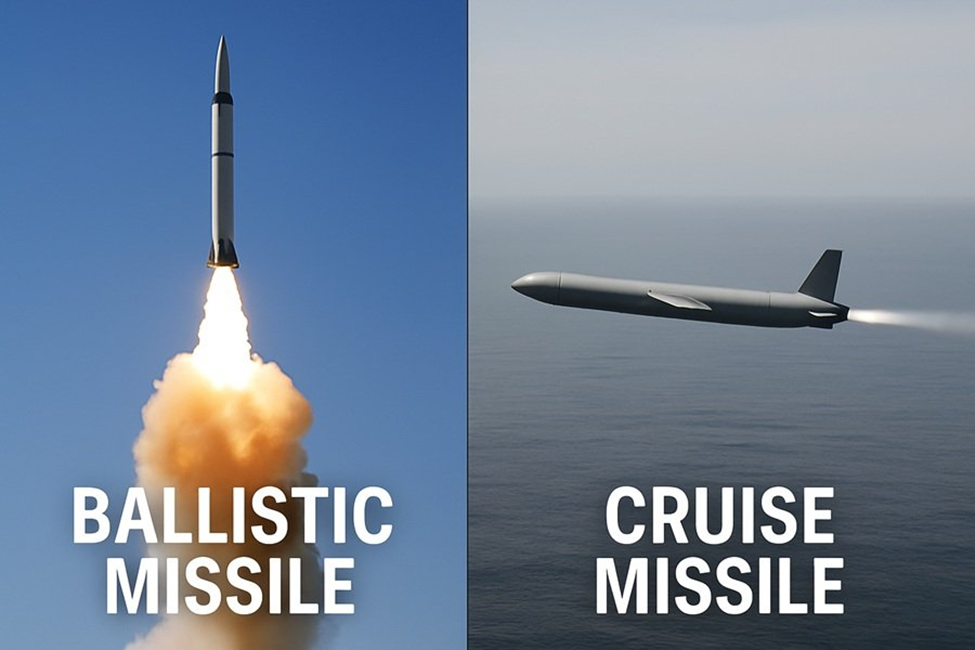
Why in the News?
- North Korean leader Kim Jong Un recently oversaw a long-range strategic cruise missile launching drill recently, highlighting the country’s ongoing military advancements.
- The drill was part of a series of military demonstrations aimed at strengthening North Korea’s nuclear deterrent capabilities ahead of the 2026 party congress.
- The launch involved missiles flying above the sea west of the Korean Peninsula, successfully hitting designated targets.
What is a Missile?
A missile is a guided airborne weapon capable of self-propelled flight, typically powered by a rocket motor or jet engine, designed to deliver a warhead to a target with precision. Missiles consist of five key components:
- Guidance system – Ensures accurate trajectory control.
- Targeting system – Identifies and locks onto the intended target.
- Flight system – Maintains stability and trajectory during flight.
- Engine – Propels the missile to the target.
- Warhead – The destructive payload carried by the missile.
Key Features of India’s Missile Systems
India’s missile programs emphasize indigenous technology, rapid deployment, high accuracy, and lethality:
- High Accuracy: Indian missiles employ advanced guidance mechanisms, including inertial navigation systems, satellite navigation, radar, and optical seekers, enabling precise strikes with minimal collateral damage.
- Example: Agni-V and BrahMos consistently achieve high precision in target engagement.
- Quick Deployment: Solid-fuel propulsion allows rapid reaction times. Missiles can be launched within minutes from special Transport-Erector-Launcher (TEL) vehicles, enhancing operational flexibility.
- High Lethality: Powerful propulsion systems allow missiles to carry heavy warheads over extended ranges, inflicting significant damage.
- Example: The BrahMos supersonic cruise missile is among the fastest and most lethal in its category globally.
Classification of Missiles
Missiles are classified based on speed and trajectory, which determine their operational role, range, and strategic significance, as follows:
1. Classification Based on Speed
- Subsonic Missiles (Mach < 1): These missiles travel slower than the speed of sound. They are suitable for precision strikes at shorter ranges and are often stealthy due to low-altitude flight.
- Examples: Indian Prithvi, U.S. Harpoon.
- Supersonic Missiles (Mach 1–5): Missiles in this category travel faster than sound but below Mach 5, combining speed with accuracy, making them harder to intercept.
- Examples: Indian BrahMos, Russian Iskander.
- Hypersonic Missiles (Mach > 5): These missiles travel at more than five times the speed of sound. Their high velocity and maneuverability make interception extremely difficult, even by modern defence systems.
- Examples: Indian Shaurya, Russian Avangard, China’s DF-ZF.
2. Classification Based on Trajectory
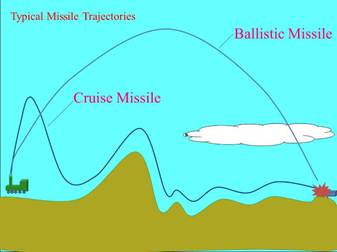
- Ballistic Missiles: Ballistic missiles are propelled only briefly after launch and then follow a ballistic trajectory determined by gravity and initial velocity.
- Can carry nuclear or conventional warheads.
- Long-range ballistic missiles, such as Intercontinental Ballistic Missiles (ICBMs), exit the Earth’s atmosphere before re-entering.
- Examples: India’s Agni series, Prithvi.
- Hypersonic Glide Vehicles (HGVs): HGVs achieve hypersonic speeds during atmospheric re-entry, allowing them to maneuver unpredictably and evade missile defence systems.
- Examples: China’s DF-17, Russia’s Avangard.
- Cruise Missiles: Cruise missiles are self-propelled and guided, flying within the Earth’s atmosphere along a low-altitude, nearly constant trajectory.
- Designed for precision strikes over long distances.
- Can carry conventional warheads and are difficult to detect at low altitudes.
Ballistic Missile (BM)
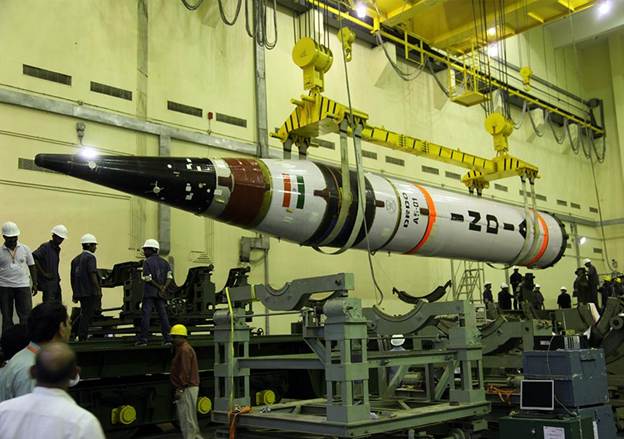
- A ballistic missile is a weapon that follows a ballistic trajectory to deliver one or more warheads to a predetermined target.
- After the initial launch, it relies mostly on gravity and initial velocity; active propulsion is only used during the early phase of flight.
- Its trajectory is influenced by factors like gravity, air resistance, and the Earth’s rotation (Coriolis force).
- Range and flight profile:
- Shorter-range ballistic missiles remain within the Earth’s atmosphere.
- Long-range intercontinental ballistic missiles (ICBMs) follow a sub-orbital flight path, spending most of their trajectory outside the atmosphere.
Types of Ballistic Missiles (Based on Range):
- Short-Range Ballistic Missile (SRBM): 300–1,000 km
- Medium-Range Ballistic Missile (MRBM): 1,000–3,500 km
- Intermediate/Long-Range Ballistic Missile (IRBM/LRBM): 3,500–5,500 km
- Intercontinental Ballistic Missile (ICBM): 5,500 km and above
Examples: Indian Prithvi I & II, Agni I & II, Dhanush
Cruise Missile (CM)
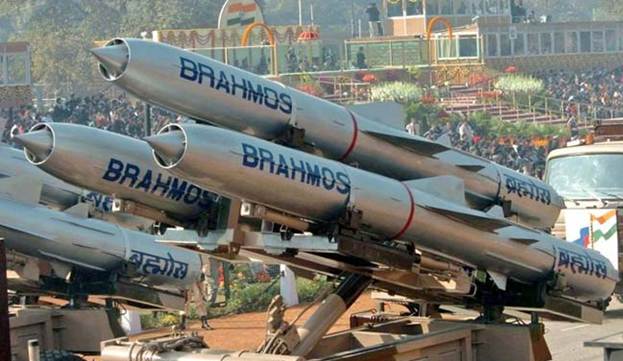
- A cruise missile is a guided missile that remains within the Earth’s atmosphere throughout its flight.
- It is self-propelled for the entire trajectory and maintains constant speed and altitude.
- Cruise missiles are designed for high-precision strikes over long distances and can fly very low, making them difficult to detect.
Types of Cruise Missiles by Speed:
- Subsonic Cruise Missiles (Mach < 1): Travel slower than sound, ideal for long-range precision strikes.
- Examples: Indian Nirbhay, U.S. Tomahawk.
- Supersonic Cruise Missiles (Mach 1–3): Travel faster than sound, reducing reaction time for targets.
- Example: Indian BrahMos.
- Hypersonic Cruise Missiles (Mach > 5): Extremely fast missiles capable of rapid, high-precision strikes over long distances.
- Examples: Russian 3M22 Zircon, Indian BrahMos-II.
India’s Missile Programs
India has developed a range of missile systems to strengthen conventional military readiness and nuclear deterrence.
| Missile Program | Launch | Objectives | Key Missiles |
| Integrated Guided Missile Development Program (IGMDP) | 1983 – Completed 2008 | – Establish indigenous missile capabilities – Develop a comprehensive missile arsenal for defense | Prithvi (SRBM), Agni (IRBM & MRBM), Akash (SAM), Trishul (SAM), Nag (ATGM) |
| BrahMos Aerospace (India-Russia JV) | 1998 | – Develop supersonic cruise missile – Precision strike capability on land, sea, and air | BrahMos supersonic cruise missile |
| Indian Ballistic Missile Defence (BMD) Programme | 1999 | – Two-tiered missile defence (endo & exo-atmospheric) – Protect against ballistic missile attacks | Prithvi Air Defence (PAD) / Pradyumna, Advanced Air Defence (AAD) / Ashwin |
| Independent Missile Projects (Post-IGMDP) | 2008 onwards | – Expand and modernize missile arsenal – Develop advanced systems including hypersonic and submarine-launched missiles | Agni series, K-series (submarine-launched), Hypersonic Technology Demonstrator Vehicle (HSTDV) |
Comparison: Ballistic vs. Cruise Missiles
Understanding the difference between ballistic missiles and cruise missiles is crucial for interpreting news related to missile tests and for understanding India’s missile defence systems.
| Features | Ballistic Missile | Cruise Missile |
| Propulsion | Propelled only during the initial launch phase; coasts for the remainder of the flight. | Continuously self-propelled throughout its flight. |
| Engine Type | Uses rocket engines. | Uses jet engines. |
| Flight Path | Follows a high-arching trajectory; long-range missiles exit the atmosphere and re-enter. | Flies entirely within the atmosphere along a relatively straight, level path. |
| Accuracy | Relatively lower accuracy since it is unguided for most of its trajectory; influenced by gravity, air resistance, and Coriolis effect. | Highly accurate due to constant propulsion and guidance systems. |
| Range | Very long-range capability (approx. 300 km to 12,000 km), as propulsion is only required initially. | Limited range (usually below 500 km) as it relies on continuous propulsion. |
| Payload | Can carry heavy payloads and multiple warheads, including Multiple Independently Targetable Re-entry Vehicles (MIRVs). | Payload is generally lighter and limited to a single warhead. |
| Warhead Type | Primarily designed to carry nuclear warheads. | Primarily designed for conventional warheads. |
| Examples | Prithvi I & II, Agni I–IV, Dhanush | BrahMos, Nirbhay |
Integrated Guided Missile Development Programme (IGMDP)
- Objective: Conceived by Dr. A.P.J. Abdul Kalam in 1983 to make India self-reliant in missile technology, particularly after restrictions imposed by the Missile Technology Control Regime (MTCR).
- MTCR Context: Missile Technology Control Regime (MTCR), established in 1987 by Canada, France, Germany, Italy, Japan, the United Kingdom, and the United States, aims to prevent the proliferation of missiles and unmanned delivery systems capable of carrying Weapons of Mass Destruction (WMDs).
- Criteria: payload ≥ 500 kg and range ≥ 300 km. It is a voluntary and non-binding regime.
- Implementation: IGMDP created a consortium of DRDO laboratories, industries, and academic institutions to develop indigenous missile subsystems, components, and materials.
- Duration: 1983 – March 2012
- Missiles Developed Under IGMDP:
- Prithvi: Short-range surface-to-surface ballistic missile (SRBM).
- Agni: Intermediate-range surface-to-surface ballistic missile (IRBM); later separated from IGMDP due to strategic importance.
- Trishul: Short-range low-level surface-to-air missile (SAM).
- Akash: Medium-range surface-to-air missile (MR-SAM).
- Nag: Third-generation anti-tank guided missile (ATGM).
Which of the following correctly distinguishes ballistic missiles from cruise missiles?
(a) Ballistic missiles are self-propelled throughout their flight, while cruise missiles are propelled only during launch.
(b) Ballistic missiles can carry Multiple Independently Targetable Re-entry Vehicles (MIRVs) and may exit the atmosphere; cruise missiles are self-propelled within the atmosphere and usually carry a single warhead.
(c) Cruise missiles follow a ballistic trajectory determined by gravity, while ballistic missiles maintain constant speed and altitude.
(d) Both ballistic and cruise missiles fly entirely within the atmosphere and have similar precision and payload.

Answer: (b)

Explanation:
Option (a) – Incorrect: Ballistic missiles are propelled only briefly at launch, while cruise missiles are self-propelled throughout their flight, so this statement reverses their characteristics.
Option (b) – Correct: Ballistic missiles can carry MIRVs and may exit the atmosphere, whereas cruise missiles are self-propelled within the atmosphere and usually carry a single warhead.
Option (c) – Incorrect: Cruise missiles do not follow a ballistic trajectory, and ballistic missiles do not maintain constant speed and altitude, making this statement wrong.
Option (d) – Incorrect: Ballistic missiles may leave the atmosphere and carry heavy/multiple warheads, unlike cruise missiles, so they do not have similar flight paths, precision, or payloads.