
After Reading This Article You Can Solve This UPSC Mains Model Question:
“Climate-Resilient Agriculture is not merely an environmental necessity but a developmental imperative for India.”Critically examine. (GS-3, Agriculture).
Introduction:
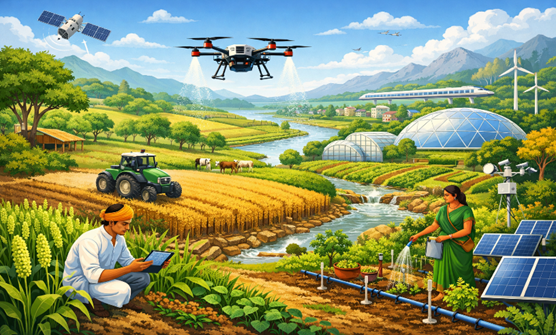
CRA (also described as Climate-Smart or Climate-Resilient Agriculture) is an integrated approach of practices, technologies, policies and institutions that enable agricultural systems to anticipate, absorb, adapt to and recover from climate-related shocks and stresses while sustaining productivity, incomes and food security. It combines adaptation, risk-management and mitigation where feasible.
Why India Needs CRA:
1. Extreme Weather as the “New Normal”
Recent data from the Centre for Science and Environment (CSE) 2025-26 report reveals that India experienced extreme weather events on nearly 99% of days in 2025.
- Heatwaves in Winter: The traditional Rabi (winter) season is shrinking. Early heatwaves now frequently threaten the “grain-filling” stage of wheat, potentially reducing yields by 5–20%.
- Monsoon Volatility: While the total volume of rain might remain stable, it is now delivered in “bursts.” Short, intense spells cause flash floods (e.g., in Punjab and Gujarat), while long dry spells in between cause agricultural drought.
2. Vulnerability of Rainfed Areas
- Rainfed Dependency: Approx. 51% of India’s net sown area is rainfed. This land accounts for 40% of total food production and supports the majority of India’s pulses, oilseeds, and nutri-cereals (millets).
- Marginalized Farmers: Over 85% of Indian farmers are small and marginal (owning <2 hectares). Unlike large-scale farmers, they lack the capital to recover from a single lost season, leading to a cycle of debt and migration.
3. Looming Economic & Food Security Crisis
- GDP Impact: The World Bank warns that climate-induced productivity losses could shave off up to 5% of India’s GDP by 2030.
- Nutritional Insecurity: Higher CO2 levels are paradoxically making our food less nutritious. Research indicates a decline in protein, iron, and zinc concentrations in staples like rice and wheat, exacerbating India’s “hidden hunger” or micronutrient deficiency.
- Trade Stability: To protect domestic supply, India has frequently resorted to export bans (e.g., on non-basmati rice and onions). CRA is needed to ensure a surplus that maintains India’s status as a reliable global “breadbasket.”
4. Resource Exhaustion (The Water-Energy-Food Nexus)
- Groundwater Crisis: Traditional farming of water-guzzling crops (like sugarcane and rice) in semi-arid zones has led to a massive drop in water tables. In the Indo-Gangetic Plain, aquifers are falling by ~4 cm per year.
- Soil Fatigue: Decades of monoculture and chemical-heavy farming have depleted soil organic carbon (SOC). CRA practices like Direct Seeded Rice (DSR) and Zero Tillage are essential to restore soil health and moisture retention.
5. Strategic Autonomy & “BioE3” Policy
CRA is central to India’s BioE3 (Economy, Environment, and Employment) Policy. By adopting genome-edited crops and bio-fertilizers, India can:
- Reduce reliance on imported chemical fertilizers (saving foreign exchange).
- Meet its Net-Zero 2070 commitments by turning farms into “carbon sinks” through agroforestry and DAC-assisted sequestration.
India’s Current Status & Trends:
1. Macro-Economic Status
- GDP Contribution: Agriculture contributes approximately 18–20% to India’s GDP.
- Employment: Despite rapid urbanization, the sector remains the largest employer, supporting over 44–45% of the total workforce.
- Real GVA Growth: The sector has maintained a steady momentum with an estimated growth rate of 2.1–3% in recent years, despite global volatility.
- Budgetary Push: The Union Budget 2025-26 allocated over ₹2.1 lakh crore to the Ministry of Agriculture, a 12% increase aimed specifically at “Digital Public Infrastructure” and “Climate Resilient Research.”
2. Emerging Trends & Shifts
A. The “Digital Stack” Revolution
The “Agri Stack” has transitioned from a vision to a utility. By early 2026, over 70 million digital Farmer IDs have been issued.
- Precision Agriculture: Integration of AI and IoT is no longer a pilot project. Farmers are seeing up to 20% reduction in input costs through satellite-based soil health monitoring.
- Drone Adoption: The market for agri-drones is projected to surpass $600 million in 2026, driven by government subsidies (Drone Didi scheme) for precision spraying.
B. Transition to Natural & Regenerative Farming
There is a decisive shift toward Natural Farming (NMNF) to combat soil fatigue.
- Organic Leadership: States like Sikkim and Uttarakhand have achieved near-total organic status, while Rajasthan and Maharashtra are rapidly scaling up through the Paramparagat Krishi Vikas Yojana (PKVY).
- Bio-Inputs: The 2021 Fertilizer Control Amendment now fully integrates bio-stimulants, reducing the heavy reliance on imported urea and DAP.
C. Diversification and Allied Sectors
- Horticulture over Cereals: For the first time, the acreage for horticulture (fruits/vegetables) is outperforming traditional Rabi crops in growth terms, driven by health-conscious consumer demand and higher export margins.
- The “Livestock Buffer”: Animal husbandry and dairying now account for nearly 30% of average farmer income, acting as a crucial safety net against crop failure.
3. Strategic “Self-Reliance” (Atmanirbharta)
- Pulse Mission: A 6-year mission launched in 2025 aims to make India completely self-reliant in pulses by 2030.
- Oilseeds: Through the National Mission on Oilseeds, India is targeting a production increase from 39 million tonnes to nearly 70 million tonnes by 2031 to cut the massive edible oil import bill.
Key Government initiatives:
1. Mission Mausam (Phase I: 2024–2026)
- Panchayat-Level Forecasting: Moving from 12-km resolution to a highly localized 5–6 km resolution, providing village-specific alerts.
- Nowcasting: Increasing the frequency of weather updates from every 3 hours to every hour.
- Weather Intervention: Researching technologies like Cloud Seeding and Hail Suppression to actively manage local weather risks.
- Infrastructure: Deploying 50 new Doppler Weather Radars (DWRs) and 100+ disdrometers to ensure “no weather system goes undetected.”
2. National Mission on Natural Farming (NMNF)
- Target: Transitioning 1 crore farmers to natural farming across 7.5 lakh hectares.
- Bio-Input Resource Centres (BRCs): Setting up 10,000 centres to provide farmers with local, chemical-free alternatives (like Jeevamrut).
- Incentives: Providing an output-based incentive of ₹4,000 per acre to support farmers during the transition phase.
3. PM Fasal Bima Yojana (PMFBY)
- New Covers: For the first time, it includes losses from Wild Animal Attacks and has reintroduced Paddy Inundation (flooding) as a localized risk.
- YES-TECH: Using satellite remote sensing for Yield Estimation System based on Technology to ensure faster, dispute-free claim settlements.
- FIAT Fund: A dedicated Fund for Innovation and Technology (₹824 Cr) to upgrade insurance tech.
4. BioE3 Policy (Economy, Environment, and Employment)
- Biotechnology Focus: Promoting high-yield, climate-resilient, and bio-fortified seeds (rich in zinc and iron).
- Carbon Sequestration: Encouraging “Carbon Farming” where farmers earn through the Carbon Credit Trading Scheme (CCTS) by adopting regenerative practices.
5. Digital Public Infrastructure (Agri-Stack)
- Farmer ID (Kishan Identity): A unified digital ID for over 70 million farmers (as of 2026) to streamline the delivery of subsidies, soil health cards, and KCC credit.
- Clean Plant Programme (CPP): A ₹1,765 crore initiative to provide virus-free, high-quality planting material for the horticulture sector.
6. National Innovations in Climate Resilient Agriculture (NICRA)
- Flagship research and demonstration programme led by Indian Council of Agricultural Research (ICAR).
- Develops and tests drought-, flood-, heat- and salinity-tolerant crop varieties.
- Implements climate-resilient villages model, combining technology, weather advisories and capacity building.
7. Crop Diversification & Millet Promotion
- Shift away from water-intensive crops in stressed regions towards millets, pulses and oilseeds.
- Millets are climate-resilient (low water input, heat tolerant) and align with nutrition and sustainability goals.
Major challenges in scaling CRA in India:
1. The “Adoption Gap” among Smallholders
Over 85% of Indian farmers are small and marginal. For them, CRA is often perceived as a “high-risk” transition.
- Fear of Failure: Farmers operating on thin margins are reluctant to switch from chemical-intensive “assured” yields to biological or natural farming, fearing a temporary dip in production (yield gap).
- Knowledge Deficit: A survey indicated that while 90% of farmers are aware of climate change, only 10% have formal training in CRA techniques like zero-tillage or microbial soil enhancers.
2. Technological & Digital Barriers
- Digital Divide: Precision agriculture (using AI, drones, and sensors) requires stable internet and digital literacy. While the “Agri Stack” is growing, many remote, climate-vulnerable zones remain “analog.”
- Inconsistent Quality of Bio-inputs: The market for bio-fertilizers and bio-pesticides is plagued by quality inconsistencies, which erodes farmer trust in biological alternatives compared to standardized chemical fertilizers.
- Slow Seed Rollout: Although 1,900+ climate-resilient varieties exist, the seed replacement rate (SRR) is low. Farmers often continue using older, non-resilient seeds because the new varieties haven’t reached local primary cooperatives (PACS).
3. Resource & Infrastructure Constraints
- High Initial Capital: Technologies like solar-powered micro-irrigation or Direct Air Capture (DAC) for greenhouses have high upfront costs that are prohibitive without significant subsidies.
- Custom Hiring Centres (CHCs) Shortage: Implements for CRA (like Happy Seeders for zero-tillage) are expensive. Current CHCs are often under-equipped or unavailable during peak demand seasons (e.g., the short window between Paddy and Wheat).
- Institutional Fragmentation: As noted in the CEEW 2025 report, there is often an overlap or lack of coordination between different local bodies like KVKs (Krishi Vigyan Kendras), ATMAs (Agricultural Technology Management Agency), and the State Agriculture Departments.
4. Policy and Economic Misalignments
- Incentive Bias: Subsidies for electricity and chemical fertilizers often discourage water and soil conservation. Farmers are incentivized to grow “water-guzzling” crops like rice in water-stressed regions because of the assured Minimum Support Price (MSP).
- Climate Insurance Penetration: While the PM Fasal Bima Yojana (PMFBY) has improved, it currently covers only about 40% of farmers. Scaling this to 100%—including tenant farmers—remains a massive administrative hurdle.
Way forward:
1. Institutionalizing the “Lab-to-Land” Pipeline
- Expansion of NICRA: The National Innovations in Climate Resilient Agriculture (NICRA) should move beyond 151 clusters to cover all 310 “high-risk” districts identified by the ICAR.
- Revamping KVKs: Transforming Krishi Vigyan Kendras into Climate Innovation Hubs equipped with digital twins of local farms to simulate weather impacts before the sowing season.
2. Technological & Biological Leapfrogging
- Precision Biomanufacturing: Under the BioE3 Policy, India must scale the production of climate-specific microbial consortia (bio-stimulants) that help crops survive extreme heat and salinity.
- Genome Editing: Fast-tracking the deployment of non-GMO, CRISPR-edited varieties that are drought-tolerant, specifically for staples like rice and wheat.
- Digital Public Infrastructure (Agri-Stack): Leveraging the Unified Farmer ID to provide hyper-local, “Panchayat-level” weather advisories through AI-driven platforms like Bhashini (for vernacular accessibility).
3. Financial & Policy Re-alignment
- Green Subsidies: Gradually shifting from “Input Subsidies” (power, urea) to “Ecosystem Service Payments.” Farmers should be paid for sequestering carbon, improving soil organic matter, and conserving groundwater.
- Carbon Credit Integration: Creating a robust domestic market for agricultural carbon credits, allowing farmers to monetize practices like Direct Seeded Rice (DSR) and Zero Tillage.
- Income-Replacement Insurance: Expanding pilot schemes that provide immediate payouts to outdoor workers (especially women) during extreme heatwaves, ensuring they don’t have to choose between health and livelihood.
4. Resource Circularity & Infrastructure
- Water Management: Scaling “Per Drop More Crop” by making micro-irrigation mandatory for water-guzzling crops like sugarcane in semi-arid zones.
- Decentralized Storage: Investing in solar-powered cold storage at the village level to reduce post-harvest losses, which often spike during unseasonal rains.
Conclusion:
In the vision of Viksit Bharat @2047, Climate-Resilient Agriculture must evolve from a survival strategy into a technology-enabled, climate-secure and farmer-centric growth model—ensuring prosperity, sustainability and global leadership for Indian agriculture.