
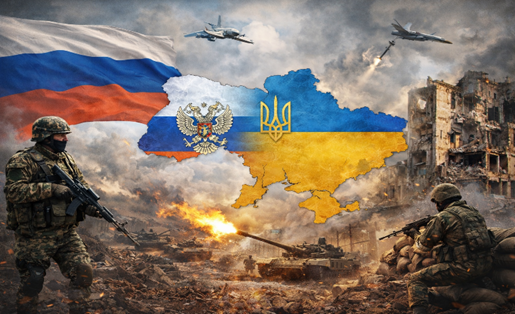
After Reading This Article You Can Solve This UPSC Mains Model Question
“The Russia–Ukraine conflict marks a decisive shift from a rules-based international order to power-based geopolitics.” Discuss the causes, impacts, and implications for global governance. (GS-2, International Relations)
Context:
Russia’s allegation that Ukraine launched a massive drone attack on President Vladimir Putin’s country residence in the Novgorod region marks a deeply concerning moment in the nearly four-year-long war
Current status of Russia-Ukraine Conflict:
1. Battlefield Status: Russian Momentum
- Highest Gains Since 2022: In 2025, Russia captured approximately 5,600 sq km of Ukrainian territory. This represents nearly 1% of the country and is more than the gains of 2023 and 2024 combined.
- Current Frontlines: Russian forces are pressing advantages in the Donbas (specifically around the Pokrovsk-Siversk axis) and have recently advanced in western Zaporizhzhia.
- Casualties: Estimates suggest total Russian combat losses have surpassed 1.2 million personnel since the invasion began in February 2022, highlighting the high human cost of these territorial gains.
2. Diplomatic Push: The “90% Peace Deal”
- US-Brokered Negotiations: President Zelenskyy recently announced that a peace deal—facilitated by the US (Trump administration)—is “90% ready.”
- The 10% Deadlock: The remaining hurdles are primarily centered on territorial sovereignty and long-term security guarantees. While Zelenskyy seeks a 50-year security commitment, the US proposal reportedly suggests a 15-year period.
- Coalition of the Willing: A major summit is scheduled to take place in Paris (January 5–6, 2026) involving leaders from the EU, NATO, and Canada to finalize a post-war security architecture for Ukraine.
3. Political Overhaul in Kyiv
- New Leadership: In a significant move, Zelenskyy appointed Kyrylo Budanov (the former military intelligence chief) as his new top aide on January 2, 2026. This follows the resignation of the previous chief of staff, Andriy Yermak, amid a corruption probe.
- Defense Ministry Shift: Zelenskyy has also signaled a move to replace the Defense Minister with Mykhailo Fedorov, the current Digital Transformation Minister, to prioritize drone technology and electronic warfare.
4. India’s Evolving Role
- The “Peace Mediator”: Prime Minister Modi has explicitly stated, “India is not neutral; India is on the side of peace.” Following Putin’s visit to New Delhi in December 2025, there are reports that President Zelenskyy may visit India January 2026) for a crucial summit.
- Strategic Autonomy: India continues to balance its relationship by importing Russian oil (crucial for domestic inflation control) while participating in Western-led peace discussions.
Origin & causes:
1. Historical Roots
- Soviet legacy: Ukraine was part of the USSR until 1991. After independence, it remained economically, culturally and strategically intertwined with Russia.
- Crimea & Black Sea: Crimea (with Russia’s Black Sea Fleet base at Sevastopol) has deep strategic and historical importance for Russia.
- Identity divide: Western Ukraine leaned toward Europe; eastern and southern regions had stronger linguistic and cultural links with Russia.
2. NATO Expansion & Security Dilemma
- Since the 1990s, NATO expanded eastwards (Poland, Baltics, etc.).
- Russia perceived this as encirclement and a violation of informal post–Cold War understandings.
- Ukraine’s aspiration to join NATO was seen by Russia as a red line, threatening its strategic depth.
3. Political Trigger: Euromaidan (2013–14)
- Pro-EU protests erupted after Ukraine’s President Viktor Yanukovych suspended an EU association deal.
- Yanukovych fled; a pro-Western government came to power.
- Russia viewed this as a Western-backed regime change on its doorstep.
4. Annexation of Crimea (2014)
- Russia annexed Crimea after a disputed referendum.
- This violated Ukraine’s sovereignty and the Budapest Memorandum (1994), under which Ukraine gave up nuclear weapons in return for security assurances.
- Western sanctions began; trust collapsed.
5. Donbas Conflict & Frozen War (2014–2021)
- Pro-Russian separatists, backed by Russia, took control in Donetsk and Luhansk (Donbas).
- Minsk I & II agreements failed to bring lasting peace.
- Ukraine’s military ties with NATO deepened; Russia increased troop presence near Ukraine.
6. Immediate Causes of 2022 Invasion
- Russia demanded:
- No NATO membership for Ukraine
- Rollback of NATO forces in Eastern Europe
- Talks failed; Russia launched a full-scale invasion on 24 Feb 2022, citing:
- Protection of Russian speakers
- “Denazification” and “demilitarisation” of Ukraine
- Preventing Ukraine’s Western integration
7. Broader Structural Causes
- Power transition: Russia resisting decline in a US-led order
- Great power rivalry: Russia vs West (US-EU-NATO bloc)
- Energy geopolitics: Ukraine as a transit route for Russian gas to Europe
- Normative clash: Sovereignty vs spheres of influence
Major Phases of the Russia–Ukraine Conflict:
Phase I: Post-Soviet Transition & Strategic Drift (1991–2013)
- Ukraine emerges as an independent state after the USSR’s collapse.
- Strategic oscillation between Europe and Russia; internal political divisions deepen.
- Ukraine gives up nuclear weapons under the Budapest Memorandum (1994) in exchange for security assurances.
Phase II: Euromaidan, Crimea & Donbas Conflict (2014–2021)
- Euromaidan protests lead to a pro-Western government in Ukraine.
- Russia annexes Crimea (2014).
- Pro-Russian separatist war in Donetsk & Luhansk (Donbas).
- Minsk I & II Agreements fail; conflict becomes a “frozen war.”
Phase III: Full-Scale Invasion & High-Intensity War (Feb 2022 – mid 2022)
- Russia launches a multi-front invasion on 24 February 2022.
- Rapid thrusts toward Kyiv, Kharkiv, and southern Ukraine.
- Strong Ukrainian resistance with Western military and intelligence support.
Phase IV: Attrition, Counteroffensives & Territorial Contestation (Late 2022–2023)
- Ukraine conducts counteroffensives, reclaiming parts of Kharkiv and Kherson.
- Russia mobilises reservists; annexes four Ukrainian regions after contested referendums.
- War shifts to trench warfare, artillery duels, missile strikes on infrastructure.
Phase V: Protracted War & Globalised Conflict (2024–Present)
- Stalemated frontlines in eastern and southern Ukraine.
- Continued Western military aid; intensified sanctions on Russia.
- Growing fatigue in Europe, but no decisive diplomatic breakthrough.
IMPACT OF the Russia-Ukraine Conflict:
1. Geopolitical Impact: The New Cold War
- NATO and EU Expansion: The war revitalized NATO, leading to the historic accession of Finland and Sweden. It also accelerated Ukraine’s path toward EU membership, shifting the “center of gravity” of European security eastward.
- The Russia-China-Iran Axis: Western sanctions have pushed Russia into a tighter strategic embrace with China, Iran, and North Korea, creating a formidable “anti-Western” bloc.
- Erosion of Russian Hegemony: Russia’s preoccupation with Ukraine has weakened its influence in Central Asia and the South Caucasus (e.g., the collapse of the Assad regime in Syria and Azerbaijan’s gains in Nagorno-Karabakh).
- Return of Statecraft: Diplomacy has shifted from “soft power” to “hard security,” with nations worldwide increasing defense budgets and stockpiling munitions.
2. Economic Impact: Fragmentation & Inflation
- The “First Global Energy Crisis”: The decoupling of Europe from Russian gas led to record price volatility. While prices stabilized by 2026, the long-term impact is a permanent shift toward LNG (from the US/Qatar) and a massive acceleration in Renewable Energy.
- Food Insecurity: Known as the “Breadbasket of Europe,” the disruption of Ukrainian wheat and sunflower oil exports triggered double-digit inflation in low-income countries (e.g., Somalia, Egypt, Sudan).
- Supply Chain “Friend-shoring”: The war exposed the risks of over-dependence on single sources for critical materials like Palladium (47% from Russia), Neon gas (50% from Ukraine for chips), and Potash/Fertilizers.
3. Humanitarian & Social Impact
- Mass Displacement: By 2026, over 6.8 million refugees are recorded in Europe, and millions remain internally displaced within Ukraine. This is the largest displacement crisis in Europe since WWII.
- Hybrid Warfare: Sabotage of undersea cables in the Baltic Sea and cyberattacks on power grids have become “normalized” tools of conflict, affecting civilian life far from the front lines.
- Demographic Crisis: Both nations face long-term labor shortages and aging populations due to high casualties and “brain drain” (professionals fleeing Russia to avoid mobilization).
4. Specific Impact on India
- Strategic Autonomy (The “Middle Path”): India’s refusal to condemn Russia while providing humanitarian aid to Ukraine has defined its role as a “Vishwa Bandhu” (Global Friend). India has emerged as a potential mediator.
- Energy Security: India capitalized on discounted Russian crude, which now accounts for nearly 40% of its energy imports. This “lubricated” global markets by keeping prices lower than they would have been without Indian buying.
- Defense Indigenization: Delays in Russian equipment (like S-400 systems) and concerns over the performance of Russian hardware have given a massive boost to the Aatmanirbhar Bharat initiative and defense diversification (buying more from France, USA, and Israel).
- Economic Trade: Bilateral trade reached $65.7 billion in 2023-24, with a target of $100 billion by 2030.
Way Forward:
1. Immediate De-escalation Measures
- Ceasefire & humanitarian corridors to protect civilians, ensure aid delivery, and facilitate safe return of displaced persons.
- Expansion of neutral monitoring mechanisms under the United Nations to reduce civilian harm.
- Protection of nuclear facilities (e.g., Zaporizhzhia) to avoid catastrophic risks.
2. Reviving Diplomacy & Dialogue
- Restart structured negotiations involving Russia and Ukraine with credible mediators.
- Utilise Track-I and Track-II diplomacy (official + informal channels).
- Regional organisations like OSCE can play a role in confidence-building.
3. Security Architecture Reforms
- Re-examine European security arrangements to address mutual threat perceptions.
- Discussions on:
- Military transparency
- Arms control and confidence-building measures
- Prevent further escalation between NATO and Russia.
4. Legal Accountability & Norm Enforcement
- Independent investigations into alleged war crimes through international legal mechanisms.
- Upholding principles of:
- Sovereignty
- Territorial integrity
- Rule of law
- Strengthen international norms against aggression.
5. Economic Stabilisation & Reconstruction
- A comprehensive post-conflict reconstruction plan for Ukraine focusing on:
- Infrastructure
- Energy systems
- Housing & livelihoods
- International financial institutions and donor coordination essential.
- Avoid prolonged sanctions that harm global growth while ensuring accountability.
6. Addressing Global Spillovers
- Stabilise global food and energy markets through:
- Grain export mechanisms
- Energy diversification
- Prevent weaponisation of supply chains affecting developing countries.
7. Role of India
- India can:
- Act as a bridge-builder between Russia and the West
- Advocate peaceful resolution at multilateral forums
- Provide humanitarian and reconstruction support
- Continue policy of strategic autonomy, focusing on national interest and global stability.
Conclusion:
The Russia–Ukraine conflict highlights the need to redesign 21st-century global security around preventive diplomacy, inclusive security frameworks, and economic interdependence, rather than rigid military blocs. Sustainable peace requires technology-enabled diplomacy, revival of arms control regimes, and climate-resilient green reconstruction to curb energy weaponisation. In an era of intensifying geopolitical competition, emerging powers like India must promote strategic autonomy, multilateral reform, and a humanitarian-first approach to shape a resilient, multipolar, and cooperative world order.