
After Reading This Article You Can Solve This UPSC Mains Model Question:
Assess the global implications of the USA–Venezuela crisis in the context of a multipolar world order. (GS-2 International Relations)
Introduction
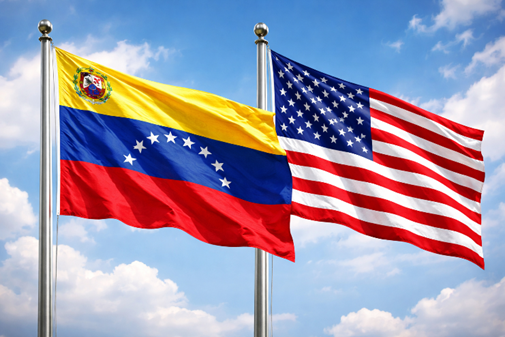
The crisis between the United States of America and Venezuela represents one of the most intense episodes of U.S. interventionism in Latin America in recent decades. It reached a critical point when Venezuelan President Nicolás Maduro was captured by U.S. forces and transferred to the United States to face criminal charges, triggering global debate on sovereignty, legality, and power politics.
Background: Roots of the Venezuelan Crisis:
1. Democratic Backsliding & Political Centralisation
- Rise of Chavismo led to over-centralisation of executive power.
- Weakening of separation of powers through politicisation of judiciary, election bodies, and armed forces.
- Under Nicolás Maduro, repeated disputed elections (2018, 2024) eroded domestic and international legitimacy.
- Suppression of opposition, curbs on media, and use of emergency powers entrenched authoritarian rule.
2. Economic Mismanagement
- Overdependence on oil (≈ 90% of export earnings) created a mono-product economy.
- Price controls, currency controls, and populist subsidies distorted markets.
- Resulted in GDP contraction of over 70% since 2013 and hyperinflation exceeding 1,000,000% (2018–19).
3. Governance Failure & Corruption
- Systemic corruption weakened state capacity and public trust.
- Allegations of criminalisation of state institutions, including links between political–military elites and narcotics trade.
4. Humanitarian Crisis & Social Breakdown
- Severe shortages of food, medicines, electricity, and healthcare.
- Collapse of public services and welfare delivery.
- Over 7.7 million Venezuelans migrated abroad, creating a regional refugee crisis.
5. External Pressures & Sanctions
- U.S.-led sanctions (post-2017) targeted oil exports, financial systems, and state institutions.
- While not the root cause, sanctions intensified economic distress.
6. Geopolitical Polarisation
- Venezuela aligned with Russia, China, Iran, and Cuba, increasing great-power rivalry.
- Crisis became embedded in global ideological and strategic competition.
7. Collapse of the Social Contract
- State failed to ensure economic security, political participation, and basic welfare.
- Political authority increasingly relied on coercion rather than consent.
Motives Behind U.S. Action:
1. Narcotics and Criminal Accountability Narrative
- U.S. agencies accused President Nicolás Maduro and senior Venezuelan officials of:
- Narco-terrorism
- Drug trafficking in collaboration with transnational cartels
- Using cocaine flows as a weapon against U.S. society
2. Regime Change and Democratic Legitimacy Concerns
- The U.S. has consistently refused to recognise Maduro’s presidency, citing:
- Disputed elections (2018, 2024)
- Suppression of opposition
- Democratic backsliding
3. Strategic and Energy Interests
- Venezuela possesses the world’s largest proven oil reserves (300+ billion barrels).
- Prolonged instability and sanctions:
- Prevent adversarial powers from monopolising Venezuelan energy assets
- Allow the U.S. to influence global oil supply chains
4. Containment of Rival Powers
- Venezuela has strong strategic ties with:
- Russia (military cooperation, energy)
- China (loans, infrastructure, oil-backed credit)
- Iran and Cuba (security and intelligence support)
- U.S. intervention aimed to curb the expansion of rival influence in the Western Hemisphere, traditionally considered its strategic backyard.
5. Monroe Doctrine and Regional Dominance
- The action reflects a revival of Monroe Doctrine thinking, emphasising:
- Regional dominance
- Intolerance of hostile regimes aligned with adversaries
- Signals U.S. resolve to maintain primacy in the Western Hemisphere.
Implications of the USA–Venezuela Crisis on the World:
1. Erosion of International Law and Sovereignty Norms
- The unilateral use of force by the United States of America inside Venezuela challenges:
- Article 2(4) of the UN Charter (prohibition on use of force)
- Principles of state sovereignty and non-intervention
- Sets a dangerous precedent where powerful states may bypass multilateral institutions and justify force under domestic laws.
- Weakens the authority of the United Nations, accelerating institutional erosion.
2. Normalisation of Unilateralism over Multilateralism
- The crisis reinforces a global trend where major powers increasingly:
- Act outside UN frameworks
- Prefer coercive diplomacy and military solutions
- This weakens collective security mechanisms and peaceful dispute resolution.
- Encourages self-help and militarisation, increasing global instability.
3. Intensification of Great Power Rivalry
- Russia and China condemned U.S. actions, portraying them as:
- Neo-imperialist
- Evidence of Western double standards
- Latin America re-emerges as a theatre of great-power competition.
- Pushes the world further towards fragmented multipolarity, not cooperative multipolarism.
4. Impact on Global Energy Markets
- Disruptions to production, exports, and shipping routes:
- Add volatility to global oil prices
- Affect inflation and balance of payments worldwide
5. Humanitarian and Migration Spillovers
- Political instability worsens Venezuela’s humanitarian crisis.
- Renewed migration pressures on Latin America and beyond.
6. Declining Credibility of Democracy Promotion
- While framed as promoting democracy, selective intervention:
- Undermines moral legitimacy of democracy promotion
- Fuels narratives of regime change for strategic gain
- Authoritarian regimes use this precedent to justify repression.
- Democracy becomes associated with external coercion rather than internal consent.
7. Impact on Global South and Middle Powers
- Many Global South states see the crisis as:
- Evidence of power asymmetry in global governance
- Reinforces demand for:
- Strategic autonomy
- Non-alignment 2.0
- Reform of global institutions
Regional and Global Reactions:
- Latin America: Several countries condemned the U.S. action as neo-imperialist, while a few tacitly welcomed the removal of Maduro, reflecting ideological divides within the region.
- Global powers: Russia and China criticised the U.S. move as illegal and destabilising, using it to reinforce narratives of Western unilateralism.
- Multilateral institutions: Both the United Nations and the Organization of American States called for restraint, dialogue, and humanitarian access.
Impact of the USA–Venezuela Crisis on India:
1. Energy Security and Economic Impact
India is the world’s third-largest crude oil importer, making it highly sensitive to global energy disruptions.
- Venezuela holds the largest proven oil reserves globally.
- Instability, sanctions, and production disruptions:
- Increase global oil price volatility
- Raise India’s import bill
- Worsen current account deficit
- Add to inflationary pressures, especially fuel and food inflation
2. Foreign Policy and Diplomatic Balancing
India maintains a comprehensive strategic partnership with the United States of America, but also adheres to principles of sovereignty and non-intervention.
- The crisis tests India’s ability to:
- Support rule-based international order
- Avoid endorsing unilateral military actions
- Preserve relations with Latin American countries
3. Implications for Multilateralism and Global Governance
- Unilateral actions weaken institutions like the United Nations.
- India, as a proponent of multilateralism and UNSC reform, is concerned about:
- Erosion of UN Charter principles
- Declining legitimacy of international institutions
4. Global South Solidarity and Normative Concerns
- Many Global South nations view the crisis as:
- Selective application of international law
- Continuation of power asymmetries in global governance
India’s leadership aspirations in the Global South require:
- Upholding sovereignty
- Opposing coercive unilateralism
- Advocating peaceful conflict resolution
5. Diaspora and Consular Implications
- Political instability raises risks for:
- Indian nationals
- Indian-owned businesses in Latin America
- India may need to:
- Enhance consular preparedness
- Coordinate evacuation plans if instability spreads
Way Forward:
A. Political Transition & Institutional Restoration
- Empowering Legitimate Leadership: Analysts suggest that the US should pivot from “running” the country to facilitating the transition to the 2024 election’s legitimate winner, Edmundo González Urrutia, and opposition leader María Corina Machado. This would provide the domestic legitimacy that the current interim arrangement lacks.
- Constitutional Reform: There is an urgent need to rebuild the Supreme Court (TSJ) and the National Electoral Council (CNE), which were hollowed out by Chavismo.
- National Reconciliation: A South African-style “Truth and Reconciliation Commission” may be necessary to address crimes against humanity while allowing lower-level officials to reintegrate into a democratic fold, preventing a power vacuum or civil war.
B. Economic & Energy Revitalization
- Global Investment (The $100 Billion Plan): Experts estimate that restoring Venezuela’s oil production from 1 million to 4 million barrels per day will require roughly $80–100 billion in investment over a decade.
- Dismantling “Dutch Disease”: The future government must diversify the economy to reduce 90%+ dependence on oil exports. Establishing a Sovereign Wealth Fund (modeled after Norway or UAE) would help insulate the economy from oil price volatility.
- Debt Restructuring: Venezuela carries over $150 billion in external debt. A comprehensive restructuring plan involving the IMF and World Bank is essential to regain access to global capital markets.
C. Diplomatic Maneuvering for India
- Strategic Autonomy: India should continue its “calibrated silence,” prioritizing the safety of its citizens and assets over ideological condemnations. This “Middle Path” allows India to engage with the eventual legitimate government without alienating the US.
- Asset Protection: India must negotiate with the US-backed transition team to ensure that ONGC Videsh’s (OVL) equity stakes in the San Cristóbal and Carabobo fields are protected and that the $600 million in stuck dividends are repatriated.
- Global South Leadership: As a leader of the Global South, India can advocate for “Sovereignty with Responsibility”, ensuring that while dictators are held accountable, the precedent of unilateral regime change does not become a standard tool for global powers.
Conclusion:
The USA–Venezuela crisis underscores the fragility of the international order when power politics override legal norms. While accountability for alleged crimes is essential, it cannot come at the cost of sovereignty, multilateralism, and human security. For the global community—and for India in particular—the episode highlights the urgent need to reinforce rule-based international governance and peaceful conflict resolution mechanisms.