
Why in the News
- Recently, the stability of the North Atlantic Treaty Organization (NATO) has come under intense global scrutiny following remarks by U.S. President Donald Trump regarding a potential takeover of Greenland, an autonomous territory of Denmark.
- Following a U.S. military operation in Venezuela, Danish Prime Minister Mette Frederiksen issued a stern warning that any unilateral U.S. action against a fellow member’s territory would signify the “end of NATO.”
Genesis and Evolution of NATO
- Founding and Purpose: Established on April 4, 1949, via the Washington Treaty (North Atlantic Treaty), NATO was designed to act as a collective deterrent against Soviet expansion in post-World War II Europe.
- Nature: NATO is an intergovernmental military alliance of 32 countries from Europe and North America.
- Core Principle (Article 5): The cornerstone of the alliance is Collective Defense. Article 5 stipulates that an “armed attack” against one member is considered an attack against all, requiring a unified response.
- Note: Historically, Article 5 has been invoked only once—following the 9/11 terrorist attacks on the United States.
- Headquarters: Located in Brussels, Belgium
Objectives of NATO
- Provide collective security against external threats.
- Maintain military readiness, modernization, and strategic planning among member states.
- Enable crisis management operations using coordinated military and diplomatic strategies.
- Strengthen partnerships with non-member countries to promote global security and stability.
- Serve as a transatlantic link connecting Europe and North America for cooperative defense and security initiatives.
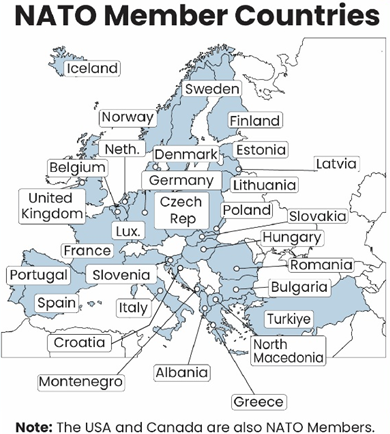
Membership and Expansion of NATO
As of 2026, NATO has expanded to 32 member countries, nearly triple its original 12 founding members.
- Founding Members (12): Belgium, Canada, Denmark, France, Iceland, Italy, Luxembourg, Netherlands, Norway, Portugal, United Kingdom, and the United States.
- Recent Accessions:
- Finland (2023): Joined as the 31st member, doubling NATO’s direct land border with Russia.
- Sweden (2024): Joined as the 32nd member, ending over 200 years of military neutrality and significantly bolstering security in the Baltic region.
- Aspirant Partners:Ukraine, Georgia, and Bosnia and Herzegovina have formally declared their aspirations to join the alliance.
- Ukraine formally applied for NATO membership in 2022 and received assurances of support at the Vilnius Summit in 2023.
- Open Door Policy (Article 10): NATO maintains an “Open Door Policy,” allowing any European state that can enhance the security of the North Atlantic area to apply for membership.
- EU-NATO Overlap: While many countries belong to both, EU members Austria, Cyprus, Ireland, and Malta are notably not part of NATO.
- Strategic Significance of Expansion:
- Strengthens collective defense in Europe.
- Challenges Russian influence, particularly in Eastern Europe and the Baltic region.
- Enhances Arctic and Northern European security with Finland and Sweden’s membership.
NATO’s Geopolitical Interface with Russia and Ukraine
NATO’s geographic footprint is a critical factor in European stability and tension with Moscow.
- Bordering Russia: Six NATO members share a direct land border with Russia: Norway, Finland, Estonia, Latvia, Lithuania, and Poland.
- Bordering Ukraine: NATO members Poland, Romania, and Slovakia are frontline states that provide essential logistics and humanitarian support during the ongoing conflict.
- Historical Rivalry: In 1955, the Soviet Union formed the Warsaw Pact as a counterweight to NATO; however, after 1991, many former Warsaw Pact members (e.g., Poland, Hungary, Bulgaria) joined NATO.
NATO Partnerships
NATO collaborates with over 40 non-member countries to enhance global security without giving them decision-making powers.
- Key Partnership Programs:
- Partnership for Peace (PfP): Bilateral cooperation with Euro-Atlantic countries on military training, defense reforms, and crisis management.
- Mediterranean Dialogue (MD): Engagement with Mediterranean nations to strengthen regional security and maritime cooperation.
- Istanbul Cooperation Initiative (ICI): Cooperation with Middle Eastern countries on counter-terrorism and defense capacity-building.
- International Cooperation: Works with the UN, EU, and OSCE to support peacekeeping and crisis management.
- NATO Plus Five: A framework including the U.S., NATO members, and five global partners – Australia, New Zealand, Japan, South Korea, and Israel – aimed at enhancing global defense coordination against emerging threats, including China.
- Major Non-NATO Ally (MNNA): A U.S. legal status providing benefits in defense trade and security. Currently, 18 countries (including Israel, Japan, and Qatar) are designated as MNNAs. India is not an MNNA but maintains a cooperative relationship with NATO.
India’s Position with NATO
India is not a member of NATO but maintains a close partnership with the alliance. Although there has been speculation about India joining NATO, the Indian government has not sought membership and remains open to deepening cooperation with the alliance.
- Contributions: India has participated in NATO-led operations, including the International Security Assistance Force (ISAF) mission in Afghanistan.
- Framework for Enhanced Cooperation (2021): In 2021, India and NATO signed a Framework for Enhanced Cooperation to engage in dialogue on maritime security, counter-terrorism, and emerging technologies without committing to a military alliance.
2022 NATO Strategic Concept
- Adopted at the 2022 summit, the Strategic Concept reflects the contemporary security environment.
- Identifies Russia as the primary and direct threat to Allied security.
- Recognizes China for challenging European interests.
- Highlights additional security challenges such as terrorism, cyber threats, hybrid warfare, and maritime security.
Key Achievements of NATO
- Cold War Era: Maintained peace between East and West, ensuring the conflict remained “cold.”
- Post-Cold War: Facilitated U.S.-Russia dialogue through the NATO-Russia Founding Act.
- Ukraine War: NATO condemned Russian aggression and provided military, humanitarian, and logistical support to Ukraine.
- Maritime Security: Conducts Operation Sea Guardian to ensure safe maritime navigation in the Mediterranean.
- Humanitarian Assistance: Provided relief during crises, e.g., set up temporary shelters after Türkiye’s 2023 earthquakes.
Consider the following statements regarding the North Atlantic Treaty Organization (NATO):
1. NATO was founded in 1949 through the signing of the Washington Treaty.
2. NATO maintains partnerships with over 40 non-member countries, including programs such as the Partnership for Peace and the Mediterranean Dialogue.
3. Article 10 of the NATO Treaty allows any European country that can enhance the security of the North Atlantic area to apply for membership.
4. India is a full member of NATO and has voting rights in alliance decisions.

Which of the statements given above is/are NOT correct?
(a) 2 and 4 only
(b) 3 and 4 only
(c) 4 only
(d) 1 and 4 only

Answer: (c) 4 only

Explanation:
Statement 1: Correct – NATO was indeed founded on April 4, 1949, through the signing of the Washington Treaty.
Statement 2: Correct – NATO maintains relations with over 40 non-member countries and engages them through partnership programs like PfP, Mediterranean Dialogue, and Istanbul Cooperation Initiative.
Statement 3: Correct – Article 10 of the North Atlantic Treaty allows any European state that can contribute to the security of the North Atlantic area to apply for membership (Open Door Policy).
Statement 4: Incorrect – India is not a NATO member. It maintains a close partnership with NATO, participates in some missions, and signed the “Framework for Enhanced Cooperation” in 2021, but it does not have voting rights or membership in the alliance.