
Why in the News?
- Healthcare experts and organizations like the Center for Spina Bifida Prevention (CSBP) highlighted a critical “prevention gap” in India.
- Despite the 1991 Medical Research Council (MRC) Vitamin Study proving that pre-conceptional folic acid can prevent over 70% of Neural Tube Defects (NTDs), India continues to report a high prevalence of 4 cases per 1,000 births.
- Recent advocacy focuses on making folic acid fortification of staples (like salt and tea) a public health priority to reduce the massive socio-economic burden of this condition.
What is Spina Bifida
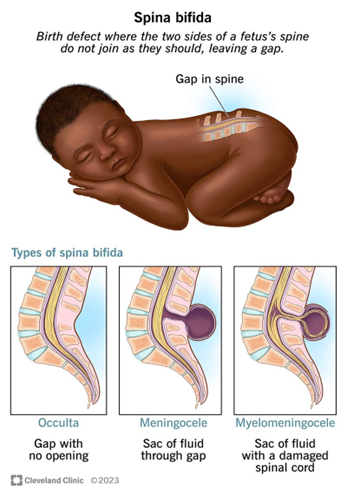
- Spina Bifida is a congenital neural tube defect (NTD) affecting the spine and spinal cord, caused by incomplete closure of the neural tube during early embryonic development, typically within the first 28 days of pregnancy.
- The condition can range from mild anatomical defects to severe neurological disability and it is classified under non-communicable congenital disorders.
Types of Spina Bifida
- Myelomeningocele (Open Spina Bifida) is the most severe form of the condition, in which a portion of the spinal cord and associated nerves protrude outside the body through an opening in the spine, often enclosed within a sac, resulting in significant neurological impairment.
- Meningocele is a less common and less severe form of spina bifida, where the meninges, which are the protective membranes covering the spinal cord, bulge out through a spinal opening in a fluid-filled sac, while the spinal cord itself usually develops normally and the nerves remain unaffected.
- Spina Bifida Occulta, commonly referred to as “hidden spina bifida”, is the mildest form of the condition, characterised by improper formation of one or more vertebrae, resulting in a small gap in the spine, and it often remains asymptomatic.
Causes of Spina Bifida
Spina Bifida results from a multifactorial interplay of genetic, environmental, and nutritional factors, with folic acid deficiency during early pregnancy being the most significant and preventable risk factor.
- For example, use of certain antiepileptic drugs, poorly controlled maternal diabetes, family history of neural tube defects, and maternal obesity or elevated body temperature in early pregnancy.
Signs and Symptoms of Spina Bifida
- The symptoms of Spina Bifida vary depending on the type of defect, the location of the spinal opening, and the extent of the gap.
- Mild forms show no visible or noticeable symptoms.
- In more severe cases, affected individuals may experience bowel and bladder dysfunction, back pain, weakness or paralysis of the lower limbs, and loss of sensation in the legs.
- Many children with severe forms also develop hydrocephalus, which involves accumulation of excess fluid in the brain, leading to increased pressure on brain tissue.
Indian Scenario-Spina Bifida
- India continues to report a high prevalence of Spina Bifida at around 4 per 1,000 births, with approximately 25,000 affected children born annually, over 75% of whom lack access to specialised medical and rehabilitative care, while the country still lacks a national folic acid awareness programme and mandatory fortification policy, despite WHO guidance.
How to Prevent Spina Bifida
- Prevention: Spina Bifida can be largely prevented through adequate intake of folic acid during the early and periconceptional weeks of pregnancy.
- Food Fortification: Itinvolves adding essential micronutrients to commonly consumed foods to improve population nutrition.
- 68 countries have made mandatory folic acid fortification of staple foods such as wheat flour and maize flour.
Diagnosis and Treatment of Spina Bifida
- Prenatal Screening: Detected via maternal blood tests (checking for high Alpha-fetoprotein levels), detailed ultrasounds, or amniocentesis.
- Treatment: Although no definitive cure exists, a range of medical, surgical, and rehabilitative interventions is available to effectively manage symptoms and improve quality of life.
Q . With reference to Spina Bifida, consider the following statements:
1. It is a congenital disorder caused by incomplete closure of the neural tube during early embryonic development.
2. India continues to report a high prevalence of Spina Bifida at around 4 per 1,000 births.
3. Folic acid deficiency during early pregnancy is a major preventable risk factor.

Which of the statements given above are not correct?
(a) 1 and 2 only
(b) 1 and 3 only
(c) None
(d) 1, 2 and 3

Answer: (c) None

Explanation:
Statement 1 is correct: Spina Bifida is caused by incomplete neural tube closure in early embryonic development.
Statement 2 is correct: India reports a high prevalence of approximately 4 per 1,000 births.
Statement 3 is correct: Folic acid deficiency is the most important preventable risk factor.