
After Reading This Article You Can Solve This UPSC Mains Model Question:
India’s space programme has moved from technological demonstration to strategic necessity.” Discuss the next big challenges before ISRO in transitioning towards an industry-led and commercially viable space ecosystem. (250 words) (GS-3 Science & Technology)
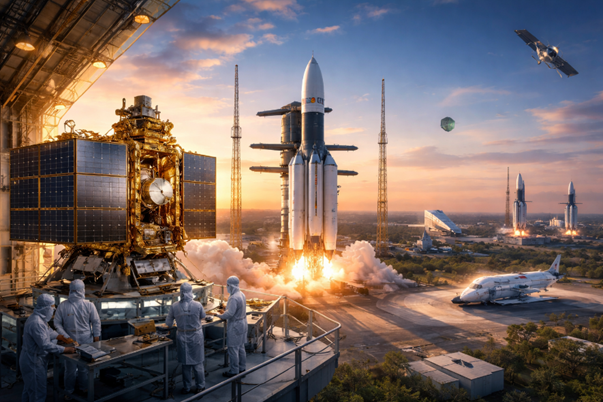
ISRO next big challenge is linked to building a globally competitive commercial space ecosystem in India.
Introduction — ISRO’s Evolution
India’s space ecosystem now faces its next big challenge — transitioning from state-led missions to a globally competitive commercial space industry.
The Indian Space Research Organisation (ISRO), established in 1969, has grown from a modest space programme to a globally respected space agency known for cost-effective engineering and scientific missions. It has reliably deployed satellites for national services (communications, navigation, disaster management) and international customers, showcasing global launch capabilities (PSLV/GSLV) and deep-space exploration feats such as Chandrayaan and Mars Orbiter Mission.
Landmark Achievements So Far
The Indian Space Research Organisation has recorded several milestones that place India among leading spacefaring nations:
1. Reliable and cost-effective launch capability
- PSLV emerged as a globally trusted launcher with a high success rate, capable of placing satellites in multiple orbits in a single mission.
- GSLV Mk-III (LVM3) established India’s heavy-lift capability, crucial for human spaceflight and deep-space missions.
2. Path-breaking planetary and scientific missions
- Mars Orbiter Mission (Mangalyaan) made India the first country to reach Mars orbit in its maiden attempt, demonstrating interplanetary navigation at low cost.
- Chandrayaan-3 achieved a historic soft landing near the Moon’s south pole, a first for any nation, enhancing India’s stature in lunar science.
- Aditya-L1, India’s first solar observatory, positioned at the L1 point to study the Sun and space weather.
3. Human spaceflight preparedness
- Successful Crew Module Atmospheric Re-entry Experiments and abort tests under the Gaganyaan programme marked major progress toward sending Indian astronauts to space.
4. Strategic and societal applications
- A strong constellation of Earth-observation, communication, and navigation (NavIC) satellites supports weather forecasting, disaster management, agriculture, governance, and national security.
- Indigenous satellite systems strengthened strategic autonomy and reduced dependence on foreign data.
5. Commercial and global outreach
- Launch of hundreds of foreign satellites positioned India as a competitive player in the global launch services market, reinforcing ISRO’s reputation for affordable and dependable space solutions.
The “Next Big Challenge” — Industrial Scale Success
For the Indian Space Research Organisation, the next big challenge is not scientific capability but industrial scalability — moving from mission-by-mission excellence to mass, market-oriented space activity.
1. From laboratory success to factory-scale production
- ISRO has traditionally designed, tested, and integrated launch vehicles and satellites in-house, suitable for limited missions.
- The future demands assembly-line production of rockets, satellites, and subsystems to meet rising domestic and global demand.
- This shift is essential to compete with global players that offer high launch frequency, faster turnaround, and lower marginal costs.
2. Deep integration of the private sector
- Industrial-scale success requires ISRO to act as an enabler and regulator, not the sole operator.
- Private companies must handle end-to-end activities: manufacturing, launch services, satellite operations, and downstream applications.
- Institutions like IN-SPACe and NSIL are key, but coordination, clear role division, and predictable regulations remain a work in progress.
3. Competing in the global space economy
- The global space sector is shifting from government-led exploration to commercial constellations, space services, and space-based data markets.
- India’s cost advantage alone is insufficient; reliability at scale, assured timelines, and commercial accountability are now decisive.
- Without industrial scalability, India risks being a technology demonstrator rather than a market leader.
4. Technology transition for scale
- Reusable launch vehicles, next-generation launch systems, in-orbit servicing, and space docking must move from experimental missions to operational systems.
- Scaling these technologies requires standardisation, certification, and industrial ecosystems, not just successful demonstrations.
5. Institutional and cultural shift
- Industrial-scale success needs a mindset change — from scientific perfection to commercial optimisation, balancing risk, cost, and timelines.
- ISRO’s challenge lies in transferring mature technologies to industry while retaining its core role in frontier research and national missions.
Institutional and Policy Challenges
As the Indian Space Research Organisation transitions towards an industry-led space ecosystem, several institutional and policy challenges have emerged that constrain industrial-scale success:
1. Role clarity among space institutions
- The creation of IN-SPACe (regulator and promoter), NSIL (commercial arm), and ISRO (R&D and strategic missions) was intended to unbundle functions.
- However, overlapping mandates, evolving guidelines, and operational ambiguities often slow decision-making and discourage private investment.
- Clear separation between regulation, promotion, and execution remains incomplete.
2. Absence of a comprehensive Space Law
- India still lacks a full-fledged Space Activities Act.
- This creates uncertainty regarding:
- Liability and insurance for launch failures
- Ownership of space objects and data
- Dispute resolution mechanisms
- Such legal ambiguity raises risk perception for private and foreign investors.
3. Regulatory predictability and licensing delays
- Space activities require multiple approvals related to safety, frequency allocation, orbital slots, and export controls.
- Lengthy and evolving licensing procedures increase project timelines and costs, weakening India’s competitiveness against agile global players.
4. Technology transfer bottlenecks
- ISRO holds extensive intellectual property developed with public funds.
- Delays and restrictions in technology transfer, pricing, and hand-holding slow private sector capability building.
- Startups often lack access to testing facilities and flight heritage, which are critical for market credibility.
5. Financing and risk-sharing constraints
- Space ventures are capital-intensive and high-risk, with long gestation periods.
- India lacks:
- Adequate patient capital
- Government-backed risk-sharing mechanisms
- Mature space insurance markets
- This limits scaling beyond pilot projects.
6. Human resource and organisational rigidity
- ISRO faces challenges in attracting and retaining specialised talent due to:
- Rigid recruitment norms
- Limited lateral entry
- Competition from private and global space firms
- Institutional culture still prioritises risk-avoidance over speed, unsuitable for commercial operations.
Strategic and Global Implications
The transition of the Indian Space Research Organisation towards industrial-scale and commercial success carries far-reaching strategic and global implications for India.
1. Geopolitical influence and strategic autonomy
- Space has emerged as a critical strategic domain alongside land, sea, air, and cyber.
- A strong indigenous space ecosystem ensures sovereign access to space-based data, reducing dependence on foreign satellites for navigation, communication, and surveillance.
- Systems such as NavIC strengthen national security and military preparedness, especially in contested regions.
2. National security and defence preparedness
- Satellites play a vital role in intelligence, surveillance, reconnaissance (ISR), early warning, secure communications, and precision operations.
- Industrial-scale capacity allows:
- Rapid satellite replacement in case of conflict or accidents
- Enhanced space situational awareness
- This is crucial as outer space becomes increasingly militarised and contested.
3. Positioning in the global space economy
- The global space economy is expanding rapidly, driven by satellite internet, Earth observation, and space services.
- Industrial success enables India to:
- Capture a larger share of launch services
- Become a hub for affordable satellite manufacturing
- Export space-based services to developing countries
- Without scale, India risks remaining a technology provider rather than a market leader.
4. Diplomatic leverage and soft power
- ISRO’s missions have already enhanced India’s science diplomacy.
- Expanded commercial and collaborative space activities strengthen India’s role in:
- South–South cooperation
- Capacity-building for smaller space nations
- Shaping global norms on peaceful use of outer space
5. Rule-making and global governance of space
- As congestion, debris, and militarisation increase, global norms on:
- Space traffic management
- Debris mitigation
- Responsible behaviour in outer space
are becoming urgent.
- A strong industrial space presence allows India to actively influence international space governance, rather than remain a rule-taker.
Way Forward
To successfully meet the challenge of industrial-scale success, the Indian Space Research Organisation must combine institutional reform, technological acceleration, and strategic vision.
1. Clear governance and legal framework
- Enact a comprehensive Space Activities Act defining:
- Liability, insurance, and dispute resolution
- Licensing and authorisation mechanisms
- Roles of ISRO, IN-SPACe, NSIL, and private players
- Ensure regulatory certainty and predictability to attract long-term private investment.
2. ISRO as an enabler, not monopolist
- Gradually shift ISRO’s role toward:
- Frontier R&D and strategic missions
- Human spaceflight and deep-space exploration
- Transfer mature technologies and routine operations to industry with hand-holding and certification support.
3. Deepening private-sector participation
- Encourage end-to-end private space missions — from launch vehicles to satellite operations and downstream applications.
- Facilitate access to:
- Testing and integration facilities
- Launch infrastructure
- Flight heritage data
- Promote Public–Private Partnerships (PPP) and anchor-customer models.
4. Technology push for scalability
- Fast-track development of:
- Reusable launch vehicles
- Next Generation Launch Vehicle (NGLV)
- Space docking, in-orbit servicing, and refuelling
- Move from demonstration to operationalisation and standardisation.
5. Finance, insurance and risk-sharing
- Create dedicated space-sector financing instruments:
- Sovereign-backed guarantees
- Viability gap funding for early missions
- Space insurance pools
- Encourage patient capital through green and innovation-linked bonds.
6. Human capital and institutional flexibility
- Enable:
- Lateral entry and short-term expert hiring
- Industry–academia–ISRO talent mobility
- Foster a culture that balances speed, risk management, and commercial accountability.
7. Global collaboration and norm-setting
- Expand international partnerships in:
- Space sustainability
- Planetary exploration
- Space traffic management
- Play an active role in shaping global space governance norms, ensuring peaceful and responsible use of outer space.
Conclusion
ISRO’s future success depends on transforming technological excellence into industrial-scale capability. By enabling private participation, strengthening institutions, and advancing cutting-edge technologies, India can secure strategic autonomy, global competitiveness, and leadership in the emerging space economy while ensuring the peaceful and sustainable use of outer space.