
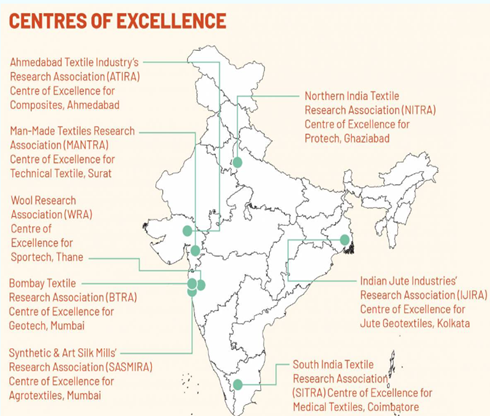
Why in the News?
- According to the Manmade and Technical Textiles Export Promotion Council, India’s technical textile exports totaled $1.95 billion from April to October 2025, slightly down from $1.97 billion during the same period in 2024.
What are Technical Textiles?
- Technical textiles are textile products engineered for functionality rather than aesthetics. They are designed to perform specific technical functions (e.g., strength, durability, chemical/heat resistance) and are used in industries like automotive, medical, agriculture, construction, aerospace, and personal protection.
Classification
Technical textiles are broadly grouped into 12 segments based on application:
- Agrotech: Textiles for agriculture, horticulture, forestry (shade nets, crop covers).
- Buildtech: Construction and building (architectural membranes, road geotextiles).
- Clothtech: Clothing components (interlinings, shoe parts, high-visibility vests).
- Geotech: Civil engineering geotextiles (erosion control, drainage, soil stabilization).
- Hometech: Household/furnishing textiles (carpets, upholstery, blackout curtains).
- Indutech: Industrial uses (filtration fabrics, conveyor belts, ropes).
- Medtech: Medical/hygiene textiles (surgical gowns, wound dressings, diapers).
- Mobiltech: Transport textiles (car seats, airbags, seatbelts, aircraft interiors).
- Oekotech: Environmental protection (waste disposal, water treatment, pollution control).
- Packtech: Packaging textiles (jute sacks, FIBCs, soft luggage).
- Protech: Protective textiles (bulletproof vests, fire/chemical-resistant clothing).
- Sportech: Sports/leisure (sportswear, tents, parachutes, artificial turf).





Characteristics
- Functional performance: Designed for specific technical or performance requirements rather than aesthetics.
- Durability: High strength, wear resistance, and long service life.
- Lightweight: Often lighter than conventional materials with equivalent strength.
- Resistance properties: Can be resistant to fire, chemicals, UV, water, or microbes depending on use.
- Comfort & safety: Optimized for ergonomics, breathability, or protection.
- Specialized materials: May use synthetic fibers, composites, or hybrid structures.
- Customizable: Tailored for specific industries or applications.
- Sustainability: Some are eco-friendly or recyclable, especially in Oekotech.
Key Government Initiatives
- National Technical Textiles Mission (NTTM) 2020–24:
- R&D: Support for specialty fibers, agro-textiles, geotech, protech.
- Market Development: Promote awareness via national & international events.
- Skill Development: Train manpower; develop technical textile courses.
- Promotion & Marketing: Fostering entrepreneurship through the Grant for Research and Entrepreneurship across Aspiring Innovators in Technical Textiles (GREAT) scheme, offering grants up to ₹50 lakh.
- Production Linked Incentive (PLI) Scheme (2021): Boosts production of man-made fiber apparel, fabrics, and technical textiles; attracts investment.
- Startup India Initiatives: Fund of Funds (FFS), Seed Fund (SISFS), and Credit Guarantee (CGSS) support technical textile startups.
- SAMARTH Scheme: Capacity building for skilled manpower in textiles; aligns with Skill India.
- PM MITRA Scheme: Large-scale textile manufacturing hubs benefiting technical textiles indirectly.
- Harmonized System of Nomenclature (HSN) Codes for Technical Textiles: Dedicated HSN codes to help monitor production, trade & incentives for technical textile items.
Which category of technical textiles is used for bulletproof vests, firefighter suits, and industrial protective clothing?
A. Sportech
B. Protech
C. Buildtech
D. Clothtech

Answer: B

Explanation: Protech textiles are a category of technical textiles designed specifically for protection against physical, chemical, and environmental hazards. Their primary function is safety and defense. Examples include:
o	Bulletproof vests – protect against firearms and ballistic threats
o	Firefighter suits – resistant to heat and flames
o	Industrial protective clothing – shields workers from chemicals, mechanical injuries, or electrical hazards.