
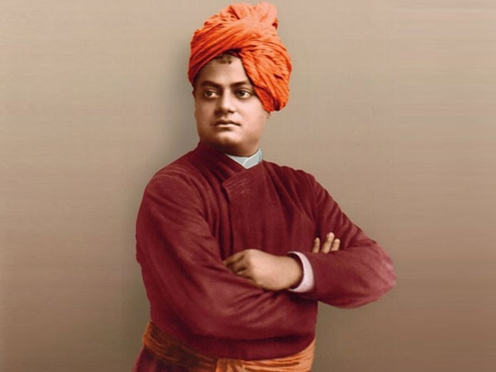
Why in the News?
- Recently, the nation celebrated the 163rd birth anniversary of Swami Vivekananda.
- Since 1984, the Government of India has declared 12 January as National Youth Day (Rashtriya Yuva Diwas) to honour Vivekananda’s immense contributions to youth empowerment, nation-building, and spiritual revival.
- The National Youth Day commemorates Vivekananda’s teachings on discipline, self-confidence, moral courage, patriotism, and service to humanity, inspiring youth and citizens across India.
Background of Swami Vivekananda
Swami Vivekananda, originally named Narendranath Datta, is widely regarded as one of India’s foremost spiritual leaders and philosophers. He played a pivotal role in the Indian Renaissance, advocating for a revival of India’s spiritual and cultural heritage.
- Date of Birth: 12 January 1863
- Place of Birth: Kolkata, West Bengal, India
- Parents: Vishwanath Datta (Father) and Bhuvaneshwari Devi (Mother)
- Education:
- Attended Metropolitan Institution, Kolkata
- Excelled in Western philosophy, studying thinkers such as John Stuart Mill, David Hume, and Immanuel Kant
- Gained deep understanding of Indian spiritual texts, including the Vedas and Upanishads
- Early Traits: From a young age, Narendranath displayed keen intellect, spiritual curiosity, and moral courage
- Spiritual Guidance: Met his mentor Ramakrishna Paramahamsa in 1881, who recognized his spiritual potential and guided him toward self-realisation, universal spiritual understanding, and the unity of all religions.
Major Contributions of Swami Vivekananda
The teachings of Swami Vivekananda inspired leaders of India’s independence movement, emphasizing education, rational thinking, moral courage, and ethical action as instruments of societal transformation.
1. Revival of Hinduism and Global Recognition: Swami Vivekananda promoted Vedanta and Yoga philosophy to a global audience, integrating spiritual wisdom with modern scientific knowledge.
- Delivered the historic speech at the Parliament of the World’s Religions, Chicago (1893), presenting Hinduism as a universal, rational, and inclusive spiritual path.
- Advocated Neo-Vedanta, a philosophy that combines spirituality with practical life, social reform, and modern education.
2. Establishment of the Ramakrishna Mission: In 1897, Swami Vivekananda founded the Ramakrishna Mission, headquartered at Belur Math, West Bengal, to promote both spiritual and social work.
- The Mission functions as a philanthropic and spiritual organization with a focus on education, healthcare, humanitarian relief, and promotion of Vedanta philosophy.
- The Mission emphasises Karma Yoga, encouraging selfless service and practical application of spiritual principles in everyday life.
3. Educational Reform and Youth Empowerment: Swami Vivekananda advocated a holistic education system that integrated scientific knowledge, spiritual wisdom, moral values, and character-building.
- He inspired the youth of India to take pride in the nation’s cultural and spiritual heritage and actively participate in social reform and nation-building.
- His famous slogan, “Arise, awake, and stop not till the goal is reached,” motivates young people to strive for personal and national development with determination.
4. Social Reform and Inclusion: Swami Vivekananda worked towards the upliftment of marginalized communities, challenged caste-based discrimination, and promoted women’s empowerment.
- His approach combined spiritual values with social action, making social reform an integral part of his philosophy.
5. Literary and Philosophical Contributions: Swami Vivekananda authored several key texts, including Jnana Yoga, Bhakti Yoga, Karma Yoga, and Raja Yoga, which compile his teachings on knowledge, devotion, action, and meditation respectively.
- His core philosophical teachings include:
- Self-Realisation: Human beings should strive to recognize the divinity within themselves.
- Universal Religion: All religions are different paths that ultimately lead to the same ultimate truth.
- Service to Humanity: He emphasised that service to humanity is a means of spiritual growth, encapsulated in his teaching: “Jiva is Shiva” – serving human beings is equivalent to serving God.
- Karma Yoga: Individuals must perform their duties selflessly, without attachment to the results of their actions.
Q. The Ramakrishna Mission, founded by Swami Vivekananda, primarily aims to:
(a) Promote scientific research in India
(b) Propagate Vedanta philosophy and undertake social service
(c) Conduct political activities for Indian independence
(d) Provide vocational training exclusively

Answer: (b) Propagate Vedanta philosophy and undertake social service
Explanation:

Option (a)– Incorrect: While Swami Vivekananda emphasized education and the integration of science and spirituality, the Ramakrishna Mission is not a scientific research organization. Its core purpose is spiritual and philanthropic work.
Option (b)– Correct: The Ramakrishna Mission, founded in 1897 by Swami Vivekananda, is dedicated to promoting Vedanta teachings and engaging in social service, including education, healthcare, disaster relief, and upliftment of marginalized communities. The Mission follows the principle of Karma Yoga (selfless service).
Option (c) – Incorrect: The Mission is apolitical and has never been involved in political movements. Swami Vivekananda focused on spiritual, social, and moral upliftment, not direct political activism.
Option (d) Incorrect: Vocational training may be a part of its educational initiatives, but it is not the exclusive focus of the Mission. The organization has a broader mandate, including spiritual, educational, and humanitarian work.