
Why in the News?
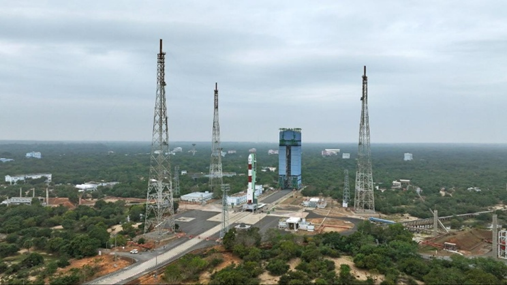
- The Indian Space Research Organisation (ISRO) is scheduled to launch the PSLV-C62/EOS-N1 mission from the first launch pad of the Satish Dhawan Space Centre (SDSC), Sriharikota.
- This mission marks the 105th launch from Sriharikota, the 64th PSLV flight, and the fifth mission of the PSLV-DL variant.
- The launch will deploy EOS-N1, an Earth observation satellite with strategic applications, along with 15 co-passenger satellites from India and international partners.
PSLV-C62 Mission: Key Details
- Mission Overview: The PSLV-C62 is a multi-payload mission by the Indian Space Research Organisation (ISRO), carrying 1 primary satellite and 18 secondary payloads. It is ISRO’s first launch of 2026 and is scheduled to lift off from Sriharikota.
- Primary Payload – EOS-N1 (‘Anvesha’):
- Type: Earth observation satellite with hyperspectral imaging capability.
- Developer: Primarily built by Defence Research and Development Organisation (DRDO) for strategic purposes.
- Capabilities:
- Captures data in hundreds of wavelengths, enabling precise identification of materials and objects.
- Supports national security, border surveillance, and strategic monitoring.
- Civilian applications include agriculture planning, urban mapping, mineral exploration, and environmental monitoring.
- Secondary Payload – Kestrel Initial Demonstrator (KID):
- Type: Experimental re-entry capsule developed with a Spanish startup.
- Mission Objective: Expected to re-enter Earth’s atmosphere and splash down in the South Pacific Ocean.
- Other Secondary Payloads: Includes 17 commercial satellites from India, Mauritius, Luxembourg, UAE, Singapore, Europe, and the USA.
- Indian startups and academic institutions contributing satellites:
- OrbitAID Aerospace – AayulSAT (India’s first on-orbit satellite refuelling payload)
- CV Raman Global University – CGUSAT-1
- Dhruva Space – DA-1
- Space Kidz India – SR-2
- Assam Don Bosco University – Lachit-1
- Akshath Aerospace – Solaras-S4
- Dayanand Sagar University – DSAT-1
- Indian startups and academic institutions contributing satellites:
- Technological Significance:
- AayulSAT aims to demonstrate in-orbit servicing and satellite refuelling, extending operational life of satellites.
- These technologies are crucial for reducing space debris and promoting sustainable use of increasingly crowded orbital space.
Polar Satellite Launch Vehicle (PSLV): Overview
- About: The PSLV is India’s third-generation launch vehicle and the first Indian launcher to incorporate liquid stages. It is an indigenously built expendable launch system developed by ISRO. Since its first successful launch in October 1994, PSLV has become a reliable and versatile workhorse, launching both Indian and foreign satellites.
- Notable Achievements:
- Launched Chandrayaan-1 (2008) and Mars Orbiter Mission (Mangalyaan) (2013).
- Successfully deployed satellites for LEO, GTO, communication, meteorology, navigation, scientific research, and space exploration.
- Launched Astrosat, India’s first space observatory.
- Key Features:
- Expendable launch vehicle capable of placing remote sensing satellites into Sun-Synchronous Orbit (SSO) and smaller satellites into Geostationary Transfer Orbit (GTO).
- Can carry multiple payloads using multi-payload adaptors.
- Payload capacity:
- SSPO (600 km) – 1,750 kg
- Sub-GTO – 1,425 kg
- Configurations and Variants:
- PSLV-XL: Six strap-on boosters, 1,750 kg to SSPO (used for Chandrayaan-1, Aditya-L1, Mars Orbiter Mission).
- PSLV-CA (Core Alone): No strap-ons, 1,019 kg to SSPO (used for TeLEOS-2, DS-SAR).
- PSLV-QL: Four strap-ons, 1,523 kg to SSPO.
- PSLV-DL: Two strap-ons, designed for dual satellite launches.
- PSLV-G: Standard variant with six strap-on boosters.
- Stages of PSLV:
- First Stage (PS1): Solid rocket with six strap-on boosters for initial thrust.
- Second Stage (PS2): Liquid-fueled Vikas engine for efficiency.
- Third Stage (PS3): Solid motor for high thrust after atmospheric phase.
- Fourth Stage (PS4): Twin liquid engines to inject payload into orbit; can be restarted multiple times for multi-satellite deployment.
- PSLV Orbital Experimental Module (POEM):
- Uses spent PS4 stage as an orbital platform for in-orbit experiments.
- Stabilized using dedicated guidance and control systems, powered by solar panels and lithium-ion batteries.
- Example: POEM-3 launched with PSLV-C58 carrying XPoSat.
- Reputation: Known as the “Workhorse of ISRO” due to its reliability, versatility, and multi-payload capabilities.
Key Comparison Between PSLV and GSLV
ISRO operates two main satellite launch vehicles: the Polar Satellite Launch Vehicle (PSLV) and the Geosynchronous Satellite Launch Vehicle (GSLV). Both serve distinct purposes in India’s space programme.
| Feature | PSLV (Polar Satellite Launch Vehicle) | GSLV (Geosynchronous Satellite Launch Vehicle) |
| Number of Stages | 4 stages: PS1, PS2, PS3, PS4 | 3 stages: GS1, GS2, CUS |
| Lift-off Mass | 320 tonnes (PSLV-XL variant) | 420 tonnes |
| Fuel Type | Combination of solid and liquid propellants | Liquid fuels (liquefied nitrogen and oxygen) |
| Generation & First Flight | Third-generation launcher; first flight in 1993 | Fourth-generation launcher; first flight in 2014 |
| Orbit Capability | Can launch satellites into LEO, SSO, GTO, and navigation orbits | Primarily designed for Geostationary Transfer Orbit (GTO) missions |
| Primary Use | Mainly for earth observation and remote-sensing satellites | Primarily for communication satellites such as INSAT-class in geostationary orbit |
| Strap-on Boosters | Available in four variants: 6, 4, or 2 solid rocket strap-ons | Equipped with four liquid strap-on boosters |
| Payload Capacity | Up to 1,750 kg to Sun-Synchronous Polar Orbit (SSPO) | Up to 2,250 kg to GTO |
| Variants | PSLV-CA, PSLV-G, PSLV-XL, PSLV-DL, PSLV-QL | GSLV Mk I, GSLV Mk II, GSLV Mk III |
Q. Consider the following about the Polar Satellite Launch Vehicle (PSLV):
1.	It is a four-stage launch vehicle using a combination of solid and liquid propellants.
2.	PSLV is primarily used to launch communication satellites in geostationary orbit.
3.	PSLV-C62 will launch only Indian satellites.
4.	Chandrayaan-1 and Mars Orbiter Mission were launched using PSLV.

Which of the statements given above are correct?
(a) 1, 2, and 3 only
(b) 1, 3, and 4 only
(c) 2 and 4 only
(d) All of the above

Answer: (b) 1, 3, and 4 only

Explanation:
Statement 1-Correct: PSLV is a four-stage launch vehicle that uses a combination of solid and liquid propellants for lifting satellites into orbit.
Statement 2-Incorrect: PSLV is primarily designed for Earth observation and remote sensing satellites, not for geostationary communication satellites. GSLV is used for geostationary satellites.
Statement 3-Incorrect: PSLV-C62 will carry both Indian and international satellites, including 15 co-passenger satellites from Mauritius, Luxembourg, UAE, Singapore, Europe, and the USA.
Statement 4-Correct: PSLV successfully launched Chandrayaan-1 (2008) and Mars Orbiter Mission/Mangalyaan (2013), making it India’s reliable “workhorse” launch vehicle.