
Why in the News?
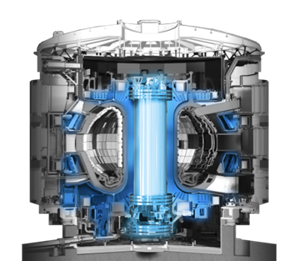
- Scientists at China’s Experimental Advanced Superconducting Tokamak (EAST), colloquially known as the “Artificial Sun,” recently achieved a significant milestone by breaking the long-standing Greenwald density limit.
- The team successfully maintained stable plasma at densities 65% higher than the theoretical threshold (1.3 to 1.65 times the limit).
- This breakthrough validates the Plasma-Wall Self-Organisation (PWSO) theory and offers a scalable pathway toward achieving burning plasma—the stage where fusion reactions become self-sustaining.
Nuclear Fusion: Concept and Natural Occurrence
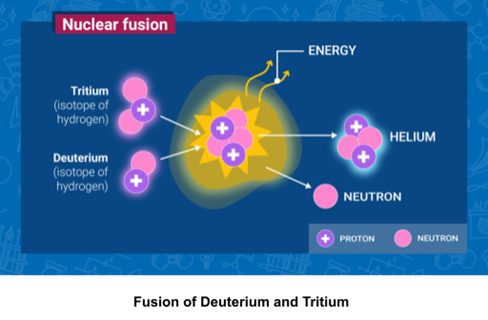
- Definition: Nuclear fusion is a nuclear reaction in which light atomic nuclei combine to form a heavier nucleus, releasing a very large amount of energy. The energy released through fusion is significantly higher than that produced by nuclear fission, as a greater portion of mass is converted into energy.
- Occurrence: Fusion can be controlled, as in stars and experimental reactors, or uncontrolled, as in thermonuclear (hydrogen) bombs.
- Thermonuclear Nature: Fusion requires extremely high temperatures to accelerate light nuclei to collide with enough energy. For example, Deuterium (from seawater) and Tritium (from lithium) are commonly used hydrogen isotopes.
- Fusion in Stars: In stars like the Sun, fusion occurs at around 10 million °C, giving nuclei sufficient kinetic energy to overcome the electrostatic repulsion between positively charged protons.
- Role of Temperature: High temperatures enable nuclei to approach closely enough for fusion.
- Confinement in Stars: Stellar gravity creates enormous pressure, confined nuclei collide more frequently, supporting continuous fusion.
- Nuclear Force Dominance: At very short distances, the strong nuclear force overcomes repulsion, allowing nuclei to bind and release energy.
- Plasma Formation: At very high temperatures, matter exists as plasma, a highly ionised state consisting of free electrons and positively charged ions, which is difficult to manage and contain.
- Challenges in Harnessing Nuclear Fusion Energy: Controlled nuclear fusion requires extremely high temperatures(~100 million °C) and plasma confinement to prevent contact with reactor walls.
- Maintaining such conditions demands advanced heating, precise magnetic control (as in Tokamaks), and materials that can endure extreme heat, radiation, and stress.
- Currently, reactors consume more energy than they produce, but research continues due to fusion’s potential as a safe, clean and nearly limitless energy source.
Significance of Nuclear Fusion as a Future Energy Source
- Abundant Fuel Supply: Deuterium from seawater and tritium from lithium provide a virtually unlimited fuel source, ensuring long-term energy security.
- Clean Energy: Fusion produces no greenhouse gases or air pollutants. Its fuel is non-radioactive, and the main by-products are helium and neutrons, making it a sustainable energy source.
- Low Radioactive Waste: Reactor components become mildly radioactive due to neutron exposure, but this fades within 50–100 years, making waste management safer than in fission reactors. Fusion fuels are only active while in the reactor.
Comparison Between Nuclear Fission and Nuclear Fusion
| Feature | Nuclear Fission | Nuclear Fusion |
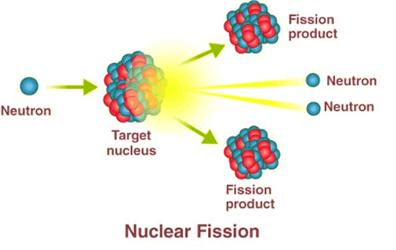
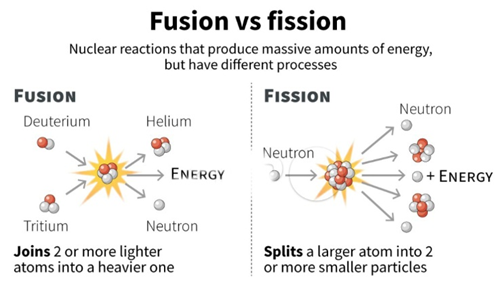
| Process | A neutron splits a heavy atomic nucleus into two smaller nuclei. | Two light atomic nuclei combine to form a heavier nucleus. |
| Natural Occurrence | Can occur naturally in uranium deposits. | Takes place naturally in stars, including the Sun. |
| Conditions Required | Requires a critical mass of fissile material and high-energy neutrons. | Needs plasma at extremely high temperatures to overcome electrostatic repulsion. |
| Chain Reaction | Involves a self-sustaining chain reaction. | Does not involve a chain reaction. |
| By-products | Produces radioactive isotopes such as cobalt-60, cesium-137, and iridium-192. | Produces minimal or no radioactive by-products. |
| Nuclear Fuel | Commonly uses uranium. | Uses light nuclei such as deuterium, tritium, or lithium. |
| Energy Requirement | Relatively lower energy required to split the nucleus. | Requires extremely high energy/temperature to fuse nuclei. |
| Cost-effectiveness | Relatively cheaper and operationally cost-effective. | More expensive due to high operational and infrastructural requirements. |
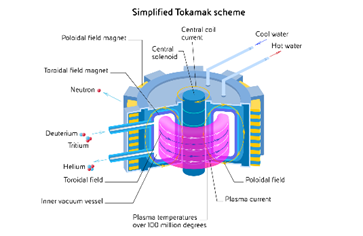
Tokamak Device: Meaning and Working Principles
- Definition and Origin: A tokamak is a magnetic confinement fusion device designed to produce nuclear fusion under controlled conditions. The term is derived from a Russian acronym referring to a toroidal (doughnut-shaped) vacuum chamber equipped with magnetic coils.
- Working Principles of Tokamak Device:
- Plasma Formation: Fusion begins with a neutral gas that is ionised into plasma, consisting of freely moving electrons and ions, which is then guided into the toroidal chamber.
- Magnetic Field Structure: Strong magnets generate two magnetic fields: a toroidal field that runs around the ring and a poloidal field that loops across it, together forming a helical magnetic field to confine the plasma.
- Plasma Confinement: Charged plasma particles spiral along magnetic field lines, preventing contact with the reactor walls and maintaining the plasma in a stable confined state.
- Plasma Current Drive: An electric current flows through the plasma, reinforcing magnetic confinement, while external systems help initiate and sustain this current.
- Plasma Heating Methods: Advanced heating techniques, including electromagnetic waves and particle beams, raise plasma temperatures to over 150 million degrees Celsius, which is required for fusion.
- Fusion Reaction: At these extreme temperatures, hydrogen isotopes fuse, releasing large amounts of energy.
- Magnetic ‘Bottle’ Concept: Overall, the tokamak functions as a magnetic bottle, using carefully controlled magnetic fields to confine hot plasma long enough for fusion reactions to occur.
Major Nuclear Fusion Projects Around the World
- Joint European Torus (JET), UK: The largest operational tokamak in the world, focusing on plasma research and holding records for fusion power output.
- ITER, France: An international megaproject constructing the world’s largest experimental tokamak to demonstrate the feasibility of fusion energy.
- National Ignition Facility (NIF), USA: An inertial confinement fusion facility using high-powered lasers to ignite fuel pellets and study fusion reactions.
- Wendelstein 7-X (W7X), Germany: An advanced stellarator testing magnetic confinement of plasma for long-duration operations.
- Large Helical Device (LHD), Japan: A helical magnetic fusion device for studying plasma confinement and stability in three-dimensional magnetic fields.
- KSTAR, South Korea: A superconducting tokamak conducting high-performance plasma experiments.
- EAST, China: An experimental advanced superconducting tokamak holding records for long plasma pulse durations.
- HL-2M Tokamak, China: The country’s largest fusion reactor aimed at studying plasma confinement and reactor engineering.
India’s Efforts and Developments in Tokamak-Based Fusion Research
India is actively engaged in tokamak research, both as a participant in the ITER project and through indigenous fusion programs led by the Institute for Plasma Research (IPR), Gandhinagar. Key projects include:
- ADITYA-U: An upgraded version of the ADITYA tokamak, medium-sized, with a toroidal magnetic field of 1.5 T, producing circular plasmas with currents of 150–250 kA and plasma durations of 250–350 ms.
- Steady-State Tokamak (SST-1): Medium-sized, with a 1.5 T magnetic field, plasma currents of ~100 kA, and confinement times around 450 ms.
- SST-2: A superconducting tokamak under construction to handle over 1000 plasma pulses and currents exceeding 1 million amperes, aimed at studying high-current plasma stability.
- SST-3: A next-generation steady-state superconducting tokamak integrating features from SST-2 and ITER, using high-temperature superconductors.
- IN-SPARC: A planned demonstration reactor targeting net energy gain from fusion by 2030, employing advanced indigenous technologies.
Q. Consider the following statements regarding nuclear fusion:
	1. It involves the splitting of heavy atomic nuclei to release energy.
	2. It is the process that powers the Sun and other stars.
	3. Fusion reactions release energy by converting a portion of mass into energy.
	4. Tokamak is a device designed to achieve controlled nuclear fusion on Earth using magnetic confinement.

Which of the statements given above are correct?
(a) 1 and 2 only
(b) 2, 3 and 4 only
(c) 1, 3 and 4 only
(d) 1, 2, 3 and 4

Answer: (b) 2, 3 and 4 only

Explanation:
Statement 1 – Incorrect: Nuclear fusion is not the splitting of heavy nuclei; that is nuclear fission. Fusion occurs when light nuclei, such as deuterium and tritium, combine to form a heavier nucleus, releasing energy.
Statement 2 – Correct: Nuclear fusion is the source of energy in stars, including the Sun. In stars, hydrogen nuclei fuse under extreme temperature and pressure to form helium, releasing enormous energy.
Statement 3 – Correct: Fusion reactions release energy because a small fraction of the mass of the nuclei is converted into energy according to Einstein’s equation E=mc^2.
Statement 4 – Correct: Tokamak is a toroidal (doughnut-shaped) device that uses magnetic confinement to contain high-temperature plasma, allowing controlled nuclear fusion on Earth. It is a key technology for achieving sustained fusion reactions, as in the ITER and EAST experiments.