
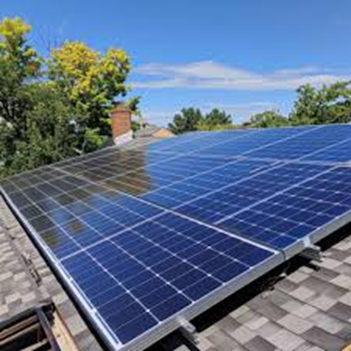
Why in the News
- Ahead of the Union Budget, India’s solar energy industry has recently sought enhanced policy and financial support, including an expanded Production Linked Incentive (PLI) scheme, PM-KUSUM 2.0, accelerated implementation of PM Surya Ghar Yojana, and viability gap funding (VGF) for energy storage.
- Industry bodies have highlighted that solar energy has emerged as a major pillar of India’s power sector, reflecting its growing role in the country’s energy transition.
Solar Energy: Concept and Working
- Solar energy refers to energy obtained from the Sun’s electromagnetic radiation and converted into usable electricity or heat. It is a renewable, inexhaustible, and clean energy source, playing a crucial role in sustainable development and climate mitigation.
- Ways of Harnessing Solar Energy:
- Photovoltaic (PV) conversion: Direct conversion of sunlight into electricity.
- Solar thermal conversion: Utilisation of solar heat to generate electricity or for heating applications.
- Usage and Scalability: Solar energy systems are highly scalable and decentralised. Example: Cochin International Airport operates entirely on solar power, demonstrating large-scale feasibility.
- Applications range from:
- Large solar parks supplying power to the national grid,
- Decentralised off-grid systems in remote and rural areas,
- Rooftop solar installations for residential and commercial buildings.
Major Types of Solar Energy Technologies
Solar energy can be harnessed through three main technologies: Photovoltaics (PV), Concentrated Solar Power (CSP), and Solar Heating and Cooling (SHC) systems. These technologies convert sunlight into electricity or useful thermal energy for various applications.
Short Code:




1. Solar Photovoltaic (PV) Technology
- Principle: Converts sunlight directly into electricity using the photovoltaic effect, where photons in sunlight free electrons in semiconductor materials.
- Components: PV cells made of silicon or other semiconductors.
- Applications: Rooftop solar panels, solar pumps, off-grid lighting, and utility-scale solar power plants.
- Advantages: Cost-effective, scalable, low maintenance, durable, and feeds surplus electricity to the grid.
- Limitations: Power generation depends on sunlight and varies during the day.
2. Concentrated Solar Power (CSP) Technology
- Principle: Uses mirrors or lenses to concentrate sunlight to generate high-temperature heat, which drives turbines for electricity.
- Features: Allows thermal energy storage, enabling electricity generation even after sunset.
- Technologies: Parabolic troughs, linear Fresnel reflectors, power towers, and dish/engine systems.
- Advantages: Provides dispatchable and reliable electricity, higher operational flexibility than PV.
- Limitations: Requires direct sunlight, high initial cost, and is land-intensive.
3. Solar Heating and Cooling (SHC) Technology
- Principle: Converts sunlight into thermal energy for direct use instead of electricity.
- Applications: Domestic and industrial water heating, space heating/cooling, refrigeration, drying, and solar cooking.
- Components: Solar collectors mounted on rooftops, heat exchangers, and thermal storage systems.
- Advantages: Reduces reliance on electricity or fossil fuels, environmentally friendly, cost-effective.
- Limitations: Requires wider adoption and greater awareness to realise full potential.
Uses of Solar Energy
Solar energy can be harnessed for electricity generation, thermal applications, and other practical uses across domestic, industrial, agricultural, and transport sectors.
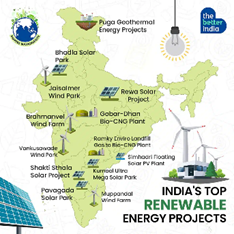
- Power Generation: Solar PV and CSP plants generate clean electricity at utility-scale, rooftop-scale, or off-grid installations. Example: Bhadla Solar Park in Rajasthan with 2,245 MW capacity.
- Water Heating: Solar collectors heat water for domestic, commercial, and industrial use, reducing dependence on electricity or fossil fuels.
- Agricultural Pumping: Solar-powered pumps provide irrigation and drinking water in rural areas, enhancing energy access. Example: Solar pumps promoted under the PM-KUSUM scheme.
- Lighting: Solar lanterns and home lighting systems supply off-grid, sustainable lighting, especially in remote areas. Example: SELCO solar lighting solutions for rural households.
- Cooking: Solar cookers use reflective mirrors to cook food without electricity or fuel, promoting clean cooking solutions.
- Vehicles: Solar PV cells supplement battery power in electric vehicles, reducing fossil fuel consumption. Example: Lightyear One EV with solar-assisted charging.
- Desalination: Solar thermal energy is used to desalinate seawater, providing potable water in water-scarce areas. Example: BARC’s solar desalination system.
Government Initiaves
| Schemes | Objective | Key Feature | Benefit | Example |
| PM-KUSUM | Promote solar irrigation & income | Solar pumps, grid-connected plants | Reduce diesel use, increase farmer income | Solar pumps in Rajasthan/UP |
| PM Surya Ghar | Provide rooftop solar to households | 300 units free electricity per month | Reduce electricity bills, promote solar | Rural & semi-urban households |
Q. Consider the following statements about solar energy in India:
1.	Solar energy can be harnessed through Photovoltaics (PV).
2.	Solar PV systems convert sunlight into electricity using the photovoltaic effect.
3.	CSP plants can store thermal energy and generate electricity even after sunset.
4.	Solar heating and cooling (SHC) systems generate electricity for the grid.

Which of the statements given above are correct?
(a) 1, 2, and 3 only
(b) 1 and 2 only
(c) 2, 3, and 4 only
(d) All of the above

Answer: (a) 1, 2, and 3 only

Explanation:
Statement 1 is correct: India uses PV, CSP, and SHC technologies.
Statement 2 is correct: PV systems convert sunlight directly into electricity through the photovoltaic effect.
Statement 3 is correct: CSP plants can store thermal energy and generate electricity even after sunset.
Statement 4 is incorrect: SHC systems provide thermal energy for water heating, space heating/cooling, or cooking; they do not generate electricity for the grid.
Practice Today’s MCQs
Short Code: