
Why in the News?
- Recently, two suspected cases of the Nipah Virus (NiV) were identified at AIIMS Kalyani in West Bengal. The patients, both healthcare workers, are in critical condition.
- This has prompted the central government to deploy a National Joint Outbreak Response Team to support state containment efforts and contact tracing across districts like North 24 Parganas and Purba Bardhaman.
Overview of Nipah Virus
- About: The Nipah virus (NiV) is a zoonotic virus, meaning it spreads from animals to humans. It belongs to the Henipavirus genus under the Paramyxoviridae family.
- Natural Hosts: Its natural hosts are fruit bats of the Pteropodidae family, while pigs can act as intermediate hosts.
- Origin: NiV was first identified in Kampung Sungai Nipah, Malaysia (1998–1999).
- Indian Outbreak: In India, the first outbreak occurred in Siliguri, West Bengal (2001), followed by outbreaks in 2007, and repeated outbreaks in Kerala (2018, 2023, 2025).
- Viral Structure and Genome: Nipah virus (NiV) is a negative-sense, single-stranded RNA meaning its RNA must first be converted into a positive-sense strand to produce proteins.
- Enveloped Virus: NiV is an enveloped virus, which means it has a lipid membrane surrounding its capsid, helping it attach to and enter host cells.
- Cytoplasmic Structure: Distinct near the endoplasmic reticulum, which are sites for viral assembly and replication.
- Structural Proteins: Encodes six major proteins:
- N (Nucleocapsid): Protects the RNA.
- P (Phosphoprotein): Involved in replication.
- M (Matrix protein): Maintains viral structure.
- F (Fusion protein) & G (Glycoprotein): Essential for attaching to and entering host cells.
- L (Large polymerase): Facilitates RNA synthesis.
- Host Receptors: The virus binds to Ephrin-B2 and B3 receptors on human cells, which explains its ability to attack both the respiratory system and the brain.





Transmission Dynamics of Nipah Virus
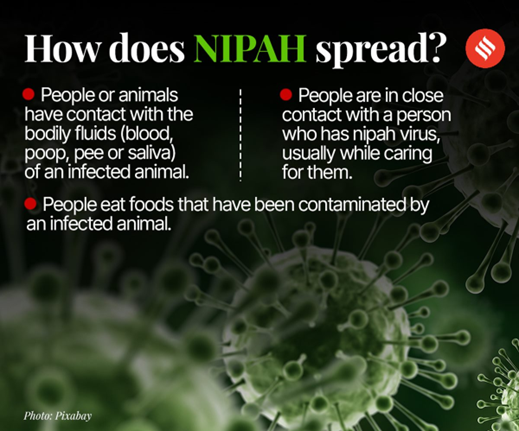
Infection may occur through close contact with infected animals such as bats or pigs, especially via their bodily fluids. Other animals like goats, horses, dogs, and cats can also be infected.
- Spillover to Humans:
- Contaminated Food: In India and Bangladesh, a major source of Nipah infection is the consumption of fruits contaminated with the saliva or urine of infected fruit bats (genus Pteropus).
- Animal Contact: Direct contact with infected pigs or bats.
- Human-to-Human: Spread through respiratory droplets or bodily fluids, particularly common in hospital settings (nosocomial transmission) and among caregivers.
Clinical Symptoms and Diagnosis of Nipah Virus Infection
Nipah virus infection primarily affects the respiratory and nervous systems and is highly contagious, spreading through contact with infected animals or humans.
- Signs and Symptoms:
- Early Symptoms: Patients may experience fever, headache, muscle pain, nausea, and a sore throat.
- Progressive Symptoms: As the disease advances, individuals may show dizziness, drowsiness, and neurological signs indicative of acute encephalitis.
- Severe Cases: In critical situations, seizures may occur, potentially leading to coma within 24–48 hours.
- Overall Severity: The infection ranges from mild to severe, potentially causing brain inflammation (encephalitis) and death.
- A person can sometimes carry the Nipah virus without showing any symptoms, remaining asymptomatic while still capable of spreading the infection.
- Diagnostic Tools: The Nipah virus is classified as a Biosafety Level-4 (BSL-4) pathogen, and testing must be conducted in specialized high-containment laboratories to prevent its spread.
- Diagnosis involves testing blood samples for antibodies, conducting histopathological examinations (microscopic study of tissues), using Polymerase Chain Reaction (PCR) to detect viral genetic material, and performing virus isolation.
- Confirmatory tests include the Serum Neutralization Test (SNT), Enzyme-Linked Immunosorbent Assay (ELISA), and Reverse Transcription PCR (RT-PCR).
Treatment and Management of Nipah Virus Infected Person
- Currently, there are no vaccines available for humans or animals. Treatment focuses on intensive supportive care, with patients kept under quarantine and isolation to prevent further transmission.
- Experimental Drugs: Ribavirin, Remdesivir, and monoclonal antibodies may reduce mortality.
Q. Consider the following statements regarding Nipah Virus (NiV):
1.	Nipah Virus is a zoonotic virus and belongs to the Henipavirus genus.
2.	Its natural hosts are fruit bats, and pigs can act as intermediate hosts.
3.	Nipah Virus is a positive-sense single-stranded RNA virus.
4.	Human-to-human transmission occurs through respiratory droplets or bodily fluids.

Which of the statements given above is/are correct?
(a) 1 only
(b) 1 and 2 only
(c) 2 and 3 only
(d) 1, 2, and 3

Answer: (b) 1 and 2 only

Explanation:
Statement 1 – Correct: Nipah Virus is a zoonotic virus (transmitted from animals to humans) and belongs to the Henipavirus genus under the Paramyxoviridae family.
Statement 2 – Correct: Its natural hosts are fruit bats of the family Pteropodidae, while pigs can serve as intermediate hosts.
Statement 3 – Incorrect: Nipah Virus is a negative-sense single-stranded RNA virus, not positive-sense. Negative-sense RNA must be transcribed into positive-sense mRNA before protein synthesis.
Statement 4 – Not part of the correct options here: While human-to-human transmission through respiratory droplets is true, the question asks which statements are correct from the listed options 1–3.
Practice Today’s MCQs