
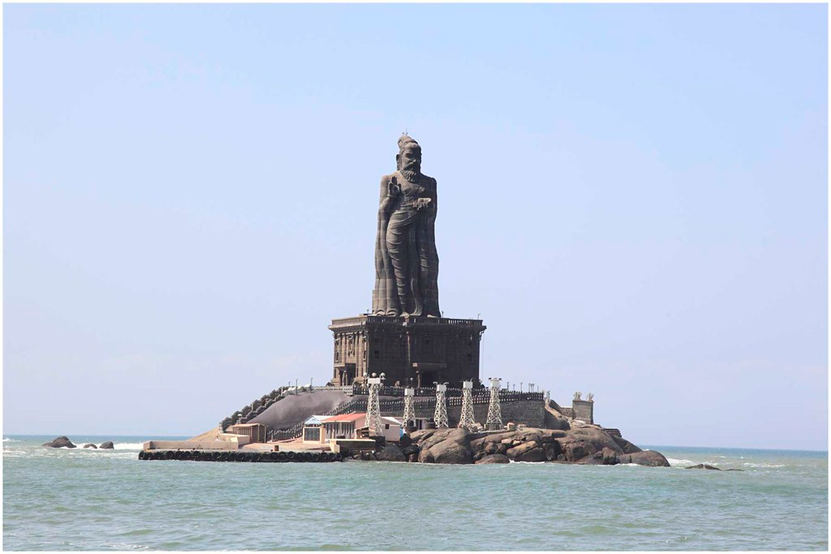
Why In the News?
- Recently, the Prime Minister of India paid homage to saint-poet Thiruvalluvar on Thiruvalluvar Day, which is celebrated annually in Tamil Nadu as part of the Pongal festivities to honour his contributions.
- Statue of Wisdom: In early 2025, the Tamil Nadu government marked the 25th anniversary of the 133-foot Thiruvalluvar Statue in Kanyakumari by officially naming it the “Statue of Wisdom.”
- Global Recognition: Recent initiatives include the establishment of a Thiruvalluvar Chair at the University of Houston (USA) and the release of the Tok Pisin translation of the Thirukkural in Papua New Guinea by the Prime Minister.
1. Who is Thiruvalluvar?
- Thiruvalluvar was an ancient Tamil poet-philosopher.
- Traditionally dated between 3rd century BCE and 1st century CE (exact period debated).
- Considered a moral philosopher rather than a religious preacher.
- Revered across religions and regions in India.
2. Major Work- Tirukkural
- Tirukkural is a classical Tamil text authored by Thiruvalluvar.
- Consists of 1,330 couplets (kurals).
- Written in Kural Venba metre.
- Each couplet contains two lines.




3. Structure of Tirukkural
Tirukkural is divided into three parts:
- Aram (Virtue / Ethics)
- Deals with moral values, righteousness, and duties.
- Contains 38 chapters.
- Porul (Wealth / Polity)
- Focuses on governance, statecraft, economy, and social life.
- Contains 70 chapters.
- Inbam (Love / Desire)
- Discusses love, family life, and emotions.
- Contains 25 chapters.
4. Philosophical Significance
- Emphasizes universal ethics rather than sectarian beliefs.
- Avoids references to any specific religion or deity.
- Applicable to individual conduct, governance, and society.
- Often compared with:
- Arthashastra (statecraft)
- Manusmriti (ethics)
- Bhagavad Gita (moral philosophy)
5. Language and Style
- Written in pure classical Tamil.
- Known for brevity, clarity, and universality.
- Translated into many Indian and foreign languages.
- One of the most translated non-religious texts in the world.
6. Cultural Importance
- Thiruvalluvar is regarded as a cultural icon of Tamil civilization.
- Statues and institutions named after him across India.
- Tirukkural is considered part of Tamil Sangam literature (post-Sangam period).
- Frequently quoted in administration, ethics, and public life.
Consider the following statements regarding Thiruvalluvar and Tirukkural:
1.	Tirukkural is written in Kural Venba metre and consists of 1,330 couplets.
2.	Tirukkural is divided into four parts dealing with ethics, wealth, love, and liberation.
3.	Thiruvalluvar’s philosophy is secular in nature and avoids explicit religious references.
4.	Tirukkural primarily focuses on devotional themes and religious rituals.

Which of the statements given above are correct?
A. 1 and 3 only
B. 1, 2 and 3 only
C. 2 and 4 only
D. 1, 3 and 4 only

Correct Answer: A
Solution
Statement 1 – Correct
 Tirukkural consists of 1,330 couplets written in the Kural Venba metre.
Statement 2 – Incorrect
 Tirukkural has three parts (Aram, Porul, Inbam), not four; it does not explicitly deal with Moksha.
Statement 3 – Correct
 Thiruvalluvar’s work is secular and universal, avoiding explicit religious or sectarian references.
Statement 4 – Incorrect
 Tirukkural focuses on ethics, governance, and love, not devotional rituals.
Practice Today’s MCQs