
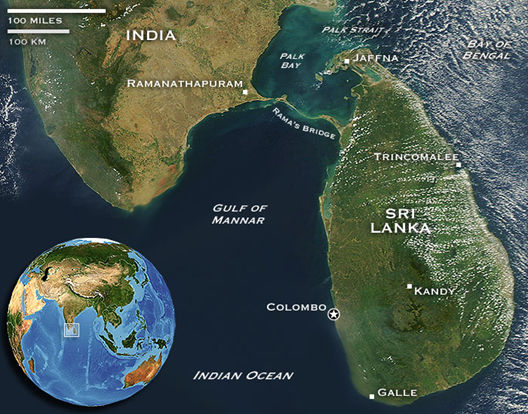
Why in the News?
- Recently, Operation Pawan regained prominence in national discourse as the Chief of the Army Staff (COAS), General Upendra Dwivedi, paid homage to the martyrs of the mission at the National War Memorial, New Delhi.
- This marks a historic shift, as it is the first time the Indian Army has officially commemorated the soldiers of this 1987 mission at the national level, addressing a decades-long demand for formal recognition.
1. About Operation Pawan
Background
- Operation Pawan was a military operation conducted by India in Sri Lanka.
- It followed the Indo–Sri Lanka Accord, 1987, signed between:
- India (PM Rajiv Gandhi)
- Sri Lanka (President J. R. Jayewardene)
2. Immediate Context
- Sri Lanka was facing a civil war between:
- Sri Lankan government forces
- LTTE (Liberation Tigers of Tamil Eelam) and other Tamil militant groups
- India had earlier supported Tamil groups politically and diplomatically.




3. Indo–Sri Lanka Accord (1987) – Key Provisions
- Devolution of powers to Sri Lankan provinces (13th Constitutional Amendment).
- Disarmament of Tamil militant groups.
- Deployment of Indian Peace Keeping Force (IPKF) to maintain peace.
- Assurance that Sri Lanka would not allow foreign powers to use its territory against India.
4. What was Operation Pawan?
- It was the codename for the combat role of IPKF in Sri Lanka.
- Conducted mainly against LTTE, after it refused to surrender arms.
- Marked a shift from peacekeeping to active military engagement.
5. Indian Peace Keeping Force (IPKF)
- Deployed in July 1987.
- Initially welcomed as peacekeepers.
- Later engaged in counter-insurgency operations against LTTE.
- Operated mainly in Northern and Eastern Sri Lanka.
6. Objectives of Operation Pawan
- Enforce the Indo–Sri Lanka Accord.
- Disarm LTTE and other militant groups.
- Restore normalcy and political process in Sri Lanka.
- Prevent external powers from influencing Sri Lanka.
7. Challenges Faced
- LTTE’s guerrilla warfare tactics.
- Lack of local support.
- Poor intelligence about LTTE terrain familiarity.
- IPKF caught between:
- Sri Lankan government
- Tamil civilian population
8. Outcome
- Operation Pawan failed to achieve its primary objectives.
- LTTE emerged stronger militarily and politically.
- Heavy casualties:
- Around 1,200+ Indian soldiers killed.
- India withdrew IPKF in March 1990 after:
- Change in Sri Lankan government
- Political opposition within India
9. Significance
- First major overseas military intervention by India.
- Highlighted limits of military solutions in ethnic conflicts.
- Impacted India–Sri Lanka relations for decades.
- Influenced India’s later doctrine of strategic restraint.
Consider the following statements regarding Operation Pawan:
1.	Operation Pawan was conducted as part of India’s commitment under the Indo–Sri Lanka Accord of 1987.
2.	The Indian Peace Keeping Force was deployed exclusively for humanitarian assistance and never engaged in combat operations.
3.	The LTTE initially agreed to disarm but later resisted the IPKF.
4.	Operation Pawan marked India’s first major overseas military intervention.

Which of the statements given above are correct?
A. 1 and 3 only
B. 1, 3 and 4 only
C. 2 and 4 only
D. 1, 2, 3 and 4

Correct Answer: (B)

Solution
Statement 1 – Correct
 Operation Pawan was launched to enforce provisions of the Indo–Sri Lanka Accord, 1987.
Statement 2 – Incorrect
 IPKF was initially a peacekeeping force but later engaged in full-scale combat operations against LTTE.
Statement 3 – Correct
 LTTE initially agreed to disarm but later refused and turned hostile.
Statement 4 – Correct
 It was India’s first large-scale military intervention outside its territory.
Practice Today’s MCQs