
After Reading This Article You Can Solve This UPSC Mains Model Question:
Examine the significance of India–Germany relations in India’s foreign policy and suggest measures to further strengthen the partnership. (GS-2 International Relations)
Context
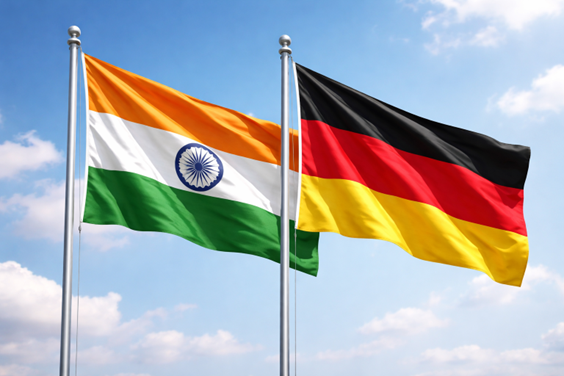
The bilateral relationship between India and Germany is currently at a historic peak. Following the landmark visit of German Chancellor Friedrich Merz to India (January 12–13, 2026), the ties have transitioned from a primarily trade-centric engagement to a deep Strategic and Technological Partnership. This visit marks the 75th anniversary of diplomatic relations and 25 years of the Strategic Partnership.
Evolution & Framework of the India-Germany Relations
The relationship has evolved from a Cold War-era “economic assistance” model to a 21st-century “Equal Strategic Partnership.”
- Phase I: Formative Years (1951–1990): India was among the first to recognize the Federal Republic of Germany (1951). Cooperation was primarily developmental (e.g., establishing IIT Madras in 1956 and the Rourkela Steel Plant).
- Phase II: Post-Cold War Expansion (1991–2000): Economic liberalization in India and German reunification led to a surge in engineering and manufacturing ties.
- Phase III: Strategic Maturation (2000–2020): Formal Strategic Partnership launched in 2000. Institutionalization began with the Inter-Governmental Consultations (IGC) in 2011.
- Phase IV: The “Zeitenwende” Pivot (2021–Present): Driven by global shifts, the partnership moved into high-security and high-tech domains (Submarines, Green Hydrogen, and Semiconductors).
Present Status: India–Germany Relations
The current relationship is anchored by the Inter-Governmental Consultations (IGC)—a unique cabinet-level dialogue mechanism.
1. Political & Diplomatic Maturity: Twin Anniversaries: 2026 marks 75 years of diplomatic ties and 25 years of Strategic Partnership.
- The “Merz Momentum”: Chancellor Friedrich Merz’s visit (his first to Asia) signaled Germany’s “Focus on India” strategy—de-risking from China and re-anchoring in India.
2. Strategic & Defense Shift: “Zeitenwende” (Turning Point): A significant policy shift where Germany now views India as a primary security partner in the Indo-Pacific.
- Institutionalization: Launched a Track 1.5 Foreign Policy and Security Dialogue and a new Indo-Pacific Consultation Mechanism to coordinate maritime security.
3. Economic & Tech Depth: Trade Record: Bilateral trade sustained at >$50 billion (making up 25% of India-EU trade).
- Critical Domains: Expansion into Semiconductors (Infineon’s GCC in GIFT City), Critical Minerals, and AI via the 2026-27 Digital Dialogue Work Plan.
4. The Green Anchor: GSDP Mid-term Review: 2026 is the half-way mark for the €10 billion Green and Sustainable Development Partnership.
- Commercial Green Energy: Transitioned from government aid to commercial reality (e.g., the AM Green-Uniper green ammonia offtake agreement).




Significance of India–Germany Relations
1. Strategic & Geopolitical Significance
- Indo-Pacific “Anchor”: Germany’s 2024–2026 “Focus on India” strategy marks a pivot away from a China-centric Asia policy. India is now Germany’s primary partner for maintaining a Rules-Based Order and maritime security.
- G4 Solidarity: Both nations collaborate closely to reform the UN Security Council, advocating for permanent seats to reflect 21st-century realities.
- Strategic Autonomy: Partnering with Germany provides India with an alternative to Russian and US dependencies, particularly in high-end technology and defense.
2. Economic & Industrial Significance
- Manufacturing Engine (Make in India): Germany’s “Mittelstand” (SMEs) are the backbone of global engineering. Their integration into India’s supply chains accelerates Industry 4.0 and high-tech manufacturing.
- De-risking Supply Chains: Following the “China+1” model, German investments in Semiconductors and Critical Minerals help India build resilient and trusted electronics ecosystems.
- Largest EU Partner: Germany acts as India’s gateway to the European market, accounting for over 25% of India-EU trade.
3. Technological & Environmental Significance
- Defense “Co-Development”: The shift from “Buyer-Seller” to “Co-Producer” (e.g., Project 75I submarines) grants India access to sensitive AIP (Air Independent Propulsion) and aero-engine technologies.
- Green Energy Leadership: Through the Green and Sustainable Development Partnership (GSDP), Germany’s technology (electrolyzers) combined with India’s low-cost renewables makes India a potential global hub for Green Hydrogen exports.
- Demographic Dividend & Skill Mapping: Germany’s labor shortage (400,000+ vacancies) and India’s young workforce create a “Win-Win” for Legal Mobility, benefiting sectors like Healthcare and STEM.
Key Challenges of India–Germany Relations
1. Geopolitical Divergences
- Strategic Autonomy vs. Alliances: Germany (a NATO pillar) seeks a firmer Indian stance against Russia. India maintains its Strategic Autonomy, balancing ties with both the West and its traditional partner, Russia.
- China Paradox: Germany views China as a “Systemic Rival” but remains economically dependent. India sees China as a direct territorial threat, leading to different speeds of “de-risking” vs. “de-coupling.”
2. Trade & Regulatory Hurdles
- The “Carbon Tax” (CBAM): Effective January 1, 2026, the EU’s Carbon Border Adjustment Mechanism penalizes Indian steel and aluminum. India views this as a non-tariff barrier that hurts its “Make in India” competitiveness.
- FTA Stagnation: Despite high-level optimism, disagreements over labor standards, dairy protection, and government procurement have historically delayed the India-EU Free Trade Agreement.
3. Defense Collaboration Asymmetry
- Export Restrictions: German domestic laws on arms exports remain among the world’s strictest. This often clashes with India’s demand for unrestricted Technology Transfer (ToT) and co-production rights.
- Delayed Deals: Landmark projects, such as the Project-75I submarines, face long lead times and high cost-thresholds compared to competitors.
4. Social & Consular Irritants
- Migration Friction: While mobility is increasing, recognition of degrees and language barriers hinder the full integration of the Indian workforce into Germany’s labor market.
- Consular Cases: Individual legal disputes (like the Ariha Shah case) act as persistent emotional triggers that occasionally cloud high-level diplomatic optics.
Recent Government Initiatives
- Defense Industrial Roadmap: A milestone agreement to move from “buyer-seller” to co-development and co-production. It fast-tracks projects like the Project-75I submarines and provides India access to German AIP (Air Independent Propulsion) technology.
- Indo-Pacific Consultation Mechanism: India launched a new dialogue with Germany to coordinate maritime security, signaling Germany’s increased strategic presence in the Indian Ocean.
- Semiconductor & Critical Minerals Partnership: Signed MoUs to build secure, trusted supply chains, including Infineon’s major tech expansion in India and joint exploration of critical raw materials.
- Visa-Free Airport Transit: Announced for Indian passport holders to facilitate easier travel through German hubs, a significant move to boost People-to-People ties.
- Green Hydrogen Offtake: Signed one of the world’s largest agreements (AM Green & Uniper) for India to export Green Ammonia to Germany, utilizing the €10 billion GSDP fund.
- Telecom & AI Work Plan: Adoption of the Digital Dialogue (2026–27) focusing on 6G standards, AI ethics, and manufacturing collaboration in ICT.
- Skilling for Global Mobility: Joint Declaration for recruiting Indian healthcare professionals and establishing a Centre of Excellence for Renewable Energy in Hyderabad to map Indian talent to German needs.
Way Forward: Strengthening India–Germany Relations
As the relationship enters its “Silver Jubilee” of Strategic Partnership (2025–26), the following steps are essential to sustain the current momentum:
- Finalizing the FTA Bridge: Both nations must prioritize the early conclusion of the India-EU Free Trade Agreement. This would provide the necessary “regulatory bridge” to reduce non-tariff barriers and offer investment protection for the German Mittelstand.
- Navigating the Carbon Gap: India and Germany should engage in high-level technical dialogues to align India’s Carbon Credit Trading Scheme (CCTS) with the EU’s CBAM. This ensures that carbon prices paid in India are recognized in Europe, protecting Indian exporters.
- Operationalizing Defense Co-production: Shift from dialogue to delivery by finalizing the Project-75I Submarine deal and the Eurodrone collaboration. Success here will cement Germany as a “trusted partner” for India’s defense indigenization (Atmanirbhar Bharat).
- Scaling the Green Corridor: Rapidly implement the Green Ammonia offtake agreements to establish a commercial “Green Corridor.” This transforms the GSDP from a government-funded initiative into a private-sector-led energy security pillar.
- Global South Synergy: Expand Triangular Cooperation where India’s project execution skills and Germany’s capital/technology combine to develop sustainable infrastructure in Africa and the Indo-Pacific, offering a transparent alternative to the BRI.
- Talent Integration: Fully leverage the Migration and Mobility Partnership (MMPA) by simplifying degree recognition and expanding German language training across Indian universities to meet Germany’s labor needs.
Conclusion
The India-Germany relationship has successfully moved beyond “Engineering Goods” to “Engineering a Multipolar World.” By bridging the Carbon Gap through technology and the Security Gap through industrial collaboration, these two democratic powers are set to remain in the “Dual Engines” of global stability. The partnership is no longer just transactional; it is existential for the strategic autonomy of both nations.