
After Reading This Article You Can Solve This UPSC Mains Model Questions:
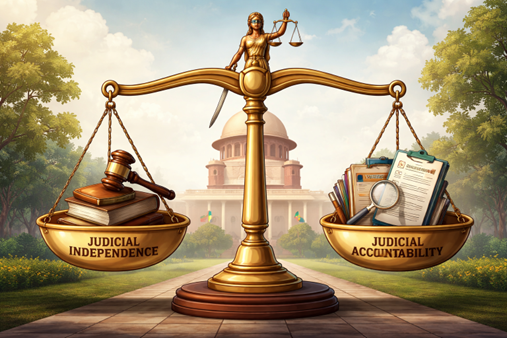
How does the constitutional scheme for removal of judges in India attempt to balance judicial independence with accountability? Examine the concerns associated with its present operation. 250 words. (GS Paper 2, Polity)
Context
Context
In December 2025, 107 Lok Sabha MPs submitted a notice seeking removal of Justice G.R. Swaminathan, Madras High Court, citing 13 charges, including: Alleged violation of secular constitutional principles & Alleged bias favouring a particular community
Constitutional Provisions of Removal
- The Term ‘Impeachment’: Strictly speaking, the Constitution uses the word “Impeachment” only for the President (Article 61). For judges, the Constitution uses the term “Removal.”
- Articles Involved:
- Supreme Court Judges: Articles 124(4) and 124(5).
- High Court Judges: Articles 217(1)(b) and 218 (which states the procedure for SC judges applies to HC judges).
- Legislative Framework: Under Article 124(5), Parliament enacted the Judges (Inquiry) Act, 1968 and the Judges Inquiry Rules to regulate the procedure for investigation and proof of misbehaviour.
Grounds for Removal of Judges
A judge can be removed only on two grounds:
- Proved Misbehaviour: Not defined in the Constitution but interpreted by the SC as conduct bringing dishonour to the judiciary, corruption, or lack of integrity.
- Incapacity: Physical or mental inability to perform duties.
Judicial Interpretations of “Misbehaviour”:
- K. Veeraswami vs. Union of India (1991): Standard of judicial behavior is absolute; deviation is a betrayal of public trust.
- M. Krishna Swami vs. Union of India (1992): Every error of judgment is not misbehaviour. It requires mens rea (guilty mind), wilful misconduct, or moral turpitude.
The Removal Process of Judges of the Supreme Court:
- Initiation (The Notice):
- A motion signed by at least 100 members (Lok Sabha) or 50 members (Rajya Sabha) is submitted to the Presiding Officer (Speaker/Chairman).
- Admission Stage (The “Threshold” Power):
- The Speaker/Chairman has the discretion to admit or refuse the motion.
- Note: In this capacity, the Speaker acts as a statutory authority, not just a presiding officer. This decision can be challenged in court.
- Investigation (Three-Member Committee):
If admitted, the Speaker/Chairman appoints a committee:
A Supreme Court Judge.
A Chief Justice of a High Court.
A Distinguished Jurist. - Parliamentary Vote (The “Address”):
If the committee finds the judge guilty, the House takes up the motion.
Required Majority (Special Majority):
Majority of the Total Membership of each House, AND
The majority of not less than 2/3rds of members present and vote. - Presidential Order:
- Once passed by both Houses in the same session, the address is sent to the President, who passes an order for removal.
Challenges regarding judicial removal
1. The “Gatekeeper” Bottleneck
- Absolute Discretion: The Speaker/Chairman can reject a motion at the threshold even if it has the required 100/50 signatures.
- Lack of Accountability: There is no statutory requirement for the Presiding Officer to provide a “reasoned order,” making the rejection potentially arbitrary or politically motivated.
2. Political Shielding
- Executive-Legislative Nexus: Since the Speaker/Chairman usually represents the ruling party, a judge perceived as “pro-establishment” can be shielded from investigation.
- Numbers Game: The requirement for a Special Majority (2/3rds present and voting) turns a legal inquiry into a political consensus-building exercise, which is rarely achieved in a polarized Parliament.
3. Definitional Vagueness
- Undefined “Misbehaviour”: The Constitution leaves “misbehaviour” undefined. This lack of a clear legal yardstick allows for subjective interpretation by both the political class and the inquiry committee.
- Actuation of Mens Rea: As noted in M. Krishna Swami (1992), proving “wilful misconduct” is a high evidentiary bar that often protects negligent or biased conduct that falls just short of criminal corruption.
4. Procedural Rigidity
- All-or-Nothing Approach: There are no intermediate disciplinary measures (like suspension or docking seniority). The process only allows for the “nuclear option” of total removal.
- Lapsing Motions: If the Lok Sabha dissolves before the process is completed, the motion lapses, allowing a judge under a cloud of suspicion to continue in office.
Way Forward
1. Institutionalize Graduated Sanctions: Move away from the “all-or-nothing” approach.
- Implement a mechanism for minor punishments (censure, suspension from judicial work) for lapses that do not warrant full removal but damage the court’s dignity.
2. Reform the Admission Stage: Amend the Judges (Inquiry) Act, 1968 to mandate that the Speaker/Chairman must issue a “Reasoned Order” when rejecting a motion.
- This ensures the decision is objective and subject to Judicial Review, preventing political shielding.
3. Statutory Code of Conduct: Formally codify the “Restatement of Values of Judicial Life” (1997) into law.
- Clear statutory definitions for “misbehaviour” and “incapacity” would reduce subjectivity during investigations.
4. Independent Oversight Body: Establish a National Judicial Oversight Committee (as suggested by the 2nd ARC) with a transparent, bipartisan composition to handle complaints from the public and the legislature.
5. Financial Transparency: Make annual disclosure of assets and liabilities mandatory for all judges of the higher judiciary to mitigate charges of “corruption” or “lack of integrity” at the threshold.
Conclusion:
To uphold the “Sentinel on the Qui Vive,” (meaning a watchful guardian) India must evolve beyond the 1968 Act toward a National Judicial Oversight framework. Codifying graduated sanctions and mandatory asset disclosures will bridge the accountability deficit, ensuring that judicial independence coexists with the transparency necessitated by constitutional morality and democratic trust.