
After Reading This Article You Can Solve This UPSC Mains Model Questions:
Analyse how the India–US Trade Deal 2026 strengthens India’s position in global supply chains while also posing challenges to its strategic autonomy. 250 Words (GS-3, Economy)
Context
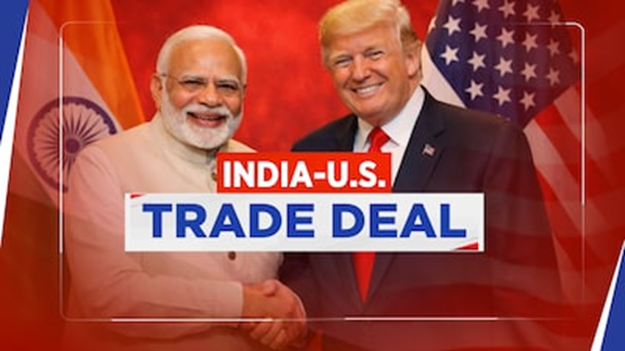
- Recently India and the United States announced a consequential trade agreement, ending nearly a year of intense “transactional diplomacy.” Coming shortly after major pacts with the European Union (EU) and the United Kingdom (UK), this deal completes a critical pillar of India’s “New Trade Architecture.”
- By reducing reciprocal tariffs to 18% and securing a $500 billion purchase commitment, the agreement transitions the relationship from a period of “tariff wars” to one of strategic economic alignment.
A Growing Network of Trade Partnerships
- Expansion of Global Trade Architecture: The India–U.S. trade deal represents a key outcome of India’s expanding international trade network, reinforcing its position in global commerce.
- Enhanced Access to Europe: Trade agreements with the European Free Trade Association (EFTA), the United Kingdom, and the European Union provide India with preferential market access across Europe.
- Strengthening the Pacific Footprint: Agreements with Australia and New Zealand position India as an important trade partner in the Pacific region.
- Deeper Engagement with West Asia: Trade pacts with Oman and the United Arab Emirates have expanded India’s market access in West Asia.
- Consolidation in the U.S. Market: The latest agreement with the United States strengthens India’s presence in the American market, reflecting deep integration with the global trading system.
About India–US Trade Relations
The road to the India-US trade deal2026 was characterized by a blend of deep economic integration and acute policy friction.
- Investment: The United States is India’s third-largest investor, with cumulative FDI inflows of USD 70.65 billion (2000–2025).
- Bilateral Trade Performance: In FY25, India–U.S. bilateral trade touched a record USD 132 billion, up from USD 119.71 billion in FY24, with India posting a trade surplus of USD 40.82 billion against the United States.
- Primary Trading Partnership: The United States (largest import market in the world) remains India’s largest trading partner, accounting for nearly one-fifth of India’s total exports, including critical sectors like Pharmaceuticals, IT services, Engineering goods, and Textiles.
- India’s Import from US: In FY25, India’s imports from the United States largely consisted of mineral fuels and oils, precious and semi-precious stones and metals, nuclear reactors and machinery, and electrical equipment.
- India’s Export to US: In contrast, India’s exports to the US in FY25 were led by electrical machinery, precious and semi-precious stones and metals, pharmaceutical products, machinery and mechanical appliances, mineral fuels, and articles of iron and steel.
- Military Partnership: US–India COMPACT (Catalyzing Opportunities for Military Partnership, Accelerated Commerce & Technology) launched in 2025 introduced Mission 500 to expand bilateral trade to USD 500 billion by 2030, supported by negotiations for a Bilateral Trade Agreement (BTA).
Key Provisions of the India-US Trade Deal 2026
The agreement balances substantial tariff relief for India with massive commercial and energy commitments for the U.S.
- Expanded Import Commitment by India: India has undertaken to import USD 100 billion worth of goods annually from the U.S. for five years, more than doubling FY25 import levels.
- The India’s import basket will mainly comprise energy products (oil, gas and coal), aircraft and aircraft components, advanced technology and high-value manufactured goods, precious metals, nuclear-related equipment, and select agricultural commodities.
- Tariff Rationalisation by the United States: The U.S. has agreed to reduce tariffs on Indian exports to 18% from the earlier peak of 50%, significantly improving market access and price competitiveness for Indian exporters, particularly in engineering goods, textiles and auto components.
- Safeguarding Sensitive Domestic Sectors: While expanding market access, India has retained firm protection for sensitive sectors, including genetically modified agricultural products, dairy, poultry, maize, cereals and corn, reflecting a calibrated trade strategy aligned with farmer welfare and food security concerns.
Strategic and Economic Significances of the India-US Trade Deal 2026
- Managing Trade Imbalances: The arrangement seeks to address the U.S. trade deficit in goods, particularly in agriculture, while for India it reduces tariff-related pressures and preserves stable access to the U.S. market.
- Energy Security and Diversification: Increased energy imports from the U.S. support India’s strategy of diversifying supply sources, lowering dependence on geopolitically volatile regions and enhancing long-term energy security.
- Geopolitical Significance: Beyond economic considerations, the deal reinforces India–U.S. strategic alignment amid shifting global trade patterns, supply-chain realignments and competitive dynamics with China, with trade increasingly serving as an instrument of strategic diplomacy.
- Enhanced Competitive Position: With tariffs reduced to 18%, India now enjoys a cost advantage over key competitors such as Vietnam and Bangladesh (20%) and China (30–35%).
- Improved Economic Stability: By eliminating the risk of a trade confrontation, the deal is expected to reduce uncertainty, support rupee stability, and revive FDI in India’s manufacturing sector.
Key Concerns of the India–US Trade Deal 2026
- Strategic Autonomy Concerns: The effectiveness of the deal is linked to expectations of reducing Russian oil imports, which could strain India’s long-standing strategic partnership with Russia, its major defence supplier, and test India’s multi-alignment and de-hyphenated foreign policy approach.
- Risk of Chinese Retaliation: As India’s role as a strategic counterbalance to China strengthens, the possibility of trade retaliation by Beijing remains, especially given India’s dependence on China for rare earths and pharmaceutical APIs.
- Lack of Regional Parity: India continues to face a relative disadvantage as competitors like Bangladesh and Vietnam benefit from GSP (Generalized System of Preferences) concessions, which were withdrawn from India in 2019.
- Domestic Economic Vulnerabilities: Greater market opening in dairy and poultry, if pursued, could expose Indian farmers to subsidised U.S. agricultural imports, risking rural distress. Additionally, replacing discounted Russian oil with costlier alternatives may raise the import bill and widen the Current Account Deficit (CAD).
- Regulatory and Technical Barriers: Despite tariff reductions, stringent U.S. Sanitary and Phytosanitary (SPS) standards continue to restrict Indian agri-food and pharma exports, while potential alignment with US-centric IPR (Intellectual Property Rights) regimes could escalate healthcare costs.
- Digital Trade Frictions: Differences over data localisation norms and India’s Digital Personal Data Protection Act (2023) remain unresolved, as U.S. technology firms seek unrestricted data flows that may conflict with India’s privacy and national security priorities.
Way Forward: Leveraging the Indo–US Trade Relations for Viksit Bharat
- Preserve Strategic Autonomy with Energy Security: Balance geopolitical alignment with economic prudence by diversifying energy sources, accelerating the National Green Hydrogen Mission, and expanding nuclear energy including SMRs, while leveraging trade partnerships for technology transfer.
- Diversify Trade and Export Markets: Reduce overdependence on the U.S. by fast-tracking FTAs with the Gulf and East Asian regions, enabling Indian exporters to access a wider set of stable markets.
- Safeguard Farmers and MSMEs: Calibrate tariff commitments through phased liberalisation and product-specific safeguards to protect agricultural livelihoods and small enterprises from import shocks.
- Institutionalise the Trade Framework: Expedite the India–U.S. Bilateral Trade Agreement (BTA) to address regulatory barriers, strengthen semiconductor and pharmaceutical supply chains, and enhance investment certainty.
- Leverage Friendshoring for Manufacturing: Use the 18% tariff advantage to attract supply chains relocating from China, moving from assembly-led growth to deep manufacturing under Make in India for the world.
- Promote Innovation-Driven Growth: Deepen collaboration under iCET (Initiative on Critical and Emerging Technology) in AI, space and advanced technologies, align IPR norms for high-tech sectors while retaining public-interest safeguards, and position India as a global R&D and innovation hub.
Conclusion
The India–U.S. Trade Deal 2026 is a historic turning point that replaces transactional friction with a stable, strategic economic alliance between the world’s two largest democracies. By securing critical market access and fostering high-tech collaboration, the agreement serves as a powerful catalyst for the Viksit Bharat 2047 vision, ensuring India’s ascent as a self-reliant global manufacturing and innovation hub.