
Context
Union Budget 2026–27 has earmarked ₹13,416.20 crore for the Department of Space, with a major thrust on deep-space exploration, astrophysics and large telescope infrastructure. This marks a strategic shift towards strengthening India’s frontier science capacity and reducing dependence on foreign observatories.
- Key Budget Announcements & Infrastructure
| Initiative | Location | Significance |
| 30-m National Large Optical-Infrared Telescope (NLOT) | India (site under development) | Will place India among global leaders in optical astronomy |
| National Large Solar Telescope (NLST) | Near Pangong Lake, Ladakh | High-resolution solar studies, space weather monitoring |
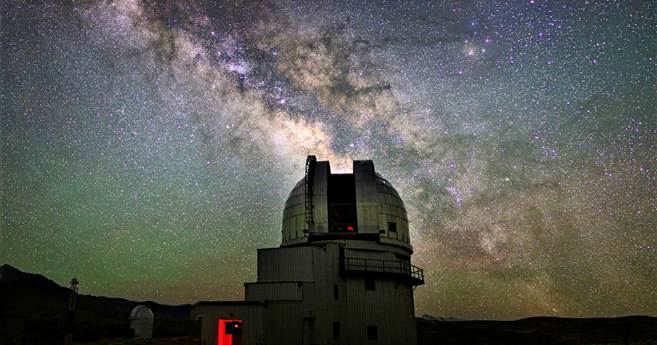
| Himalayan Chandra Telescope (HCT) | Hanle, Ladakh | Control system upgrades |
| COSMOS-2 Planetarium | Amaravati, Andhra Pradesh | Public science outreach |
| Giant Metrewave Radio Telescope (GMRT) | Near Pune | World’s largest low-frequency radio telescope array |
- India’s Present Challenges
- Underutilisation of funds: Actual expenditure often falls below budget estimates, causing project delays.
- Dependence on foreign facilities for:
- High-resolution optical astronomy
- High-frequency radio observations
- Sub-millimetre astronomy (India has no telescope in this range)
- Restricted access to international telescopes as nations prioritise domestic researchers.
- Bureaucratic resistance to innovative models like buying fractional telescope time abroad.
- Brain drain due to lack of comparable facilities within India.
- Global Context
Only USA, China, Japan, and the European Union heavily prioritise astronomy and continuously upgrade space-based and terrestrial telescopes.
- Strategic Vision
Astronomy & Astrophysics Mega Science Vision 2035
- Proposes:
- Sub-millimetre telescope (proposal in pipeline)
- Next-generation observatories
- AI-driven data processing centres
 Q. Consider the following statements regarding India’s astronomy and space research ecosystem:

 I. The Giant Metrewave Radio Telescope (GMRT) is the world’s largest low-frequency radio telescope array.
 II. India currently possesses a fully operational sub-millimetre wavelength telescope
 III. The National Large Solar Telescope is being set up near Pangong Lake in Ladakh.
 IV. IN-SPACe was established to promote public-private partnerships in the space sector.

 Which of the statements given above are correct?
 (a) I, III and IV only
 (b) I and II only
 (c) II, III and IV only
 (d) I, II, III and IV

 Correct Answer: (a)

 Explanation:
 Statement I Correct: The Giant Metrewave Radio Telescope (GMRT) located near Pune is the world’s largest radio     telescope array operating at low radio frequencies. It attracts astronomers from across the world and plays a  crucial role in studying pulsars, galaxies, and the early universe, making the statement correct.

 Statement II not Correct: India does not currently have any telescope operating in the sub-millimetre wavelength range, which is considered a critical window for studying dusty galaxies and proto-stellar disks. Such a facility is only at the proposal stage under the Astronomy & Astrophysics Mega Science Vision 2035, hence this statement is incorrect.

Statement III correct: The Union Budget 2026–27 has allocated funds for the construction of the National Large Solar Telescope (NLST) near Pangong Lake in Ladakh, aimed at high-resolution solar studies and space weather research. Therefore, this statement is correct.

Statement IV Correct: The Indian National Space Promotion and Authorisation Centre (IN-SPACe) was established in 2020 by the Department of Space to promote and regulate public-private partnerships and encourage private sector participation in India’s space ecosystem, making this statement correct.