
Context
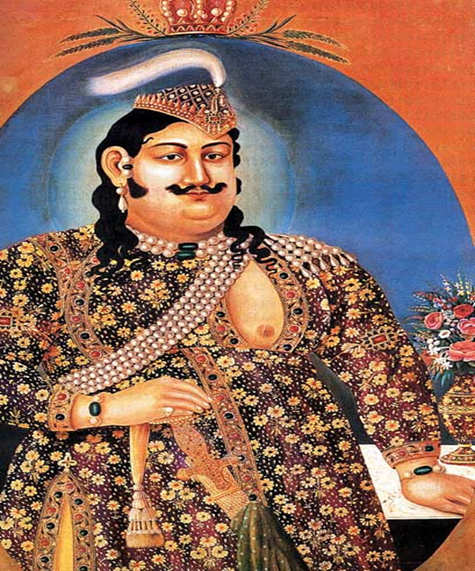
Recently, the 19th-century Nawab of Awadh, Wajid Ali Shah, returned to the limelight following the release of a new biography by his great-grandson, which challenges the long-held historical narrative that he was forcibly “exiled” to Calcutta by the British.
The book argues that the Nawab moved to Calcutta of his own volition to prepare for a journey to London to petition Queen Victoria against the annexation of his kingdom, a plan that was ultimately thwarted by the British.
Details About Nawab Wajid Ali Shah
1. The Tenth and Last Nawab of Awadh
- Wajid Ali Shah ascended the throne in 1847 at a time when the British East India Company (EIC) had already turned Awadh into a buffer state.
- Despite British claims of his “maladministration,” records show he introduced reforms in the military and judicial systems based on both Mohammedan and Hindu laws.
2. Annexation of Awadh (1856)
- Pretext: Lord Dalhousie annexed Awadh on February 7, 1856, citing “maladministration” or misgovernance, rather than the Doctrine of Lapse (as the Nawab had heirs).
- Justification: The decision was largely based on a biased report by the British Resident, Colonel Sleeman, and later James Outram.
- Impact: The annexation was a primary spark for the Revolt of 1857, as Awadh was the main recruiting ground for the EIC’s sepoys.
3. Patron of Culture and Arts
Wajid Ali Shah is often credited with the revival and refinement of North Indian art forms:
- Kathak: He was a disciple of Thakur Prasad and Durga Prasad. Under his patronage, the Lucknow Gharana of Kathak emerged, characterized by Nazakat (elegance) and Abhinaya (expression).
- Thumri: He is considered a pioneer of the light classical music form, Thumri. He composed numerous pieces under the pseudonym ‘Akhtarpiya’.
- Theatre: He established the ‘Parikhana’ (a school for music and dance) and staged elaborate dance-dramas called ‘Rahas’ (inspired by Rasleela).
4. Legacy in Calcutta (Metiabruz)
Following the annexation, he shifted to Metiabruz (Kolkata). He recreated the culture of Lucknow there, introducing:
- Cuisine: The addition of the potato to Biryani is famously attributed to the financial constraints of his exiled court in Calcutta.
- Pastimes: He popularized kite-flying and exotic animal collections (zoos) in Bengal.
5. Notable Literary Works
Wajid Ali Shah was a prolific writer in Urdu, Persian, and Braj Bhasha.
- Bani: A comprehensive treatise on music and dance.
- Huzn-i-Akhtar: An autobiographical work detailing his emotional suffering after losing his kingdom.
- Sawat-ul-Qalub: A massive collection of over 44,000 couplets.
Q. With reference to Nawab Wajid Ali Shah and the annexation of Awadh, consider the following statements:

I. Awadh was annexed by Lord Dalhousie under the provisions of the Doctrine of Lapse as the Nawab had no natural heir.
II. The Nawab composed several Thumris and musical treatises under the pen name 'Akhtarpiya'.
III. The Lucknow Gharana of Kathak reached its peak of refinement under his direct patronage and artistic guidance.

Which of the statements given above is/are correct?

A) I and II only
B) II and III only
C) III only
D) I, II, and III

Correct Answer: B

Explanation:
• STATEMENT I IS INCORRECT: Awadh was annexed on the grounds of maladministration (misgovernance), not the Doctrine of Lapse, because Wajid Ali Shah had several heirs (including Birjis Qadr).
• STATEMENT II IS CORRECT: The Nawab was a gifted musician and used 'Akhtarpiya' as his pseudonym for musical compositions.
• STATEMENT III IS CORRECT: He was a dedicated patron of Kathak; he studied under gurus Thakur and Durga Prasad and popularized the Lucknow Gharana.