
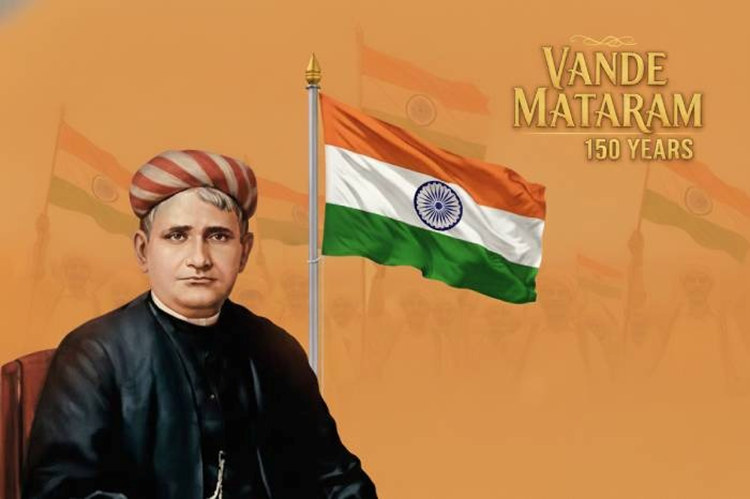
Context
Recently, a fresh administrative and political discourse has emerged following new guidelines issued by the Ministry of Home Affairs (MHA) regarding the protocol for the National Song, Vande Mataram.
Centre has mandated that the complete six-stanza version of the song be played or sung at official government functions, award ceremonies, and civil investiture ceremonies. Crucially, the directive stipulates that when both the National Song and the National Anthem are performed together, Vande Mataram must precede Jana Gana Mana.
Historical Evolution of Vande Mataram
1. Composition and Publication
- Author: Composed by Bankim Chandra Chattopadhyay in the 1870s (specifically 1875).
- Language: Written in a mixture of Sanskrit and Bengali.
- Literary Source: It was later included in his famous novel Anandamath, published in 1882, which depicts the Sannyasi Rebellion.
2. Role in the Freedom Movement
- 1896 Congress Session: First sung publicly by Rabindranath Tagore at the Calcutta session of the Indian National Congress.
- 1905 Swadeshi Movement: It became the primary rallying cry and a symbol of resistance during the protests against the Partition of Bengal.
- 1907 Global Recognition: Madam Bhikaji Cama unfurled the first version of the Indian flag in Stuttgart, Germany, with “Vande Mataram” inscribed on it.
Constitutional and Legal Status
1. National Song vs. National Anthem
- Adoption: On January 24, 1950, the President of the Constituent Assembly, Dr. Rajendra Prasad, declared Jana Gana Mana as the National Anthem and Vande Mataram as the National Song.
- Equality of Status: Dr. Prasad stated that Vande Mataram shall be honored equally with Jana Gana Mana and shall have equal status with it.
2. Legal Protections
- National Anthem: Explicitly protected under the Prevention of Insults to National Honour Act, 1971. Disrespecting or intentionally preventing the singing of the anthem is a punishable offense.
- National Song: While the government maintains it deserves equal respect, it is not explicitly mentioned in the 1971 Act or Article 51A (Fundamental Duties) of the Constitution. Article 51A(a) only mentions the National Flag and the National Anthem.
Comparison: Jana Gana Mana vs. Vande Mataram
| Feature | National Anthem (Jana Gana Mana) | National Song (Vande Mataram) |
| Composer | Rabindranath Tagore | Bankim Chandra Chattopadhyay |
| First Performance | 1911 (Congress Session, Calcutta) | 1896 (Congress Session, Calcutta) |
| Official Duration | Approximately 52 seconds | New guidelines: 3 mins 10 secs (Full version) |
| Legal Mandate | Prevention of Insults to National Honour Act, 1971 | Guidelines (MHA), No specific penal law yet |
| Fundamental Duty | Explicitly mentioned in Article 51A(a) | Not explicitly mentioned in Article 51A |
Q. With reference to the National Song and the National Anthem of India, consider the following statements:

1. The song ‘Vande Mataram’ was first sung at a public political occasion by Rabindranath Tagore in 1896.

2. Both the National Anthem and the National Song are explicitly mentioned as symbols to be respected under the Fundamental Duties (Article 51A).

3. According to the latest 2026 MHA guidelines, the National Song must be played before the National Anthem at official government ceremonies.

Which of the statements given above is/are correct?

A) 1 and 2 only
B) 2 and 3 only
C) 1 and 3 only
D) 1, 2, and 3

Answer: C

Solution:
• STATEMENT 1 CORRECT: Rabindranath Tagore set the tune for Vande Mataram and sang it at the 1896 Calcutta session of the Indian National Congress.
• STATEMENT 2 INCORRECT: Article 51A(a) of the Indian Constitution requires citizens to respect the "National Flag and the National Anthem." It does not explicitly mention the "National Song."
• STATEMENT 3 CORRECT: The new protocol issued by the Ministry of Home Affairs in early 2026 mandates that Vande Mataram precede the National Anthem during official state functions.