
Context
Genetic disorders often stem from small errors in the DNA sequence, such as nonsense mutations, which account for approximately one-quarter of all known disease-causing genetic changes. These mutations insert a premature “stop signal” in the DNA, causing protein production to end too early and leaving the body without essential functional proteins. Traditionally, each disorder required a unique, expensive, and slow-to-develop therapy.
1. The PERT Strategy: A Unified Approach
Researchers from the Broad Institute, Harvard, and the University of Minnesota have developed a single genome-editing strategy called Prime-Editing-mediated Readthrough of premature Termination codons (PERT).
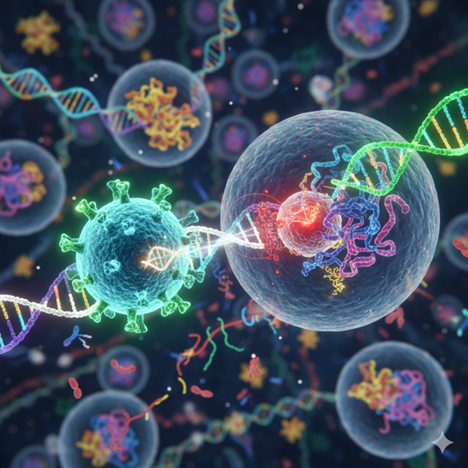
- Mechanism: PERT “reprogrammes” one of the cell’s own genes into a tool that overrides premature stop signals, allowing the cell to ignore the faulty instruction and complete the protein.
- Gene Repurposing: The technique utilizes tRNA (transfer RNA) genes. Human cells contain 448 tRNA genes, many of which are redundant.
- tRNA act as critical adaptor molecules in translation by carrying specific amino acids to the ribosome and matching them to corresponding codons on the mRNA.
- The “Suppressor tRNA”: Using prime editing, researchers converted a non-essential natural tRNA gene into a suppressor tRNA—a molecule that reads through premature stop signals and inserts an amino acid where there should have been a “stop”.
2. Key Components and Innovation
- Prime Editing (The Tool): This precise genome-editing approach uses a specialized molecule called a prime-editing guide RNA (pegRNA) to lead the editing machinery to the exact spot on the DNA.
- Prime-editing guide RNA (pegRNA) is a specially engineered RNA used in prime editing, a precise CRISPR-based genome editing method.
- It combines the roles of a guide RNA (like in CRISPR-Cas9) and a template for reverse transcription to introduce specific edits without making double-strand breaks.
- Selection Process: Researchers identified four specific tRNAs- leucine, arginine, tyrosine, and serine—that showed the most promise for therapeutic use.
- Efficiency: In cultured human cells, this combination achieved 60-80% editing efficiency, which is significantly higher than the standard 10-20% efficiency of traditional precision gene insertion methods like homology-directed repair.
3. Experimental Success and Results
The PERT strategy was tested on models of several rare diseases caused by nonsense mutations:
- Hurler Syndrome: Restored 1.7-7% of normal enzyme activity in the brain, heart, and liver, which is known to meaningfully reduce disease severity.
- Tay-Sachs & Batten Disease: Enzyme activity rose to 17-70% of normal levels in these models.
- Niemann-Pick C1: Cells produced measurable amounts of the full-length NPC1 protein, which is otherwise entirely absent in these patients.
In the context of recent advancements in genetic engineering, what is 'PERT' (Prime-Editing-mediated Readthrough of premature Termination codons)?

(A) A method to replace mitochondrial DNA in embryos to prevent hereditary diseases.

(B) A technique to increase the shelf-life of crops by silencing ripening genes.

(C) A diagnostic tool used to identify the presence of 'junk DNA' in the human genome.

(D) A strategy that reprograms tRNA genes to override premature stop signals in DNA.

Answer: D

Explanation:
PERT uses prime editing to convert redundant tRNA genes into suppressor tRNAs that can bypass nonsense mutations.