
Context
Union IT Minister Ashwini Vaishnaw has unveiled the roadmap for IndiaAI Mission 2.0 during the India AI Impact Summit 2026. This phase marks a strategic transition from foundational infrastructure building to deep research, indigenous development, and inclusive AI adoption across the national economy.
Key Pillars of the Mission
I. Democratization of Compute Infrastructure
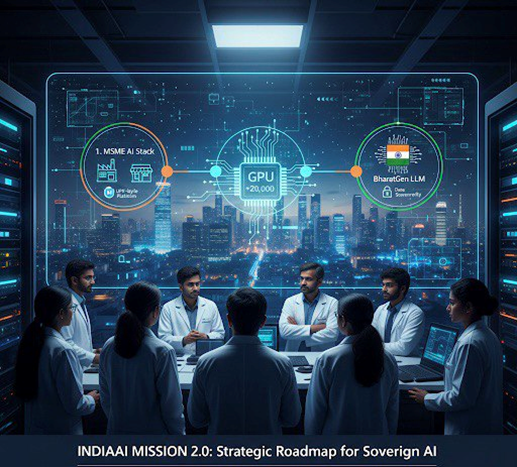
- GPU Augmentation: India plans to expand its AI compute capacity by adding 20,000 GPUs to the existing 38,000-unit fleet.
- Public Access: The mission ensures broad-based access to high-performance computing, preventing infrastructure monopoly by large corporations.
- Performance Benchmarks: Several sovereign AI models have demonstrated performance that outstrips global systems in specific evaluation parameters.
II. MSME-Focused AI Stack
- UPI-Style Architecture: The government is developing a common digital platform to host a bouquet of ready-to-use AI solutions for MSMEs.
- Ease of Adoption: This framework allows small and medium enterprises to access and deploy AI tools as seamlessly as digital payments through UPI.
III. Sovereign Capability and Innovation
- Full-Stack Sovereignty: The mission expands “Sovereign AI” beyond models to include indigenous chip development, control systems, and scalable applications.
- Strategic Autonomy: The objective is to scale AI solutions independently, eliminating reliance on foreign technological gatekeepers for approvals or upgrades.
2. Regulatory and Global Standing
I. Fair Remuneration Framework
- News Publisher Compensation: The government advocates for fair payment to news publishers when AI models use their publicly available content for training.
- Statutory Licensing: A DPIIT committee has recommended a mandatory blanket licensing regime, which could make India the first country to implement government-determined royalty rates for AI developers.
II. Investment and Economic Impact
- Global Ranking: According to Stanford’s Global Vibrancy Index, India is now positioned among the top three AI nations globally.
- Investment Projection: Over the next two years, an estimated $200 billion in investments is projected to flow into the Indian AI ecosystem.
3. High-Yield Prelims Facts
- BharatGen: This is the world’s first government-funded multimodal Large Language Model (LLM) initiative aimed at public service delivery.
- AIKosh: A centralized, high-quality social data repository developed to provide diverse Indian datasets for training sovereign models.
- Global Standing: India currently ranks 1st in AI skill penetration and AI talent concentration globally. (Standford AI Index Report, 2025)
Q. With respect to IndiaAI Mission 2.0, consider the following statements:

I. It aims to create an MSME-focused AI stack based on the principles of the Unified Payments Interface (UPI).

 II. The mission includes "BharatGen," which is characterized as the world’s first government-funded multimodal Large Language Model.

III. Under the proposed regulatory framework, India seeks to implement a mandatory blanket licensing regime for AI developers using copyrighted news content.

Which of the statements given above are correct?

(a) I and II only
(b) II and III only
(c) I and III only
(d) I, II, and III

Answer: D

Explanation:
•	Statement I is correct: The mission focuses on a common digital platform for MSMEs to access AI tools similar to the UPI model.
•	Statement II is correct: BharatGen is the designated name for the world's first government-funded multimodal LLM project.
•	Statement III is correct: The government is considering a statutory licensing framework to ensure fair remuneration for news publishers.