
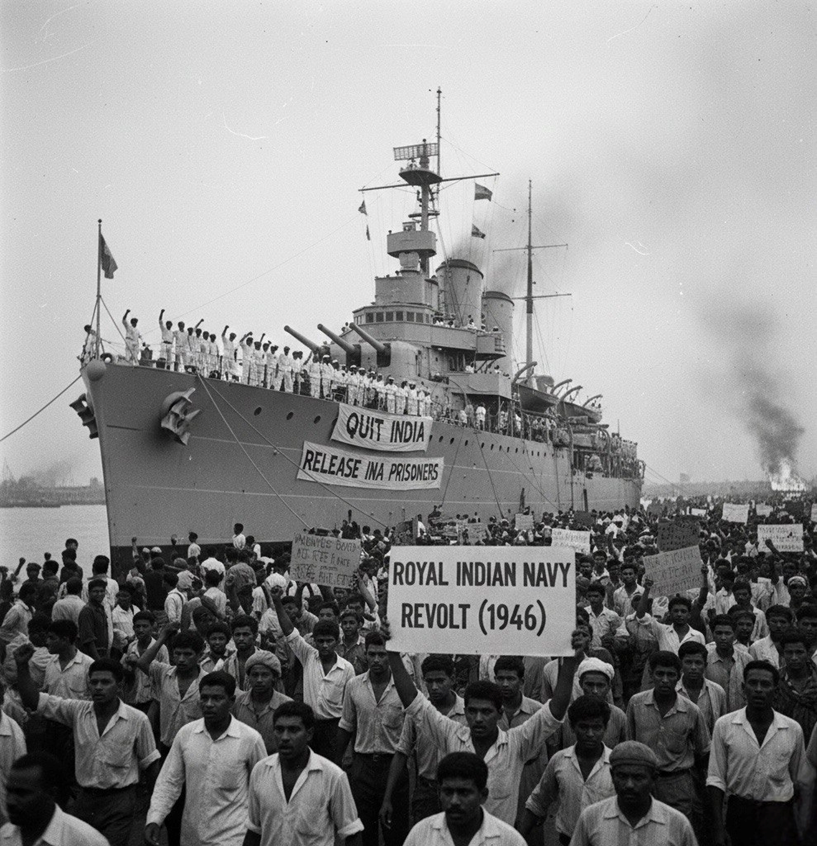
Context:
The year 2026 marks the 80th anniversary of the Royal Indian Navy (RIN) Revolt, a watershed moment in India’s struggle for independence that transcended communal divides and shook the foundations of British colonial rule.
1. Genesis of the Uprising
The revolt began on February 18, 1946, at the shore establishment HMIS Talwar in Bombay. What started as a hunger strike by naval ratings quickly escalated into a widespread insurrection. The primary catalysts included:
- Inhumane Conditions: Protest against sub-standard food and low wages.
- Racial Discrimination: Systematic mistreatment by British officers.
- Political Undercurrents: Influence of the Indian National Army (INA) trials and the charismatic leadership of Subhas Chandra Bose.
2. Scale and Spread of the Revolt
The uprising was not a localized “mutiny” but a coordinated naval and civilian defiance:
- Geographical Reach: Spread from Bombay to Karachi, Madras, Cochin, Vishakhapatnam, and Kolkata.
- Participation: Involved nearly 20,000 naval ratings, 78 ships, and 20 shore establishments.
- Symbolism: Ratings hoisted the flags of the Congress, Muslim League, and Communist Party simultaneously on naval masts, signaling unprecedented unity.
- Central Strike Committee: Led by M.S. Khan, the committee demanded the release of political prisoners and the withdrawal of Indian troops from Indonesia and Egypt.
3. Popular Mobilization
The revolt triggered a massive civilian surge in Bombay, particularly within the mill districts (Kamatipura and Madanpura).
- Hindu-Muslim Solidarity: Protesters from both communities jointly organized hartals and engaged in pitched battles against British machine guns.
- Casualties: Over 200 civilians were killed as the British utilized armored vehicles and heavy ammunition to suppress the street-level uprising.
- Surrender: On the advice of Sardar Vallabhbhai Patel and Muhammad Ali Jinnah, who provided assurances against victimization (which were later largely ignored), the ratings surrendered on February 23, 1946.
4 .Historical Significance & Legacy
- Impact on British Rule: The revolt convinced the British that the Indian Armed Forces could no longer be relied upon to maintain the Empire.
- Decolonization Catalyst: It accelerated the dispatch of the Cabinet Mission to India to negotiate the transfer of power.
Q. With respect to the Royal Indian Navy (RIN) Revolt of 1946, consider the following statements:

I. The uprising initially commenced at the shore establishment HMIS Talwar as a protest against racial discrimination and poor food quality.

II. The Naval Central Strike Committee was led by B.C. Dutt and exclusively demanded the improvement of service conditions.

III. The revolt received unified support from the top leadership of the Indian National Congress and the Muslim League, who encouraged the ratings to continue the strike.

IV. The uprising was characterized by a rare display of communal harmony, with protesters hoisting flags of the Congress, Muslim League, and the Communist Party together.

Which of the statements given above are correct?

(a) I and II only
(b) I and IV only
(c) II and III only
(d) I, II, and IV only

Answer : B

●	Statement I is correct: The revolt began on February 18, 1946, at HMIS Talwar in Bombay, primarily triggered by racial insults and poor living conditions.
●	Statement II is incorrect: While B.C. Dutt was an early protagonist, the Naval Central Strike Committee was headed by M.S. Khan. Furthermore, their demands were not "exclusive" to service conditions; they included political demands like the release of INA prisoners.
●	Statement III is incorrect: The senior leadership of both the Congress (Sardar Patel) and the Muslim League (Jinnah) did not support the violent nature of the mutiny and advised the ratings to surrender.
●	Statement IV is correct: One of the most striking features of the 1946 revolt was the communal unity among the ratings and the public, symbolized by the tri-color, the crescent, and the hammer-and-sickle flags flying together.