
Context
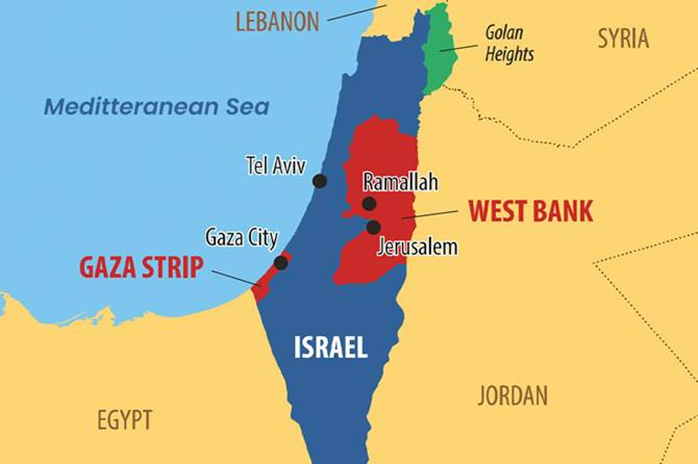
Recently, the West Bank has dominated global headlines as 85 countries issued a joint statement at the United Nations strongly condemning Israel’s latest plan to begin a massive land registration process in the territory.
1. Geographical Overview
- Location: The West Bank is a landlocked territory in West Asia, located on the western bank of the Jordan River.
- Borders: It is bordered by Jordan and the Dead Sea to the east, and by Israel to the north, west, and south along the “Green Line” (1949 Armistice Line).
- Terrain: The region is characterized by a north-south orientation of limestone hills, namely the Samarian Hills in the north and the Judean Hills in the south.
- Key Water Bodies: The Jordan River serves as the primary freshwater source and the natural eastern boundary, while the Dead Sea is the lowest point on Earth.
2. The Oslo Accords and Administrative Divisions
- Oslo II Accord (1995): This interim agreement divided the West Bank into three distinct administrative zones to facilitate a gradual transition to Palestinian self-rule.
- Area A (18%): Full civil and security control lies with the Palestinian Authority (PA); it includes major cities like Ramallah and Nablus.
- Area B (22%): The PA handles civil administration (health, education), while security is jointly controlled by Israel and the PA.
- Area C (60%): Israel retains full civil and security control; this area contains the vast majority of Israeli settlements and is the current focus of land registration disputes.
3. Strategic Cities and Locations
- Ramallah: Serves as the de facto administrative capital of the Palestinian Authority.
- Hebron (Al-Khalil): A major flashpoint city containing the Cave of the Patriarchs, a site holy to both Jews and Muslims.
- Jericho: Located in the Jordan Valley, it is one of the oldest continuously inhabited cities in the world and lies below sea level.
- Jenin: Home to a significant refugee camp and a frequent center for security operations.
4. International Legal Framework
- Status: The United Nations and the International Court of Justice (ICJ) categorize the West Bank as occupied territory rather than a part of Israel.
- Resolutions: UNSC Resolution 242 (1967) and Resolution 338 (1973) form the legal basis for the “Land for Peace” principle, calling for Israeli withdrawal from territories occupied in the Six-Day War.
Q. With reference to the geography and administration of the West Bank, consider the following statements:

1. The West Bank shares a maritime border with the Mediterranean Sea to its west.

2. Under the Oslo Accords, Area C is the largest administrative division and remains under full Israeli civil and security control.

3. The city of Jericho is located in the Jordan Valley and is situated below sea level.

How many of the above statements are correct?

A) Only one
B) Only two
C) All three
D) None

Correct Answer: B

Explanation:
•	STATEMENT 1 IS INCORRECT: The West Bank is a landlocked territory; while it is near the Mediterranean coast, it is separated from the sea by the sovereign territory of Israel.
•	STATEMENT 2 IS CORRECT: Area C covers approximately 60% of the West Bank and is the only zone where Israel maintains exclusive control over both security and civil matters (planning/construction).
•	STATEMENT 3 IS CORRECT: Jericho is situated in an oasis in the Jordan Valley and is globally recognized as one of the lowest-lying cities on Earth.