
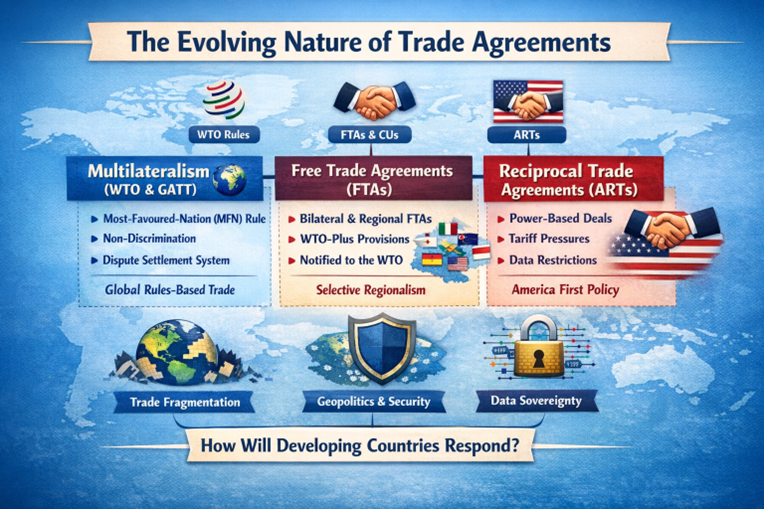
After Reading This Article You Can Solve This UPSC Mains Model Question:
The global trade architecture is witnessing a shift from rule-based multilateralism to power-driven bilateralism. Examine this transformation in the context of WTO, Free Trade Agreements (FTAs), and Agreements on Reciprocal Trade (ARTs). Discuss the implications for developing countries. (250 words, GS-2 International Relations)
Context
Global trade is shifting from WTO-led multilateralism to bilateral FTAs and imperial Agreements on Reciprocal Trade (ARTs), prioritizing unilateral interests and digital control over non-discriminatory, rules-based international cooperation.
The Three Typologies of International Trade Deals
1. Multilateralism (The WTO Era)
- This is the “gold standard” of the post-WWII global order, governed by the World Trade Organization (WTO) and the General Agreement on Tariffs and Trade (GATT).
- Core Principle: The Most-Favoured-Nation (MFN) rule. If a country grants a trade favor (like a 5% tariff) to one member, it must immediately extend that same favor to all other 160+ WTO members.
- The Goal: To create a non-discriminatory, rules-based system where large and small nations follow the same playbook.
- Scope: Broadly covers goods, services (GATS), and intellectual property (TRIPS).
- Democratic Agency: Features a “one-country-one-vote” system, allowing developing nations like India to form coalitions and bargain against superpowers.
2. Preferentialism (FTAs and Customs Unions)
- While the WTO emphasizes non-discrimination, Article XXIV of GATT provides a legal “escape hatch.” It allows countries to sign deals that give special treatment to specific partners.
- Free Trade Agreements (FTAs): Signatories eliminate tariffs among themselves but maintain their own individual tariffs for the rest of the world (e.g., India-UAE CEPA, RCEP).
- Customs Unions (CUs): Members not only eliminate internal tariffs but also adopt a Common External Tariff (CET) for non-members (e.g., the European Union).
- “WTO-Plus” Features: Modern FTAs often include chapters that the WTO hasn’t fully mastered, such as environmental standards, labor laws, and digital trade rules.
3. Reciprocal Trade (The “ART” Model)
- The most recent and controversial typology, championed by the Trump administration (and now adopted as a strategy in various forms), is the Agreement on Reciprocal Trade (ART).
- Philosophy: Moves away from “trade liberalization” toward “strict reciprocity.” It is a tit-for-tat model: “If your tariff on our cars is 20%, ours on yours will also be 20%.”
- Legal Status: These are often signed outside of the WTO’s Article XXIV framework. Because they aren’t notified to the WTO, they lack transparency and cannot be scrutinized by other nations.
- “Imperial” Nature: These deals often include “One-Sided” clauses. For example, a partner country might be forced to adopt U.S. national security trade restrictions or surrender data sovereignty (the right to tax digital services like Netflix or Google).
- The “Shadow” Factor: ARTs are often negotiated under the threat of unilateral, high-penalty tariffs, making them power-based rather than rules-based.
Key Shifts in Trade Dynamics
1. Geopolitical Reconfiguration
Traditional trade models were built on comparative advantage (producing where it’s cheapest). Today, “efficiency” is being replaced by “resilience” and “security.”
- Friend-shoring: Nations are redirecting supply chains toward “politically aligned” partners to mitigate risks from adversaries.
- Decoupling & De-risking: The U.S. and EU are actively reducing dependence on China, especially in critical sectors like semiconductors, rare earth minerals, and green energy.
- Trade Rerouting: While U.S. imports from China fell by ~20% in 2025, imports from ASEAN (especially Vietnam) surged, suggesting that Chinese goods are being “rerouted” or processed through intermediary countries to bypass tariffs.
2. The Weaponization of Tariffs
Tariffs are no longer just economic tools to protect domestic industry; they have become strategic weapons.
- Unilateralism: The 2024–2026 period has seen a massive spike in manufacturing tariffs, notably a global trend sparked by the U.S. “Liberation Day” reciprocal tariffs.
- Reciprocity over Liberalization: The shift toward Agreements on Reciprocal Trade (ARTs) marks a departure from the “win-win” philosophy of FTAs. These agreements often force partners to lower their tariffs while the dominant power maintains its protectionist barriers.
3. Digital Sovereignty vs. Data Flows
In the 20th century, trade was about containers; in the 21st, it is about data bytes.
- The E-commerce Moratorium: Developing nations (led by India and South Africa) have challenged the WTO moratorium on customs duties for electronic transmissions, arguing it results in massive revenue loss.
- Restrictive Digital Clauses: New ARTs often include clauses that prohibit data localization and ban digital taxes (like India’s Equalisation Levy), stripping nations of their “Digital Sovereignty”—the ability to regulate and tax their own digital markets.
4. “Green” Protectionism
Climate change is the new frontier for trade barriers.
- CBAM (Carbon Border Adjustment Mechanism): The EU’s carbon tax on imports ensures that “green” domestic products aren’t undercut by “dirty” imports from countries with lax environmental laws.
- Sustainability Standards: Trade deals now mandate adherence to high labor and environmental standards, which developing nations often view as “non-tariff barriers” designed to keep their goods out of Western markets.
Strategic Implications for India
1. The “Dual Axis” Strategy: EU vs. USA
India balances two distinct models:
- EU Axis (Formal Multi-alignment): The India-EU FTA emphasizes rules-based trade, eliminating tariffs on 96% of goods to reduce Chinese dependency.
- U.S. Axis (Transactional Reciprocity): A narrower Bilateral Trade Agreement (BTA) focuses on specific tariff disputes (steel/aluminum) and energy security (LNG/Crude) rather than deep structural integration.
2. Digital Sovereignty: The “Red Line”
India maintains a strict stance on protecting its digital borders:
- Refusal of “Data Free Flow”: India rejects trade clauses (U.S./UK) that ban data localization, ensuring domestic control.
- The Delhi Declaration (2026): At the AI Impact Summit, India opposed “AI extractivism,” advocating for sovereignty over data to prevent foreign firms from harvesting local data for profit.
3. Friend-Shoring and “De-risking” from China
India positions itself as the primary global alternative to China:
- Trusted Source Strategy: Participation in the Critical Minerals Ministerial secures raw materials for EVs and semiconductors, slashing reliance on Chinese imports.
- Selective Integration: By avoiding the China-led RCEP and prioritizing “democratic partners” (UK, EU, UAE), India pursues a strategy of values-based globalization.
4. Impact on Domestic Policy: Atmanirbharta 2.0
Trade negotiations are now a direct extension of internal economic policy:
- PLI Scheme Alignment: Negotiators protect Production Linked Incentive (PLI) sectors (solar, white goods) by ensuring tariff cuts do not hurt domestic capacity.
- Rare Earth Corridors: Budget 2026 introduced mineral corridors to link international raw material procurement directly to domestic manufacturing hubs.
Conclusion
India’s shift toward Strategic Pragmatism secures its digital and energy sovereignty, positioning the nation as a resilient, trusted hub within a fragmented global order through high-standard, value-based trade partnerships.