
After Reading This Article You Can Solve This UPSC Mains Model Question:
What is Carbon Capture, Utilization and Storage (CCUS)? What is the potential role of CCUS in tackling climate change? 150 Words (GS-3 Environment)
Context
In the 2026 Union Budget, India prioritized “Hard-to-Abate” sectors (Steel and Cement), providing Viability Gap Funding (VGF) for CCU pilot plants to counter the EU’s Carbon Border Adjustment Mechanism (CBAM).
About the Carbon Capture and Utilisation (CCU) Technologies
Carbon Capture and Utilisation (CCU) refers to technologies that capture CO₂ emissions from industrial sources (thermal power plants, cement, steel, refineries) and either utilise them in value-added products (chemicals, fuels, building materials) or store them (CCS – Carbon Capture and Storage).
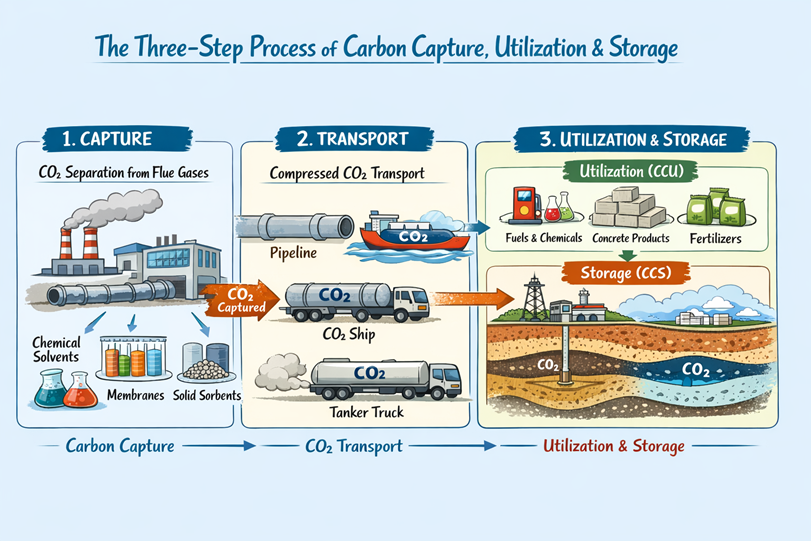
The Three-Step Process
- These diagrams visually explain the three-step CCUS process:
- Capture – CO₂ separated from industrial flue gases.
- Transport – Compressed CO₂ moved via pipelines/ships/tankers.
- Utilisation or Storage –
- Carbon Capture and Utilisation (CCU): Converted into fuels, chemicals, concrete and fertilizers.
- Carbon Capture and Storage (CCS): Injected into deep geological formations for permanent storage.
Why India Needs Carbon Capture and Utilisation (CCU)
1. Decarbonizing “Hard-to-Abate” Sectors
- Chemical Necessity: Sectors like Cement and Steel produce CO2 as a direct chemical byproduct (calcination) that renewables cannot eliminate.
- Economic Backbone: These industries are essential for “Viksit Bharat @ 2047”; CCU allows growth without high carbon penalties.
2. Protecting “Young” Industrial Assets
- Avoiding Stranded Assets: India’s industrial plants are relatively new. CCU allows for retrofitting existing coal and gas plants instead of costly, premature shutdowns.
- Resource Security: Extends the utility of domestic coal reserves while aligning with Net Zero 2070 targets.
3. Circular Carbon Economy (Waste-to-Wealth)
- Import Substitution: Converts captured CO2 into Urea (fertilizer) and Methanol, reducing India’s dependence on expensive chemical imports.
- Sustainable Infrastructure: Supports “green” construction by mineralizing CO2 into bricks and concrete.
4. Economic & Global Competitiveness
- Trade Resilience: Helps Indian exports bypass international carbon taxes like the EU’s CBAM (Carbon Border Adjustment Mechanism).
- Green Growth: Leverages the ₹20,000 crore CCUS allocation (Budget 2026) to foster start-ups and create specialized “Green Value Chain” jobs.
India’s Carbon Capture and Utilisation (CCU) Status
- Financial Commitment: A landmark ₹20,000 crore outlay in the Union Budget 2026-27 to de-risk private investment and scale up CCUS from pilots to commercial industrial plants.
- Operational Milestones: Launch of five integrated CCU Testbeds in the cement sector via Public-Private Partnerships (PPP) between top institutes like IITs/IISc and major firms (JSW, Dalmia).
- Market Mechanisms: Activation of the Indian Carbon Credit Trading Scheme (CCTS), with the first Carbon Credit Certificates (CCC) expected by October 2026 for 490 obligated entities.
- Strategic Roadmap: NITI Aayog’s 2026 reports identify CCUS as the only viable path for deep decarbonization in sectors like Cement and Aluminium, where demand is projected to grow 7x by 2070.
- Targeted Sectors: Strategic focus on five “hard-to-abate” sectors—Power, Steel, Cement, Refineries, and Chemicals to ensure “Viksit Bharat @ 2047” goals align with Net Zero 2070.
Global Carbon Capture and Utilisation (CCU) Initiatives
- COP30 “Belém to Baku” Roadmap: The official launch of the Paris Agreement Crediting Mechanism (PACM) under Article 6.4, allowing international trade of carbon credits from engineered removals like DAC and CCU.
- EU Industrial Carbon Strategy: Implementation of the Net-Zero Industry Act (NZIA), which mandates 50 million tonnes of annual CO2 storage by 2030 and establishes cross-border “open-access” hubs like Northern Lights.
- Mission Innovation (MI): A 23-country coalition (including India) pushing the CDR Mission to remove 100 Mt of CO2 annually by 2030, supported by global competitions at the 2026 World Energy Congress.
- Global Capacity Expansion: Reports from IEA and GCCSI show a 30% annual growth in the project pipeline, with global capture capacity on track to double by 2030 through shared industrial “hubs.”
- US 45Q Tax Credits: The Inflation Reduction Act provides up to $180/tonne for CO2 captured via Direct Air Capture, transforming carbon removal into a profitable business model and scaling DAC hubs in Texas and Louisiana.
Key Challenges of Carbon Capture and Utilisation (CCU)
- The Energy Penalty: Capturing CO2 is highly energy-intensive, requiring industrial plants to divert 15–25% of their power to run capture units, which can lead to higher overall fuel consumption.
- Techno-Economic Gap: High operational costs (up to ₹5,000/tonne) make CCU-derived products like green urea or concrete struggle to compete with cheaper fossil-based alternatives.
- Green Hydrogen Scarcity: Production of high-value CCU products, such as synthetic aviation fuel, depends on an affordable and steady supply of Green Hydrogen, which remains limited.
- Non-Permanence Issues: Unlike deep storage, many CCU pathways (like fuels or plastics) only delay emissions, as the CO2 is eventually released when the product is consumed or incinerated.
- Infrastructure Bottlenecks: India lacks a dedicated national CO2 pipeline network, making the transport of compressed carbon by road or sea expensive and carbon-heavy.
- Regulatory & Liability Gaps: Uncertainties regarding legal responsibility for CO2 leakage and the lack of global standards for “Carbon-Neutral” labeling hinder large-scale investor confidence.
Way Forward
- Hub and Cluster Model: Developing regional industrial clusters (e.g., Gujarat, Odisha) to share CO2 pipeline and storage infrastructure, drastically reducing the per-tonne cost for individual factories.
- Carbon Market Activation: Implementing the Indian Carbon Credit Trading Scheme (CCTS) by October 2026 to allow companies to monetize captured carbon through tradeable certificates.
- Viability Gap Funding (VGF): Utilizing the ₹20,000 crore budget to provide direct financial support for the first 10–15 commercial-scale projects to bridge the techno-economic gap.
- High-Value Pathways: Prioritizing utilization in “Green Concrete” (mineralization) and Sustainable Aviation Fuel (SAF) by integrating with the National Green Hydrogen Mission.
- Policy Standardization: Establishing a clear national framework for CO2 transport safety, environmental standards, and long-term legal liability to encourage private investment.
- Indigenous R&D: Focusing on the development of low-cost, locally-made chemical solvents and a specialized workforce trained in carbon auditing and conversion technologies.
Conclusion
Integrating CCUS is vital for India’s Net-Zero 2070 goal. By 2026, shifting from pilots to industrial clusters will turn CO2 into a strategic asset, ensuring sustainable, competitive, and circular economic growth.