
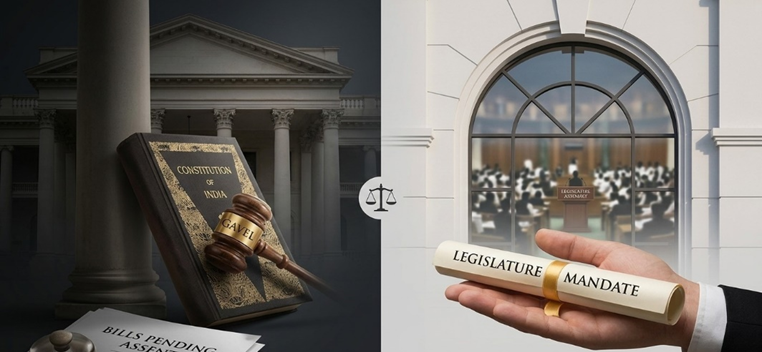
After Reading This Article You Can Solve This UPSC Mains Model Questions:
“The office of the Governor is intended to function as a neutral constitutional authority, yet recent controversies have raised concerns regarding the erosion of federal etiquette.” Discuss with reference to Articles 176, 200, and recent judicial interventions. 15 Marks (GS-2, Polity)
The Erosion of Federal Etiquette
The Governor holds a pivotal position in India’s constitutional framework as the constitutional head of the State. The office is expected to act as a neutral authority safeguarding the Constitution and facilitating the elected government, while also reflecting India’s federal system with a unitary bias by serving as a link between the Union and the State.
However in recent years, several controversies involving gubernatorial actions have raised questions about the scope of discretionary powers and the limits of constitutional authority.
These debates have brought attention to the interpretation of key constitutional provisions and judicial principles, including:
- Article 176 – Governor’s address to the State Legislature.
- Article 200 – Governor’s power regarding assent, return, or reservation of Bills.
- Doctrine of “Deemed Assent” developed through judicial interpretation to address delays in gubernatorial action.
- Article 164 – Governor’s authority in relation to appointment and tenure of ministers.
- Constitutional principles clarified in State of Punjab v. Governor of Punjab (2023) regarding the limits of gubernatorial discretion.
The Constitutional Role of the Governor: Theory vs. Practice
The office of the Governor is established under Article 153, which provides that each State shall have a Governor. The Governor is appointed by the President and holds office during the President’s pleasure under Article 156. Although the State’s executive power is formally vested in the Governor under Article 154, it is ordinarily exercised on the aid and advice of the Council of Ministers headed by the Chief Minister. In constitutional theory, therefore, the Governor performs three key roles:
- Constitutional Head of the State Executive
- Link between the Union Government and the State Government
- Guardian of Constitutional procedures within the State
The normative expectation is that the Governor functions as a non-partisan constitutional authority, ensuring continuity and stability in governance.
Article 176: The Special Address and the Governor’s Mandate.
Article 176 of the Constitution of India provides that the Governor shall address the State Legislature:
- At the commencement of the first session after each general election to the Legislative Assembly.
- At the first session of the Legislature each year.
Constitutional Significance
The Governor’s address outlines the policy framework and legislative agenda of the elected government and is followed by a Motion of Thanks, allowing the Legislature to debate government policies. In practice, the speech is prepared by the Council of Ministers, reflecting the principle that the Governor acts on ministerial advice.
Constitutional Implications
When the Governor declines to deliver the address or substantially alters the text prepared by the government, it raises constitutional concerns because:
- The address represents the policy statement of the elected government, not the personal views of the Governor.
- Refusal or alteration may undermine the principle of responsible government.
- It may disrupt established parliamentary conventions.
Thus, adherence to Article 176 is essential for maintaining the procedural integrity of legislative functioning.
The Stalemate over Legislation.
Constitutional Provision
Under Article 200 of the Constitution of India, when a Bill passed by the State Legislature is presented to the Governor, the Governor may:
- Give assent to the Bill.
- Withhold assent and return the Bill to the Legislature for reconsideration (if it is not a Money Bill).
- Reserve the Bill for consideration of the President.
Return of a Bill
If the Governor returns a Bill for reconsideration, the Legislature may re-pass the Bill with or without amendments. Once the Bill is re-passed, the Governor is generally expected to grant assent unless the Bill is reserved for the President under Article 201 of the Constitution of India.
Problem of Legislative Delay
Although Article 200 specifies the options available to the Governor, it does not prescribe a time limit for exercising these options. This constitutional silence has sometimes resulted in prolonged delays in granting assent to Bills.
Such delays may effectively obstruct legislative intent, thereby creating tensions between the Governor and the elected government.
The Doctrine of Deemed Assent
The absence of a clear timeline in Article 200 has led courts to evolve the doctrine of deemed assent.
Conceptual Basis
Deemed assent refers to a judicial interpretation whereby a Bill may be treated as having received assent if the Governor fails to act within a reasonable period or exercises powers in a manner inconsistent with constitutional principles.
Although the Constitution does not explicitly provide for deemed assent, the doctrine emerges from broader constitutional principles such as:
- Democratic accountability
- Rule of law
- Functional efficiency of constitutional institutions
Constitutional Rationale
The judiciary has emphasized that constitutional authorities must exercise their powers within a reasonable timeframe. Indefinite delay in the legislative process may amount to a violation of the spirit of parliamentary democracy.
Thus, the doctrine of deemed assent acts as a constitutional safeguard against executive inaction.
The Punjab Case (2023) and Judicial Clarification
The scope of gubernatorial powers was significantly clarified in the case of State of Punjab v. Governor of Punjab (2023).
Background
The dispute arose between the Government of Punjab and the Governor regarding the summoning of the State Assembly and the processing of legislative Bills.
Supreme Court Observations
The Supreme Court of India held that:
- The Governor cannot indefinitely delay the legislative process.
- The Governor must ordinarily act on the aid and advice of the Council of Ministers.
- Constitutional authorities should facilitate democratic governance rather than impede it.
The judgment reinforced the principle that the Governor’s role is constitutional and procedural rather than political.
Arrest of a Minister and Gubernatorial Authority
Constitutional Provision
Under Article 164 of the Constitution of India, ministers hold office during the pleasure of the Governor.
However, this “pleasure doctrine” operates within the framework of parliamentary democracy, where the Council of Ministers is collectively responsible to the Legislative Assembly.
Constitutional Practice
In practice, the Governor exercises the pleasure doctrine on the advice of the Chief Minister. Consequently:
- The Governor cannot unilaterally dismiss a minister without the recommendation of the Chief Minister.
- Arrest or criminal proceedings against a minister do not automatically terminate ministerial office.
Judicial interpretation has consistently emphasized that the political accountability of ministers lies primarily with the elected government.
Oath of Ministers in the State
Constitutional Provision
According to Article 164(3) of the Constitution of India, a minister must take the oath of office and secrecy before the Governor prior to assuming office.
Constitutional Convention
Although the Governor administers the oath, the appointment of ministers occurs on the advice of the Chief Minister. Therefore, the Governor’s role in the oath-taking process is primarily formal.
If a court suspends the conviction of a minister, constitutional scholars generally argue that there is no legal barrier to the person assuming ministerial office, provided the disqualification provisions under the Representation of the People Act do not apply.
Implications for Indian Federalism: Key Challenges
- Absence of Clear Timelines – The Constitution does not prescribe specific time limits for Governors to act on legislative Bills, leading to delays and uncertainty.
- Politicisation of the Governor’s Office – Gubernatorial appointments are often political, which can affect the perception of neutrality and impartiality.
- Frequent Judicial Intervention – Constitutional ambiguities increasingly require judicial clarification, indicating institutional friction.
- Legislative Delays – Prolonged gubernatorial inaction can obstruct or slow down the legislative process.
- Centre–State Tensions – Disputes between Governors and elected State governments may intensify conflicts within the federal structure.
- Institutional Uncertainty – Such conflicts can create instability in governance and weaken public trust in constitutional institutions.
Way Forward
- Implement Commission Recommendations – The Sarkaria Commission recommended appointing eminent individuals detached from active politics as Governors to ensure neutrality and constitutional impartiality.
- Clarify Discretionary Powers – As suggested by the Punchhi Commission, clearer constitutional guidelines should be framed regarding the discretionary powers of Governors to avoid institutional conflicts.
- Fix Reasonable Timelines for Assent to Bills – Establishing clear timelines for gubernatorial decisions on Bills can prevent legislative delays and administrative uncertainty.
- Strengthen the Principle of Ministerial Advice – Constitutional conventions must be reinforced to ensure that Governors ordinarily act on the aid and advice of the Council of Ministers.
- Ensure Non-Partisan Appointments – Greater transparency and neutrality in the appointment of Governors can strengthen public trust and uphold the spirit of cooperative federalism.
Conclusion
The constitutional controversies surrounding the Governor’s tenure highlight the complex interaction between constitutional authority and democratic governance Going forward, strengthening constitutional conventions, judicial clarity, and cooperative federalism will be essential to ensure that the Governor’s office functions as a neutral constitutional institution, facilitating governance while respecting the democratic mandate of elected State governments.