
Context
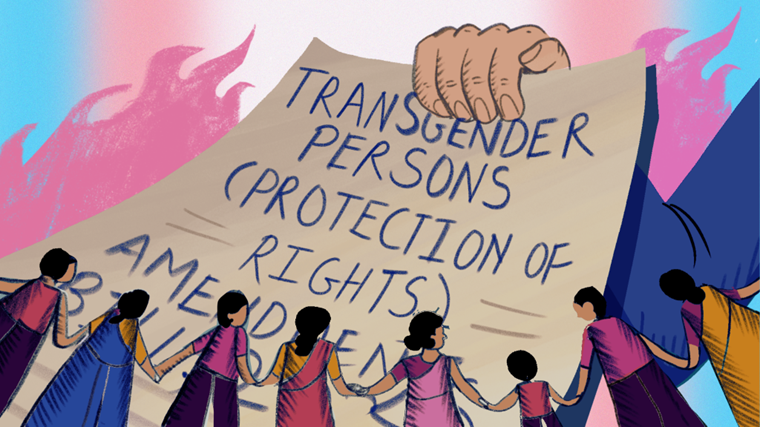
Recently, the Parliament passed the Transgender Persons (Protection of Rights) Amendment Bill, 2026, with the Rajya Sabha giving its approval on March 25, 2026, following the Lok Sabha’s passage of the Bill on the previous day. This legislative move has sparked intense national debate as it significantly alters the 2019 framework by shifting the legal recognition of transgender individuals from a “self-identification” model to a biological and medicalized framework.
Key Features of the Amendment Bill, 2026
1. Redefining “Transgender Person”
The Bill narrows the definition provided in the 2019 Act. It now specifically recognizes:
- Individuals belonging to socio-cultural identities such as Kinner, Hijra, Aravani, and Jogta.
- Persons with intersex variations or congenital variations in sex characteristics (chromosomal patterns, gonadal development, or hormones).
- Crucially, it excludes those who identify as transgender based on “self-perceived gender identity” or “gender fluidity” if they do not fit the biological or socio-cultural criteria.
2. Removal of Self-Identification
- The 2019 Act allowed a person to obtain a certificate of identity based on their self-perceived gender.
- The 2026 Amendment removes the right to self-determination. Legal recognition is now tied to a bureaucratic and medical verification process.
3. New Certification Process
- Authority: A Medical Board, typically headed by a Chief Medical Officer (CMO), is now the primary authority for assessing applicants.
- Role of DM: The District Magistrate will issue the Certificate of Identity only after receiving recommendations from the Medical Board.
- Medical Intervention: The Bill introduces oversight on gender-affirming procedures, requiring medical institutions to report such care to district authorities.
4. Enhanced Penal Provisions
The Bill introduces “graded punishments” to reflect the gravity of offences:
- Forced Identity: Compelling an adult to assume a transgender identity through force or deceit carries a sentence of 10 years to life imprisonment.
- Offences against Children: Forcing a child into a transgender identity or engaging them in forced begging/bonded labour carries a penalty of 10 to 14 years (or life) and heavy fines.
- Exploitation: Harsher punishments are set for those who force transgender persons into servitude or traditional begging systems against their will.
Comparison: 2019 Act vs. 2026 Amendment
| Feature | Transgender Persons Act, 2019 | Amendment Bill, 2026 |
| Basis of Identity | Self-perceived gender identity. | Biological traits & socio-cultural groups. |
| Certification | Administrative (DM issues based on application). | Medical (DM issues based on Medical Board report). |
| Inclusivity | Broad; included trans-men, trans-women, non-binary. | Narrow; focuses on Intersex and specific groups. |
| Punishment | 6 months to 2 years for most offences. | 5 years to Life Imprisonment (Graded). |
Constitutional & Legal Concerns
- Violation of NALSA v. Union of India (2014): The Supreme Court held that the right to self-identify one’s gender is a fundamental right under Article 21. Critics argue the Bill reverses this judicial mandate.
- Right to Privacy (Puttaswamy Case, 2017): Mandatory medical examinations are seen as an intrusion into an individual’s “bodily autonomy” and “informational privacy.”
- Article 14 (Equality): By creating a distinction between “biological” transgender persons and others, the Bill is accused of creating an arbitrary classification that lacks a rational nexus.
Q. With reference to the Transgender Persons (Protection of Rights) Amendment Bill, 2026, consider the following statements:

1. The Bill mandates that the "Certificate of Identity" can only be issued by a District Magistrate after a recommendation from a designated Medical Board.

2. It explicitly recognizes "self-perceived gender identity" as the primary basis for legal recognition, upholding the NALSA judgment.

3. The Bill introduces life imprisonment as a potential punishment for those who forcibly compel a child to assume a transgender identity.

How many of the statements given above are correct?
A) Only one
B) Only two
C) All three
D) None

Solution: B) Only two

•	STATEMENT 1 IS CORRECT: Under the 2026 Amendment, the administrative process is replaced by a medicalized one where a Medical Board (headed by a CMO) must verify the applicant before the DM issues the certificate.
•	STATEMENT 2 IS INCORRECT: The 2026 Bill specifically removes the provision for "self-perceived gender identity" and moves toward a biological/medical framework, which critics argue contradicts the NALSA judgment.
•	STATEMENT 3 IS CORRECT: The Bill introduces stringent, graded punishments, including life imprisonment and fines up to Rs 5 lakh for crimes involving the forced identity or exploitation of transgender children.