
After Reading This Article You Can Solve This UPSC Mains Model Question:
“Inter-State river water management in India requires a balance between cooperative federalism, equitable resource sharing, and dam safety. Discuss in the context of the Tungabhadra Dam.” 15 Marks (GS-2, Polity)
Why in News?
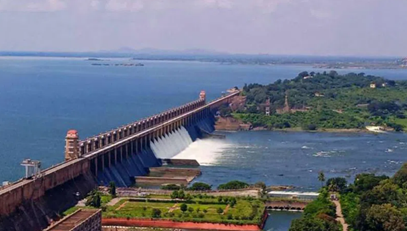
The Chief Ministers of Karnataka, Andhra Pradesh, and Telangana, along with the Union Jal Shakti Minister, jointly inaugurated 33 newly installed spillway gates of the Tungabhadra Dam on 25 June 2026, reaffirming their commitment to inter-State cooperation in water management.
About the Tungabhadra Dam
- Built across the Tungabhadra River, a major tributary of the Krishna River.
- Located in Koppal district, Karnataka.
- Serves Karnataka, Andhra Pradesh, and Telangana.
- Regulated by the Tungabhadra Board under an agreed water-sharing arrangement.
- Irrigates nearly 16.4 lakh acres:
- Karnataka – 9.26 lakh acres
- Andhra Pradesh – 6.25 lakh acres
- Telangana – 87,000 acres
- Supports agriculture, drinking water supply, and regional livelihoods.
Background
In August 2024, a crest gate of the Tungabhadra Dam was washed away during heavy inflows at full reservoir capacity (105 TMC), exposing concerns over ageing dam infrastructure and prompting the replacement of all 33 spillway gates with high-grade steel gates (₹51 crore; 60-year lifespan).
Constitutional & Institutional Perspective
A. Constitutional Provisions
1. Article 262 – Empowers Parliament to enact laws for the adjudication of inter-State river water disputes and exclude the jurisdiction of courts over such disputes.
2. Entry 17, State List (List II) – Places water, irrigation, canals, drainage, embankments and water storage primarily under the legislative domain of States, subject to Union provisions.
3. Entry 56, Union List (List I) – Authorises the Union Government to regulate and develop inter-State rivers and river valleys in the larger public interest.
B. Institutional Mechanisms
1. River Boards – Established under the River Boards Act, 1956, to promote coordinated development and management of inter-State river basins, though rarely operationalised.
2. Inter-State River Water Disputes Tribunals – Constituted under the Inter-State River Water Disputes Act, 1956, to adjudicate disputes over sharing of inter-State river waters.
3. Central Water Commission (CWC) – Provides technical expertise on water resources planning, river basin management, flood control, and dam safety.
4. National Dam Safety Authority (NDSA) – Established under the Dam Safety Act, 2021, to oversee dam safety standards, surveillance, inspection, and emergency preparedness across India.
5. Tungabhadra Board – Regulates reservoir operations and water releases to ensure equitable distribution among Karnataka, Andhra Pradesh, and Telangana in accordance with the agreed water-sharing arrangement.
Significance of the Recent Development
1. Strengthening Cooperative Federalism: The joint participation of the three riparian States reflects collaborative decision-making and reinforces trust-based inter-State cooperation in water resource management.
2. Efficient Inter-State Water Governance: A well-established water-sharing formula and the Tungabhadra Board’s regulatory framework have ensured equitable water distribution while minimising inter-State disputes.
3. Dam Safety and Modernisation: The replacement of ageing spillway gates enhances structural safety, improves operational efficiency, and strengthens resilience against extreme hydrological events.
4. Agricultural Security: Improved dam infrastructure ensures reliable irrigation for nearly 16.4 lakh acres, thereby supporting agricultural productivity and rural livelihoods across Karnataka, Andhra Pradesh, and Telangana.
Emerging Challenges associated with Water Governance
1. Inter-State Water Sharing Disputes: The Upper Bhadra Project has intensified concerns over equitable water distribution, with downstream States fearing reduced water availability due to upstream diversion.
2. Reservoir Siltation: Excessive silt accumulation has reduced the dam’s storage capacity from 133 TMC to nearly 106 TMC, affecting irrigation efficiency, water availability, and flood moderation.
3. Ageing Dam Infrastructure: The ageing structure and spillway systems necessitate continuous rehabilitation to ensure dam safety and prevent catastrophic failures.
4. Climate Change and Hydrological Extremes: Increasing incidents of extreme rainfall, floods, droughts, and erratic monsoons have made reservoir operations more complex and unpredictable.
5. Need for Scientific Reservoir Management: Limited adoption of real-time monitoring, desiltation, and modern reservoir operation techniques affects efficient water utilisation and disaster preparedness.
6. Institutional and Governance Challenges: Effective water governance requires stronger Centre-State coordination, timely implementation of rehabilitation projects, and basin-level planning to address emerging water security issues.
Best Practices & Expert Recommendations
1. Mihir Shah Committee (2016)
Recommended a paradigm shift in water governance by moving from an engineering- and construction-centric approach to Integrated Water Resources Management (IWRM), including the creation of a National Water Commission (NWC) to replace the Central Water Commission (CWC) and Central Ground Water Board (CGWB).
2. Murray–Darling Basin Authority (Australia)
A globally recognised model of Integrated River Basin Management (IRBM), where a single federal authority manages a river basin across five jurisdictions through a legally binding Basin Plan, ensuring equitable water allocation and ecological sustainability.
3. Mekong River Commission
Demonstrates successful transboundary water governance through collaborative data-sharing, joint flood forecasting, coordinated basin planning, and consensus-based decision-making among member countries.
Way Forward for Water Governance
1. Promote Cooperative Federalism – Strengthen institutional dialogue and consensus-based decision-making among riparian States to ensure equitable and sustainable sharing of water resources.
2. Adopt Integrated River Basin Management (IRBM) – Shift from State-centric approaches to basin-level planning by integrating surface water, groundwater, ecological conservation, and equitable allocation.
3. Scientific Reservoir Management – Leverage periodic desiltation, real-time hydrological monitoring, and technology-driven reservoir operations to optimise water storage and flood management.
4. Strengthen Dam Safety – Ensure regular structural audits, modernisation of ageing infrastructure, and timely implementation of Dam Rehabilitation and Improvement Projects (DRIP) to minimise disaster risks.
5. Enhance Centre–State Coordination – Strengthen cooperative governance through financial support, technical assistance, effective monitoring, and timely resolution of inter-State water issues.
6. Promote Climate-Resilient Water Governance – Develop adaptive water management strategies by improving flood forecasting, enhancing irrigation efficiency, promoting water conservation, and adopting climate-responsive reservoir operation protocols.
Conclusion
The focus of India’s water governance must shift from dispute resolution to dispute prevention by strengthening cooperative federalism, scientific management, and sustainable utilisation of shared water resources.