
Important for GS Prelims- International Relations/Economy
Introduction
India’s Free Trade Agreements (FTAs) are bilateral or multilateral trade agreements that reduce or eliminate tariffs and other trade barriers to boost exports, attract investment, integrate with global value chains, and secure market access while safeguarding sensitive domestic sectors.
India’s FTA Landscape
- India has signed 16 FTAs (including CEPAs and CECAs) historically.
- 9 FTAs are currently active, covering 38 countries.
- Negotiated primarily by the Ministry of Commerce & Industry.
Major Active FTAs
| Agreement | Key Highlights |
| India–EU FTA (2026) | Covers USD 24 trillion market; 99% of Indian exports enter duty-free; sensitive sectors like dairy and cereals protected. |
| India–UK CETA (2026) | Liberalizes 99% UK tariffs & 90% Indian tariffs; India’s first FTA with government procurement and financial services chapters. |
| India–UAE CEPA (2022) | Bilateral trade crossed USD 100 billion (FY25); India’s first FTA with digital trade, government procurement, and pharma annex. |
| India–EFTA TEPA (2025) | First Indian FTA with a binding investment commitment—USD 100 billion FDI and 1 million jobs over 15 years. |
| India–Australia ECTA (2022) | 100% duty-free access for Indian exports (from Jan 2026); Organic Products MRA signed (2025). |
| India–Mauritius CECPA (2021) | India’s first FTA with an African nation. |
| India–New Zealand FTA (2026) | Concluded in 9 months. |
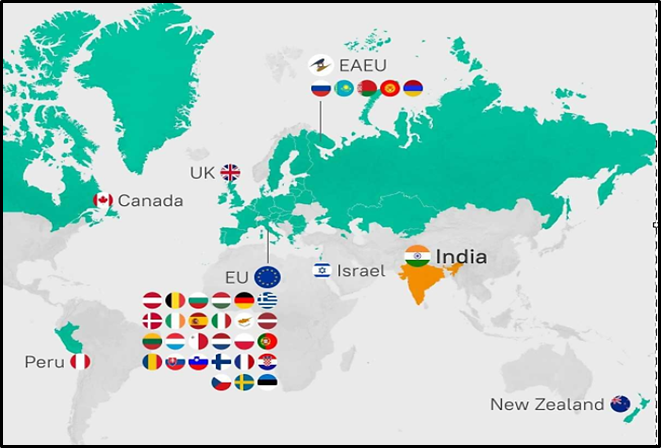
Active Negotiations (2026)
- India–GCC FTA
- India–Canada CEPA
- India–Australia CECA (upgrade)
- India–Peru FTA
- India–Israel FTA
- India–EAEU
- India–Chile CEPA
Conclusion
India’s FTA strategy has evolved from traditional tariff-reduction agreements to comprehensive, future-ready trade partnerships that combine market access with investment, digital trade, services, and strong domestic safeguards. Recent FTAs with the EU, UK, UAE, and EFTA, along with negotiations with GCC, Canada, and Israel, reflect India’s objective of becoming a major global trade and manufacturing hub.
| This concept has been elaborately discussed in the following article of DD News India, Israel Conclude Second Round of Free Trade Agreement Negotiations. |