
Context
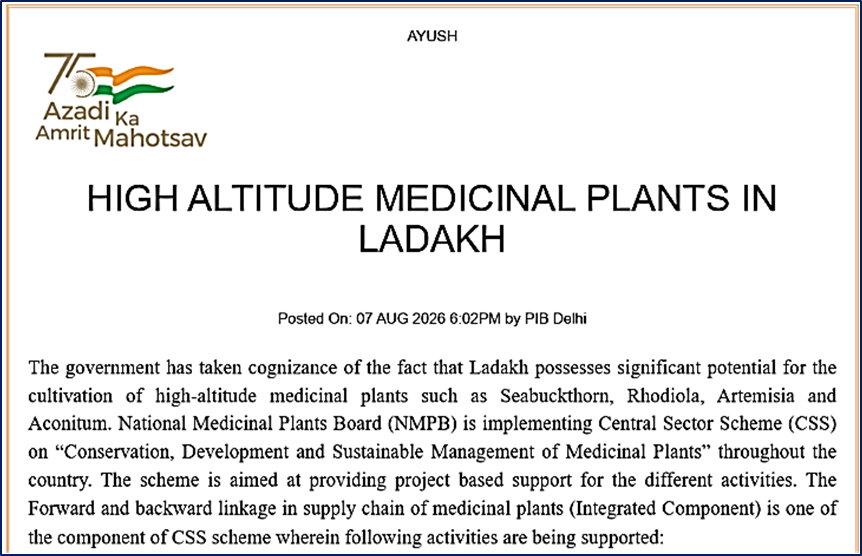
The government has highlighted the potential of Ladakh for cultivation of high-altitude medicinal plants such as Seabuckthorn, Rhodiola, Artemisia and Aconitum, owing to its unique agro-climatic conditions and rich biodiversity.
Key Medicinal Plants
- Seabuckthorn – Important high-altitude plant with applications in food, nutraceuticals and traditional medicine.
- Rhodiola – High-altitude medicinal herb.
- Artemisia – A diverse medicinal plant genus.
- Aconitum – Medicinal plant genus containing potent bioactive compounds; several species are toxic and require careful handling.
National Medicinal Plants Board (NMPB)
- NMPB is implementing the Central Sector Scheme for Conservation, Development and Sustainable Management of Medicinal Plants across India.
- It provides project-based support for conservation, cultivation, processing, research and marketing.
- Important components include:
- Quality planting material
- Training, workshops and IEC activities
- Post-harvest management and marketing
- Quality testing and certification
- Research & Development
- Promotion of medicinal plant trade
- Livelihood linkages with JFMCs, BMCs, SHGs and Panchayats
e-CHARAK
- It is an NMPB mobile application and web portal for promotion and marketing of medicinal plants.
Ladakh-Specific Institutions & Initiatives
State Medicinal Plant Board (SMPB), Ladakh
- Promotes scientific cultivation, conservation and sustainable utilisation.
- Organises training programmes, seminars, workshops and buyer-seller meets.
- Works with departments and research institutions for conservation and value addition.
National AYUSH Mission (NAM)
- A Centrally Sponsored Scheme implemented by the Ministry of Ayush through State/UT Governments.
- Covers Ladakh, including Leh and Kargil.
- Supports activities such as:
- Ayushman Arogya Mandir (Ayush)
- Co-location of Ayush facilities in PHCs, CHCs and District Hospitals
- Upgradation of Ayush hospitals and dispensaries
- Integrated Ayush Hospitals
- Supply of essential medicines
- Ayush public-health programmes
- Development of Ayush educational institutions
Conclusion
- Ladakh’s medicinal-plant sector can promote biodiversity conservation, sustainable livelihoods and AYUSH-based value addition, with government initiatives supporting cultivation, processing, research and market linkages.