
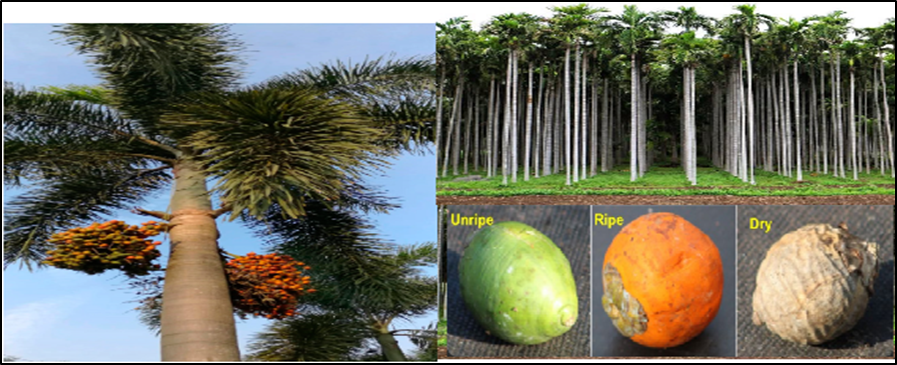
About Areca Nut
- Areca nut, commonly called betel nut or supari, is the seed of the areca palm (Areca catechu).
- Major uses: paan, betel quid, supari and mouth-freshening products, besides certain cultural and ceremonial practices.
- By-product use: husk and fibre are used for plates, packaging, biomass and compost.
Cultivation and Economic Importance
- Nature of crop: a tropical plantation crop requiring warm, humid conditions, good rainfall, fertile well-drained soil and partial shade in early growth.
- Major producing states: Karnataka, Kerala, Assam, Meghalaya, Mizoram, West Bengal, Tripura and Tamil Nadu.
- Leading producer: Karnataka accounts for the major share of India’s areca nut production.
- Intercropping: commonly grown with black pepper, cocoa, banana, pineapple and coffee under agroforestry systems.
- Livelihood base: supports farmers, plantation workers, processing units, traders and transporters.
Health Concerns
- Active alkaloid: arecoline, present in the nut, drives its harmful health effects.
- Associated conditions: oral submucous fibrosis, oral leukoplakia, gum disease, precancerous lesions, and oral and pharyngeal cancers.
- IARC classification: the International Agency for Research on Cancer classifies areca nut as a Group 1 carcinogen, carcinogenic to humans even without added tobacco.
- Regulatory distinction: areca nut, gutkha, pan masala and betel quid are not identical; gutkha contains areca nut with tobacco, while raw areca nut is not itself a tobacco product.
- FSSAI rule: prohibits use of tobacco and nicotine as ingredients in food products.
DRI Investigation: Illegal Imports and SAFTA Misuse
- Agency: Directorate of Revenue Intelligence (DRI), under the Ministry of Finance.
- Modus operandi: syndicates imported areca nuts from Indonesia, Thailand, Malaysia and other Southeast Asian countries but misdeclared Bangladesh as the country of origin.
- Objective of fraud: to wrongly claim preferential tariff treatment available under the South Asian Free Trade Area (SAFTA) to Bangladesh-origin goods.
- Issues raised: rules of origin, customs fraud, revenue leakage, trade misinvoicing, border management and misuse of preferential trade agreements.
Major Challenges
- Disease: fruit rot, yellow leaf disease and leaf spot reduce plantation productivity.
- Water dependence: irrigation is critical during dry periods.
- Climate change: erratic rainfall, floods, droughts, heat stress and strong winds affect production.
- Price volatility: prices depend on domestic demand, imports, production and trade policy.
- Illegal imports: misdeclaration of origin and smuggling affect government revenue and domestic farmers.
Conclusion
Areca nut is an important plantation crop but also a major public-health concern due to its carcinogenic nature.The DRI case highlights how illegal imports and misuse of trade agreements can cause revenue loss and affect domestic farmers.
It underscores the need for farmer protection, public-health awareness and stronger customs enforcement.
| This concept has been elaborately discussed in the following article – Areca Nut: Agriculture, Economy, Health and Illegal Imports |