
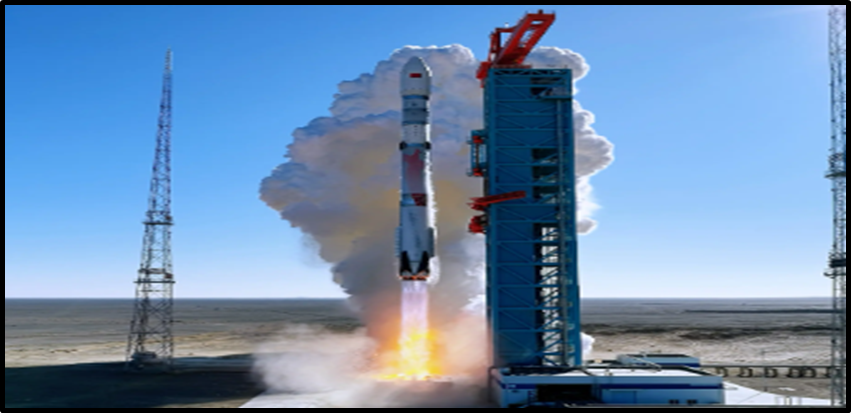
About Zhuque-3
Zhuque-3 is a two-stage, partially reusable rocket developed by China’s private space company LandSpace. It uses liquid oxygen and liquid methane as fuel.It is China’s first commercial rocket to reach orbit and recover its first stage on land using landing legs. Its main versions are ZQ-3 and the upgraded ZQ-3E.
Structure, Materials, and Manufacturing
- Airframe: Both stages are built primarily from ultra-high-strength SUS301 stainless steel instead of aluminium-lithium alloys, giving strength under both ambient and cryogenic conditions.
- Tank Fabrication: Dual cryogenic propellant tanks are made via a proprietary laser-welding process; longitudinal welds retain 95% or more, and circumferential welds 90% or more, of parent-material strength.
- Mass Balance: The liquid methane tank sits above the liquid oxygen tank to keep the centre of gravity optimally balanced through flight.
- Additive Manufacturing: Metal 3D printing accounts for an estimated 20% to 30% of the rocket’s total mass; roughly 70% of parts in the TQ-12B engine are 3D-printed, cutting engine lead times by up to 80%.
Propulsion System
- First-Stage Engines: Nine Tianque-12A (TQ-12A) engines (ZQ-3), an 80-tonne thrust-class engine throttleable from 40% to 110% of rated power; the uprated Tianque-12B (TQ-12B) powers ZQ-3E.
- Second-Stage Engine: The Tianque-15A (TQ-15A) vacuum engine supports up to three in-flight reignitions for precise orbital insertion and de-orbiting burns; the upgraded TQ-15B delivers higher thrust and specific impulse.
- Clean Combustion: Liquid methane burns without soot (‘coking’), reducing refurbishment time and inspection loops between flights.
- Future Engine: LandSpace is developing a 200-tonne class full-flow staged-combustion engine, the BF-20, targeted for maturity by 2028.
Reusability and Landing Mechanics
- Reuse Target: The first stage is designed for up to 20 reuses under a vertical takeoff, vertical landing (VTVL) profile.
- Descent Control: Four grid fins with a cold-gas reaction control system maintain stability during the supersonic glide phase.
- Landing Burn Sequence: A step-down ignition — five engines for initial deceleration, downselecting to three, then a single centre engine for touchdown.
- Landing Gear: Four deployable landing legs stabilise touchdown on land.
Commercial and Strategic Significance
- National Policy Alignment: Aligned with the CNSA’s ‘Action Plan for Promoting the High-Quality and Safe Development of Commercial Space (2025-27)’; LandSpace targets launch costs under 20,000 yuan per kilogram.
- Dual-Track National Milestone: China became the first nation to recover orbital-class boosters via two distinct pathways within weeks — the state-owned CASC’s Long March 10B via sea-platform net capture (10 July 2026), and LandSpace’s Zhuque-3 Y2 via land-based leg landing (19 August 2026).
- Future Missions: Slated to support China’s Guowang broadband megaconstellation and to launch the reusable Haolong cargo shuttle to resupply the Tiangong Space Station.
Conclusion
Zhuque-3 is LandSpace’s stainless-steel, methalox-fuelled orbital launch vehicle and China’s first commercially developed rocket to achieve orbital flight with first-stage recovery, having also become the first Chinese vehicle to land on legs on solid ground. Its maiden flight on 3 December 2025 reached orbit but failed booster recovery, while the second flight on 19 August 2026 achieved a full orbital launch and vertical landing 390 kilometres downrange in Gansu province.
The vehicle’s extensive use of laser-welded stainless steel and metal 3D-printed engine components, combined with its role in deploying the Guowang megaconstellation and supporting the Haolong cargo shuttle, positions it as a central platform in China’s commercial space strategy under the CNSA’s 2025-27 Action Plan.
| This concept has been elaborately discussed in the following article – ZHUQUE-3, China’s First Land-Based Rocket Recovery |