
What is FDI?
Foreign Direct Investment (FDI) is an investment by an individual or entity of one country in a business enterprise located in another country, involving significant ownership or managerial control. It may take the form of subsidiaries, joint ventures or new business establishments.
About FDI Routes in India
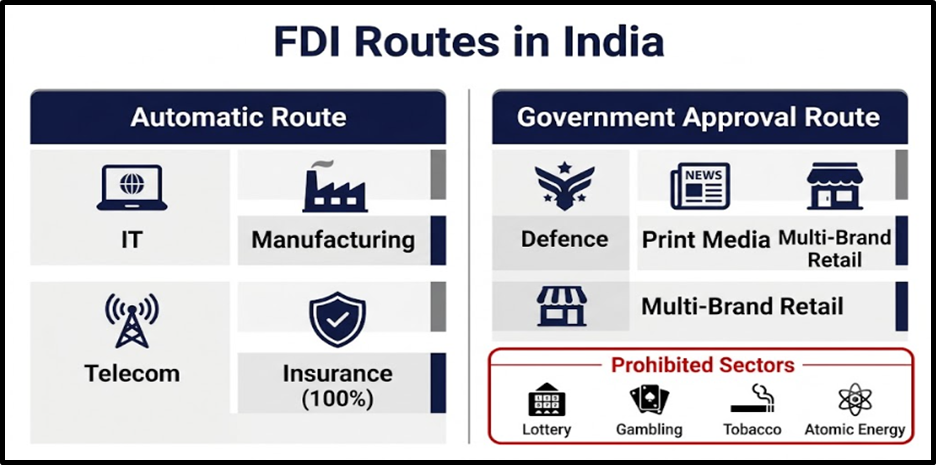
Foreign Direct Investment (FDI) into India is governed by a dual-pathway regulatory mechanism-the Automatic Route and the Government Approval Route-administered under India’s foreign exchange and industrial policy framework, with certain sectors placed under a complete prohibition. India allows FDI mainly through the Automatic Route (no prior approval) and the Government Route (prior approval required), depending on the sector and investment conditions.
The Automatic Route
- Feature: Investment without prior approval from the Government of India or the RBI; accounts for over 90% of total FDI inflows.
- 100% Sectors: IT, Manufacturing, Telecommunications, Greenfield Pharmaceuticals, Construction Development, and Food Processing.
- Compliance: Shares must be allotted within 60 days of fund receipt; Form FC-GPR must be filed on RBI’s FIRMS portal within 30 days of allotment.
- Recent Liberalisation: Insurance sector FDI limit raised from 74% to 100% under the *Foreign Exchange Management (Non-debt Instruments) (Second Amendment) Rules, 2026* (May 2026), subject to IRDAI verification (LIC excluded, capped at 20%); space component manufacturing 100% automatic under *Press Note 1 of 2024*, satellite manufacturing/operations up to 74%.
The Government Approval Route
- Application: Filed through the single-window Foreign Investment Facilitation Portal (FIFP), integrated with the National Single Window System (NSWS); DPIIT coordinates while the relevant Administrative Ministry conducts substantive review.
- High-Value Cases: Investments above ₹5,000 crore go to the Cabinet Committee on Economic Affairs (CCEA) for final approval.
- Timelines: Standard proposals take 8-10 weeks; sensitive/national-security cases needing Ministry of Home Affairs clearance can extend to 12-16 weeks or more.
- Split-Route Sectors: Defence manufacturing and brownfield pharmaceuticals-automatic up to 74%, approval required beyond; multi-brand retail trading capped at 51%; print media capped at 26%.
- Land-Border Countries Safeguard: Under Press Note 2 of 2026 (effective 1 May 2026), non-controlling land-border-country ownership up to 10% is now permitted via the automatic route.
Prohibited Sectors
- No FDI is permitted in: lottery business, gambling and betting (including casinos), chit funds and Nidhi companies, Transferable Development Rights (TDR) trading, real estate business/farmhouse construction (township development, commercial real estate and REITs excluded), tobacco manufacturing, and atomic energy and core railway operations.
- Foreign technology collaboration (franchise, trademark or management contracts) is also barred for lottery and gambling/betting sectors.
Conclusion
- India’s FDI policy mainly follows the Automatic Route, while sensitive investments require Government approval. Recent reforms have liberalised FDI, including 100% automatic FDI in insurance, while sectors like gambling, lottery, tobacco and atomic energy remain restricted.
Difference between FDI & FPI
| FDI | FPI |
| Foreign investment in a company/business with a long-term interest. | Foreign investment mainly in shares, bonds and other financial assets. |
| Investor generally seeks significant influence or control over the business. | Investor usually does not seek management control. |
| Long-term and relatively stable investment. | Generally more short-term and volatile; money can enter or leave quickly. |
| Example: A foreign company setting up or acquiring a stake in an Indian manufacturing company. | Example: A foreign investor buying shares of an Indian company through the stock market. |
| This concept has been elaborately discussed in the following article – Easing FDI Norms for Land-Border Country Investment |