
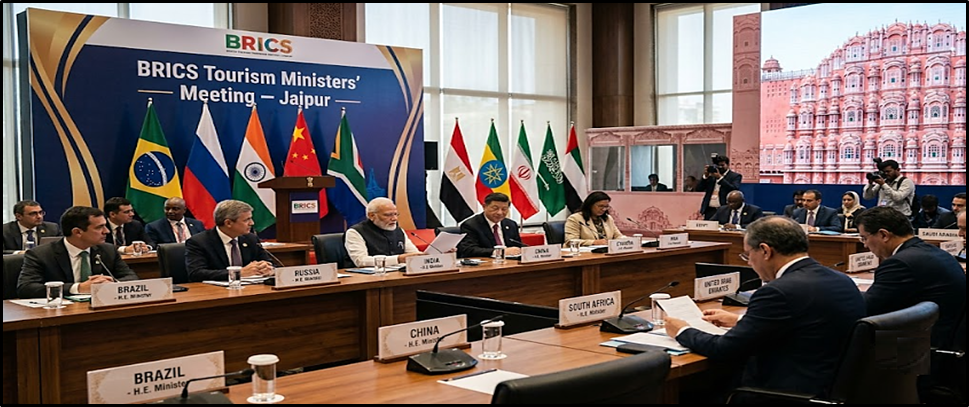
About the Jaipur Declaration(s)
“Jaipur Declaration” refers to several distinct outcome documents adopted at different multilateral meetings held in Jaipur, Rajasthan, spanning tourism, women’s parliamentary cooperation, science and technology, and circular economy under the BRICS grouping and other forums.
Institutional Origins of Each Declaration
- BRICS Tourism Ministers’ Jaipur Declaration (2026): Adopted on 21 August 2026 at the BRICS Tourism Ministers’ Meeting under India’s Chairship, chaired by Union Minister Gajendra Singh Shekhawat, themed “Building for Resilience, Innovation, Cooperation and Sustainability.”
- BRICS Women Parliamentarians’ Jaipur Declaration (2016): Adopted on 21 August 2016 by women legislators of Brazil, Russia, India, China and South Africa, themed “Women Parliamentarians: Enablers for Achieving SDGs.”
- BRICS STI Ministerial Jaipur Declaration (2016): Adopted at the 4th BRICS Science, Technology and Innovation Ministerial Meeting, noting intent to form the BRICS Working Group on Joint Ocean and Polar Research.
- Jaipur 3R and Circular Economy Declaration (2025): Adopted at the 12th Regional 3R and Circular Economy Forum in Asia and the Pacific — not a BRICS instrument.
Key Contents — 2026 Tourism Declaration
- Coverage: Nine BRICS member states, including newer entrants Iran, South Africa and the UAE.
- Four Pillars: Artificial Intelligence in tourism; sustainability and responsible tourism (aligned with SDG 8, 12, 13); tourism skilling; and seamless travel facilitation.
Conclusion
The Jaipur Declaration refers to important international agreements or statements adopted at Jaipur on different occasions, covering areas such as tourism, science, women’s empowerment and sustainable development. The latest 2026 BRICS Tourism Communiqué focuses on technology-driven and sustainable tourism.
| This concept has been elaborately discussed in the following article – BRICS Tourism Ministers Adopt the Jaipur Declaration |