
About Indian Classical Music
Indian classical music is one of India’s oldest cultural traditions, deeply connected with spirituality and philosophy, with roots in the Samaveda. Over time, it developed into two major traditions—Hindustani music in North India and Carnatic music in South India.
The Three Structural Pillars
- Swara: The seven basic notes — Sa, Re, Ga, Ma, Pa, Dha, Ni (the Saptak/Sargam); distinct from Shruti (22 microtones), of which 12 audible notes (7 Suddha + 5 Vikrita Swaras) form the standard system.
- Raga: A melodic framework with defined ascending (Aaroha) and descending (Avaroha) movement, classified by note-count as Audav (5), Shadava (6) or Sampurna (7); each raga has a Vaadi (king note), Samvaadi (queen note), Anuvaadi (auxiliary) and Vivadi (forbidden) notes, and is bound to specific times/seasons evoking the nine rasas.
- Tala: Cyclical rhythmic groupings maintained at vilambit (slow), madhya (medium) or drut (fast) tempo (laya); Hindustani music uses talas like Teental (16 beats), while Carnatic music’s rigid system of laghu, dhrutam and anudhrutam yields 35 basic talas, extendable to 108 or 175.
Hindustani Tradition — Genres and Gharanas
- Dhrupad: The oldest, most austere vocal form, adapted for court use by Raja Man Singh Tomar of Gwalior and reaching its zenith under Akbar with Mian Tansen; structured into four Vanis — Dagar, Gauhar, Khandaar and Nauhar.
- Khayal: The dominant modern style, using melodic ornamentations (tans); comprises a slow Bada Khayal and fast Chhota Khayal.
- Tarana and semi-classical forms — Thumri, Tappa, Kajri.
- Major Gharanas: Gwalior (oldest, founded by Nathan Pir Baksh), Kirana (Abdul Karim Khan), Agra, Patiala (Bade Ghulam Ali Khan), Jaipur-Atrauli (Alladiya Khan), and Bhendibazaar.
Carnatic Tradition — Structure and Composers
- Kriti Structure: Three parts — Pallavi, Anupallavi, Charanam.
- Purandara Dasa (1484-1564): Revered as the Pitamaha of Carnatic music; systematized pedagogy via sarali swaras and introduced Raga Mayamalavagowla for beginners.
- The Carnatic Trinity (born in Thiruvarur, Tamil Nadu): Tyagaraja (1767-1847) — introduced Sangati; Muthuswami Dikshitar (1775-1835) — composed across all 72 melakarta ragas; Syama Sastri (1762-1827) — master of intricate laya.
Instruments and the Digital Era
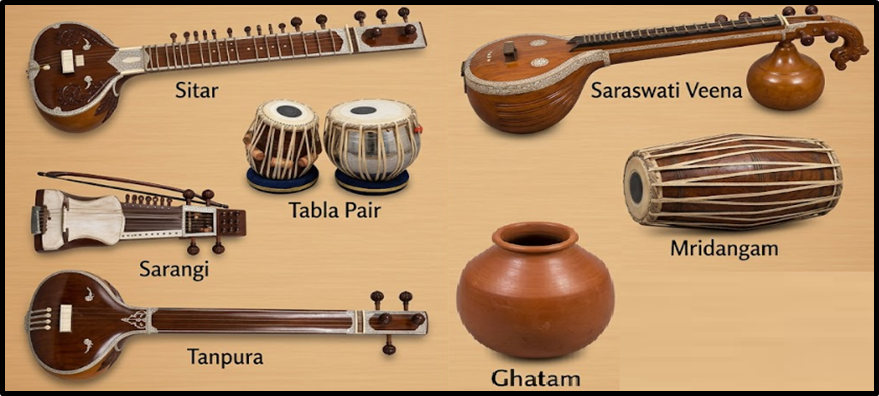
- Hindustani instruments: Sitar, Sarod, Sarangi, Bansuri, Santoor, Shehnai (melodic); Tabla, Pakhawaj (percussion); Tanpura (drone).
- Carnatic instruments: Saraswati Veena, Violin, Venu flute (melodic); Mridangam, Ghatam, Kanjira (percussion); Tanpura, Sruti Box (drone).
- Technology’s Role: Democratizes access via online learning and digital tools (electronic tanpuras, rhythm apps); institutions such as the ITC Sangeet Research Academy digitally archive historic recordings, though ethnomusicologists warn of dilution of the guru-shishya parampara and over-dependence on automated tools.
Conclusion
Indian classical music rests on the pillars of Swara, Raga and Tala, expressed through the improvisation-centric Hindustani and composition-centric Carnatic traditions that diverged around the 13th-14th centuries.
Its transmission, historically through the Gharana-based guru-shishya system, is now being reshaped by digital platforms, which expand access while posing risks to traditional pedagogy.
| This concept has been elaborately discussed in the following article – Vice President Inaugurates ‘MALHAR’: Celebrating India’s Classical Music Heritage |