
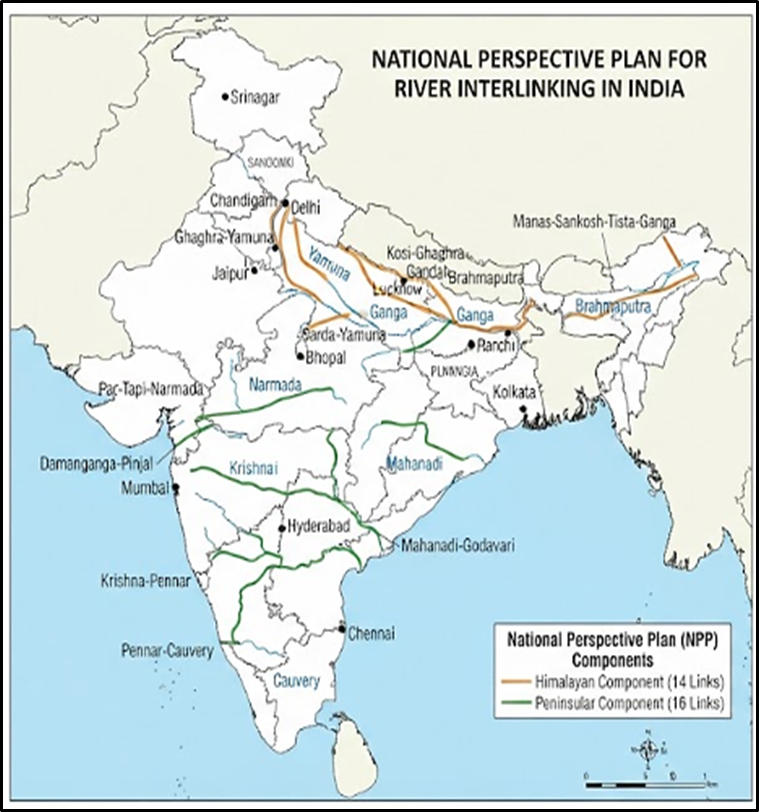
About the National Perspective Plan
The National Perspective Plan (NPP) aims to transfer water from surplus regions to water-scarce regions, helping reduce both floods and droughts.
The National Water Development Agency (NWDA) is responsible for studying and planning these river-linking projects.
Core Components
- Himalayan Rivers Development Component (14 links): Storage reservoirs on tributaries of the Ganga and Brahmaputra in India, Nepal and Bhutan; transfers surplus eastern Ganga flows westward and links Brahmaputra-Ganga and Ganga-Mahanadi, aiding flood control and irrigation in Rajasthan, Haryana and Gujarat.
- Peninsular Rivers Development Component (16 links): Covers the Mahanadi-Godavari-Krishna-Pennar-Cauvery link, west-flowing river links for Mumbai and coastal Maharashtra, the Ken-Chambal grid, and diversion of west-flowing Western Ghat rivers eastward.
Implementation Mechanism
- Special Committee on Interlinking of Rivers (SCILR): Constituted in September 2014 to build inter-state consensus on water sharing.
- Task Force (TFILR): A dedicated task force set up in April 2015 holding regular consultations with states.
- Ken-Betwa Link Project (KBLP): The first and only NPP project to enter implementation, approved by the Union Cabinet in December 2021, with the Daudhan Dam targeted for completion by March 2030.
Conclusion
The NPP, formulated in 1980, remains India’s overarching blueprint for river interlinking, structured into 14 Himalayan and 16 Peninsular links studied by the NWDA.
Despite four decades of planning, the Ken-Betwa Link Project is the only link to have reached implementation, reflecting the persistent federal, financial and environmental hurdles to executing the wider grid.
| This concept has been elaborately discussed in the following article – Ken-Betwa Link Project: India’s First River-Interlinking Project |