
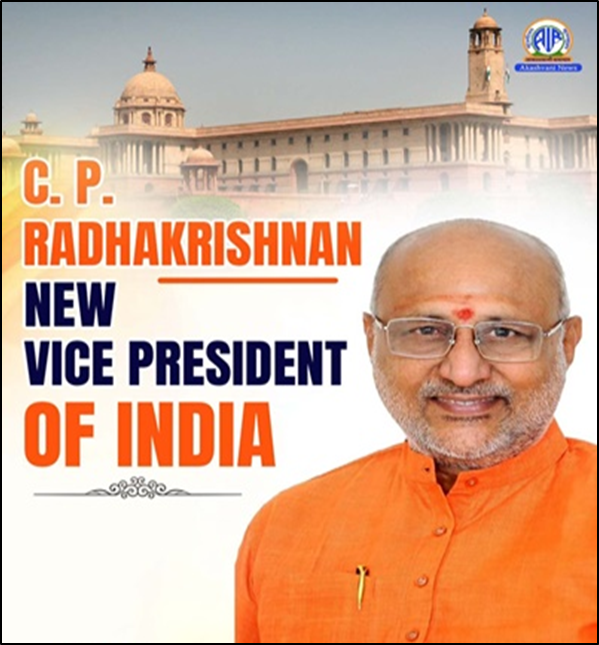
About Vice-President of India
- The Vice-President of India is the second-highest constitutional office in the country after the President.
- The office is provided under Article 63 of the Constitution and is also the ex-officio Chairman of the Rajya Sabha.
Constitutional Provisions
| Article | Provision |
| Article 63 | There shall be a Vice-President of India |
| Article 64 | Vice-President is ex-officio Chairman of the Rajya Sabha |
| Article 65 | Vice-President to act as President or discharge his functions during specified vacancies/absence |
| Article 66 | Election of Vice-President |
| Article 67 | Term of office : 5 years |
| Article 68 | Provisions relating to vacancy |
| Article 69 | Oath or affirmation |
| Article 70 | Discharge of President’s functions in other contingencies |
| Article 71 | Matters and disputes relating to election of President and Vice-President |
Election of the Vice-President
The Vice-President is elected indirectly by an electoral college consisting of the members of both Houses of Parliament.
The election is conducted through:
- Proportional representation
- Single Transferable Vote (STV)
- Secret ballot
Election of Vice-President vs President
The electoral college for the Vice-President differs from that of the President:
| Vice-President | President |
| Includes elected and nominated MPs | Only elected MPs participate |
| No State Legislative Assembly members | Elected MLAs of States and eligible UTs participate |
| Members of both Houses of Parliament | Elected MPs of both Houses + elected MLAs |
Note: Nominated members of Parliament can vote in the election of the Vice-President, but not in the election of the President.
Who Decides Election Disputes?
- Under Article 71, all doubts and disputes relating to the election of the President or Vice-President are inquired into and decided by the Supreme Court, whose decision is final.
Qualifications
A candidate for Vice-President must:
- Be a citizen of India.
- Have completed 35 years of age.
- Be qualified for election as a member of the Rajya Sabha.
- Not hold any office of profit under the Union Government, State Government, local authority or other public authority.
Term, Resignation and Re-election
The Vice-President holds office for five years from the date of entering office.
- Can resign at any time by addressing the resignation to the President.
- Can continue in office beyond five years until his successor assumes charge.
- Is eligible for re-election.
- The Constitution does not prescribe a limit on the number of terms.
Oath or Affirmation
Before entering office, the Vice-President takes an oath or affirmation to:
- Bear true faith and allegiance to the Constitution of India, and
- Faithfully discharge the duties of his office.
The oath is administered by the President or a person appointed by him.
Conditions of Office
The Vice-President:
- Cannot be a member of either House of Parliament or a State Legislature.
- If a sitting member is elected Vice-President, the seat is deemed vacated on the date he enters upon office.
- Cannot hold any other office of profit.
Role as Chairman of Rajya Sabha
Under Article 64, the Vice-President serves as the ex-officio Chairman of the Council of States (Rajya Sabha).
As Chairman, the Vice-President:
- Presides over the sittings of the Rajya Sabha.
- Maintains order and decorum.
- Decides points of order.
- Exercises the powers assigned to the Chairman under the Rules of Procedure.
Removal of the Vice-President
- The Vice-President can be removed by a resolution of the Rajya Sabha, passed by a majority of all the then members of the Rajya Sabha, and agreed to by the Lok Sabha.
- The Constitution does not specify any grounds for removal.
When does the Vice-President Act as President?
Under Article 65, the Vice-President acts as President when a vacancy occurs in the office of President due to:
- Death
- Resignation
- Removal
- Otherwise
The Vice-President also discharges the functions of the President when the President is unable to perform them due to absence, illness or other circumstances.
- When acting as President or discharging the President’s functions, the Vice-President does not perform the duties of Chairman of the Rajya Sabha. These functions are performed by the Deputy Chairman of the Rajya Sabha.
Vacancy in the Office of Vice-President
A vacancy may arise due to:
- Expiry of tenure
- Resignation
- Removal
- Death
- Other causes, such as the election being declared void
If a vacancy occurs by resignation, removal, death or otherwise, the Constitution provides for an election to fill the vacancy as soon as possible.
Unlike the office of President, the Constitution does not prescribe a six-month limit for filling a casual vacancy in the office of Vice-President.
Conclusion
The Vice-President occupies a unique constitutional position by combining the role of constitutional successor to the President with that of ex-officio Chairman of the Rajya Sabha.
| This concept has been mentioned in the following article: Indigenous Popcorn Maize Hybrid: A Step Towards Agricultural Self-Reliance |