
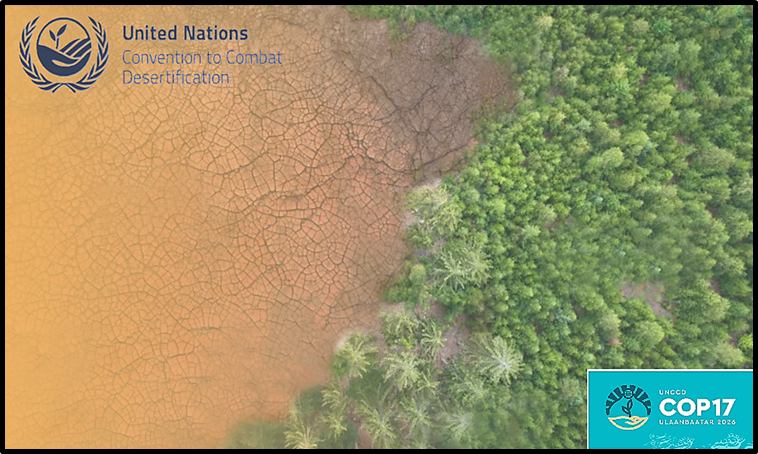
About the United Nations Convention to Combat Desertification (UNCCD)
The UNCCD is the only legally binding global agreement focused on desertification, land degradation and sustainable land management; it was adopted in Paris in 1994 and came into force in 1996.
It is one of the three Rio Conventions, along with UN Framework Convention on Climate Change (UNFCCC) and Convention on Biological Diversity (CBD), and has 197 Parties.
It mainly focuses on drylands and follows a bottom-up approach, involving local communities, farmers, pastoralists and indigenous people.
| Parameter | Detail |
| Adopted | Paris, June 17, 1994 |
| Entered into Force | December 1996 |
| Nature | Sole legally binding convention on land/desertification |
| Category | One of three Rio Conventions (with UNFCCC and UNCBD) |
| Membership | 197 Parties (196 countries + EU) |
| Core Goal | Land Degradation Neutrality (LDN) by 2030 (SDG 15.3) |
| Governing Body | Conference of the Parties (COP) |
| Financial Mechanism | Global Environment Facility (GEF), designated 2010 |
| Operational Arm | Global Mechanism (GM), est. 1994 under Article 21 |
2018–2030 Strategic Framework of UNCCD
Objective – organizes global action around five Strategic Objectives (SOs):
Strategic Objective 1: Improve affected ecosystems and combat desertification/land degradation, contributing to LDN.
Strategic Objective 2: Improve living conditions of affected populations.
Strategic Objective 3: Mitigate, adapt to, and manage drought effects to build resilience.
Strategic Objective 4: Generate global environmental benefits through effective implementation.
Strategic Objective 5: Mobilize financial and non-financial resources for implementation.
Institutional & Financial Mechanisms
- Global Mechanism (GM): Established 1994 under Article 21; operational arm advising developing nations on climate/land finance, LDN targets, and drought plans.
- Global Environment Facility (GEF): Designated the UNCCD’s financial mechanism in 2010; co-finances sustainable land management via its Land Degradation Focal Area.
- LDN Fund: Launched in 2015 under GM support; a private sector-led investment vehicle for sustainable agriculture, agroforestry, and forestry projects.
- Conference of the Parties (COP): The supreme governing body of the Convention.
Key COP Milestones
- COP 14 (Greater Noida, India, 2019): Theme “Restore Land, Sustain Future”; India’s first UNCCD COP, adopted the Delhi Declaration and launched initiatives like the Drought Toolbox, Peace Forest Initiative, 3S Initiative and International Coalition on Sand and Dust Storms.
- COP 16 (Riyadh, Saudi Arabia, 2024): First UNCCD COP in the MENA region; launched the $12.15 billion Riyadh Global Drought Resilience Partnership, VACS, Sacred Lands Declaration and World Drought Atlas.
- COP 17 (Ulaanbaatar, Mongolia, 2026): Theme “Restoring Land, Restoring Hope”; focused on turning land-restoration pledges into concrete finance and action.
India’s Efforts under the UNCCD
- Nodal Ministry: The Ministry of Environment, Forest and Climate Change (MoEFCC).
- Restoration Pledge: At COP 14, India raised its Bonn Challenge target to 26 million hectares by 2030 (from 21 million hectares).
- ISRO’s Desertification Atlas (2016): Showed 29% of India’s land undergoing degradation.
- Aravalli Green Wall Project (AGWP): Showcased at COP 16; a 1,400 km green belt across Haryana, Rajasthan, Gujarat, and Delhi targeting restoration of 1.15 million hectares by 2027, halting the eastward spread of the Thar Desert.
- Convergence Schemes: The Integrated Watershed Management Programme (IWMP) and Mahatma Gandhi National Rural Employment Guarantee Scheme (MGNREGS) support soil and water conservation infrastructure.
Conclusion
Its key goal is Land Degradation Neutrality (LDN) by 2030, aligned with SDG 15.3. The UNCCD drives global action through finance and restoration mechanisms, while India advances LDN through initiatives like the Bonn Challenge, Aravalli Green Wall, and MGNREGS convergence.
| This concept has been elaborately discussed in the following article – India Showcases Green Finance Architecture and 21.76 Million Hectares Restored at UNCCD CoP17 |